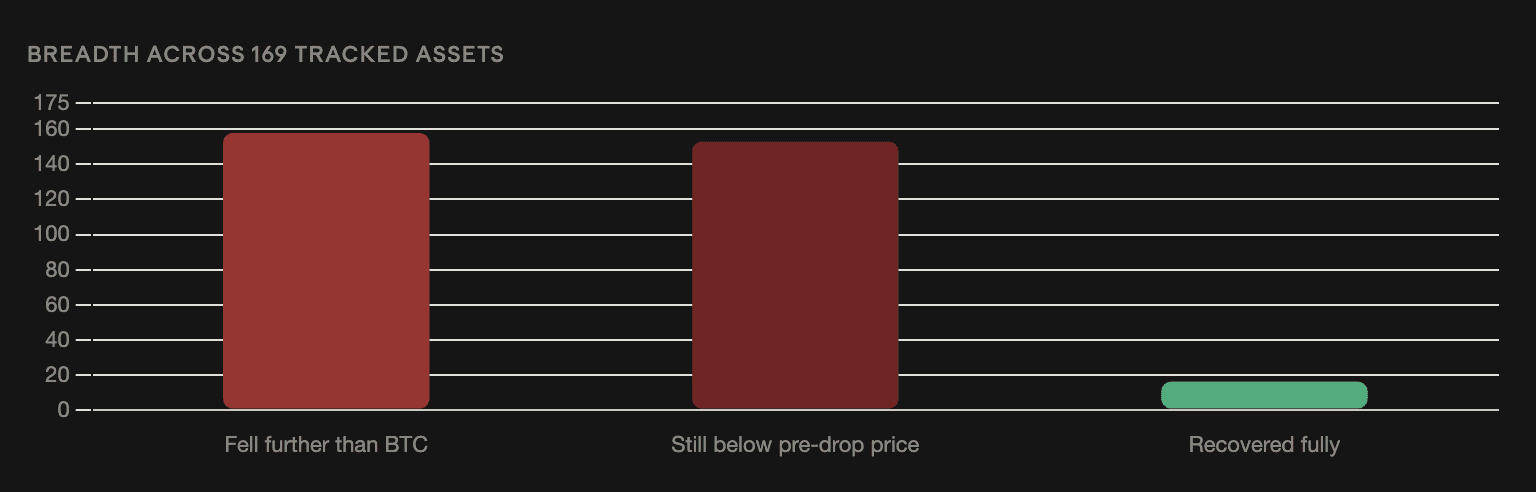
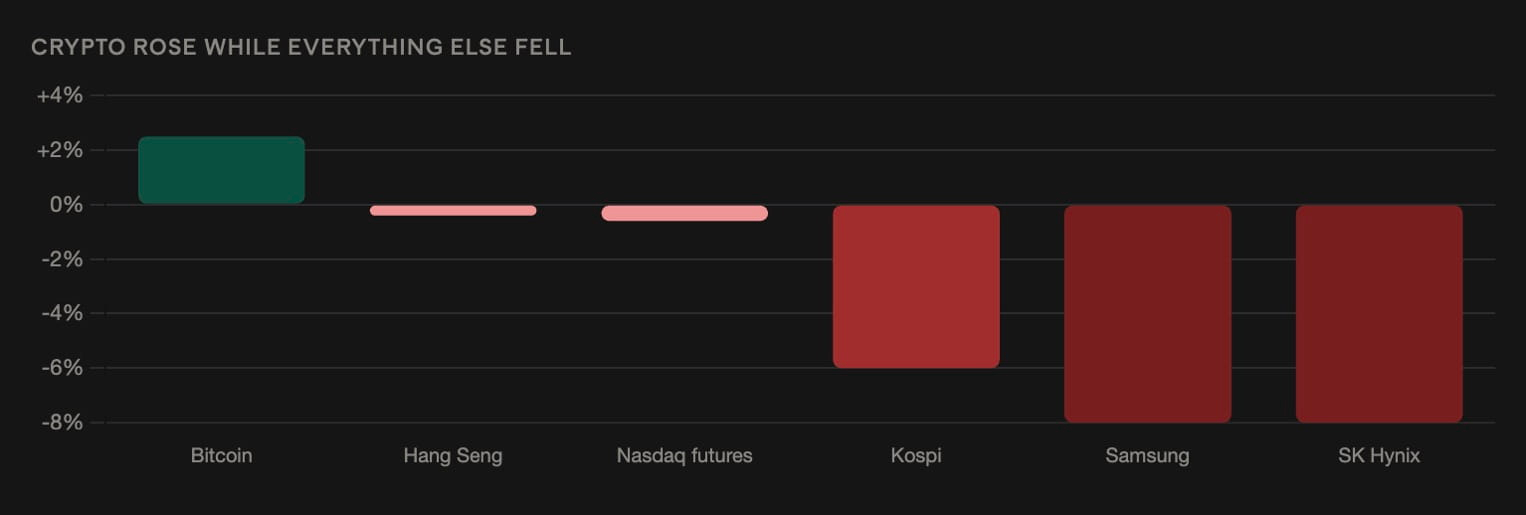
Bitcoin bounced from $81,000 to above $83,000 Tuesday while South Korea’s KOSPI plunged 6% below 6,000 and Nasdaq futures fell 0.6% — the clearest decoupling from AI chip stocks since the rally began. 90% of altcoins failed to recover their overnight drop while Bitcoin clawed back the full decline; BTC dominance rebounded to 60.28%. Long-term holders sit 72% above their $48,600 average cost basis with Bitcoin needing to fall 42% before that cohort faces average losses. Tesla’s 8,430 BTC has been untouched since 2022. Wednesday’s CPI (consensus: headline +0.5% MoM, 3.6% YoY; core +0.2% MoM, 2.4% YoY) is the immediate test — hot headline driven by energy, potentially soft core, a split that has defined every inflation read since summer.
Bitcoin Reclaims $83,000 as Kospi Crashes 6% and Chip Stocks Fall 8%
Bitcoin fell below $81,000 at 00:50 UTC Tuesday before recovering above $83,000, decoupling from Samsung and SK Hynix each falling ~8% (extending a five-session losing streak), KOSPI below 6,000 for the first time since late July, and Nasdaq futures down 0.6%. Investors cited AI valuation concerns and Chinese memory competition — a valuation concern compresses when multiples adjust; a competition concern requires defending market share. Alibaba unveiled China’s “most powerful AI chip” September 22; Micron’s Q1 guidance of $60-63B was delivered October 1 and the stock has fallen through it for two weeks. Bitcoin’s recovery against that backdrop is the second decoupling in two weeks: it gained 1% while semiconductors fell 5.9% on October 6, and now recovers $2,000+ while KOSPI loses 6%. Oil held gains: WTI near $92.67, Brent near $106, the $13+ spread between them far above the normal $2-4 range — consistent with a seaborne export constraint. DXY at 102.50, an 18-month high. CPI Thursday (Wednesday UTC) is the next test.
US Inflation Report Arrives Wednesday. Here Is What Economists Expect
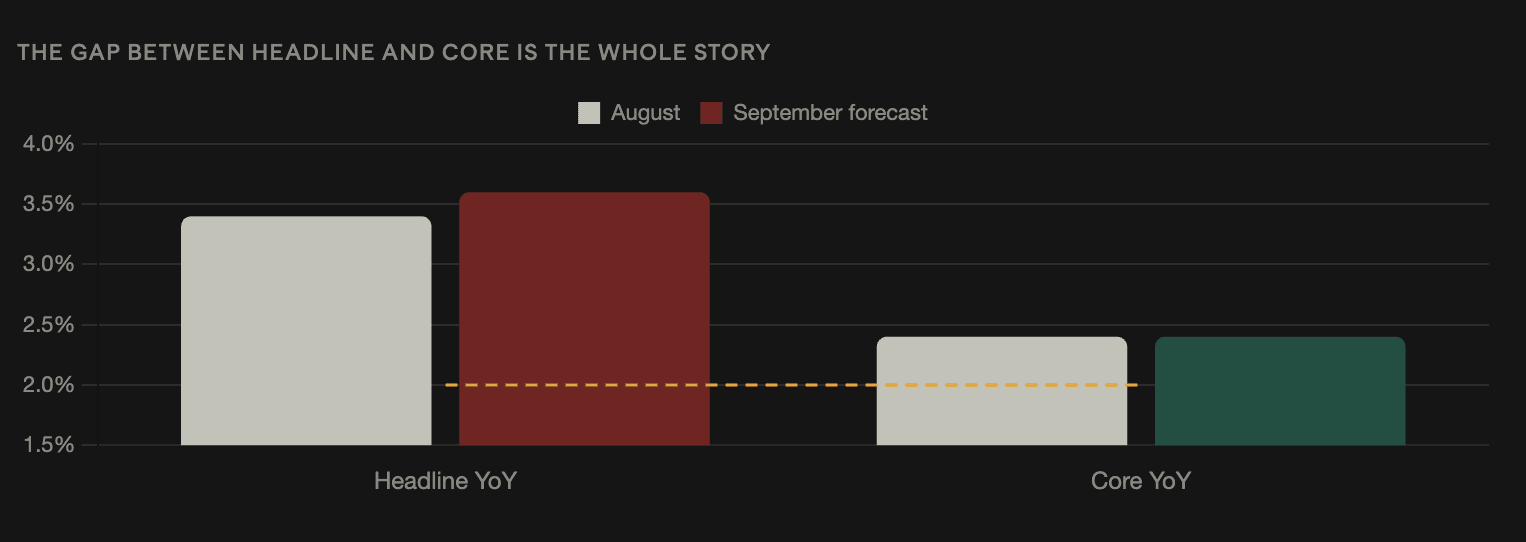
September CPI publishes Wednesday October 14 at 8:30am EDT. Consensus: headline +0.5% MoM (vs +0.4% August) and 3.6% YoY (vs 3.4%); core +0.2% MoM (vs +0.3% August) and 2.4% YoY (unchanged). The two numbers are moving in opposite directions: energy (Brent ~$106, Saudi East-West pipeline still shut, Hormuz constrained) drives headline higher while underlying price pressure cools. The 1.2 percentage point expected gap between them is entirely energy. The important context: CPI is not the Fed’s preferred measure. Warsh built his Jackson Hole case on PCE — August core PCE came in at 3% against 3.3% expected. Core CPI at 2.4% sitting below core PCE at 3% would invert their usual relationship (CPI normally runs above PCE on housing weights) — either the forecast is off or the two indices have genuinely diverged. The Fed-market split remains wide: 16 of 18 officials projected at least one more 2026 hike; markets price October at 19%. A core read at or below 2.4% widens that gap; a surprise above it narrows it. Wincent’s Paul Howard expects institutional investors to hedge with derivatives rather than reduce exposure into the print.
Tesla Still Holds 8,430 Bitcoin and Has Not Sold Since 2022
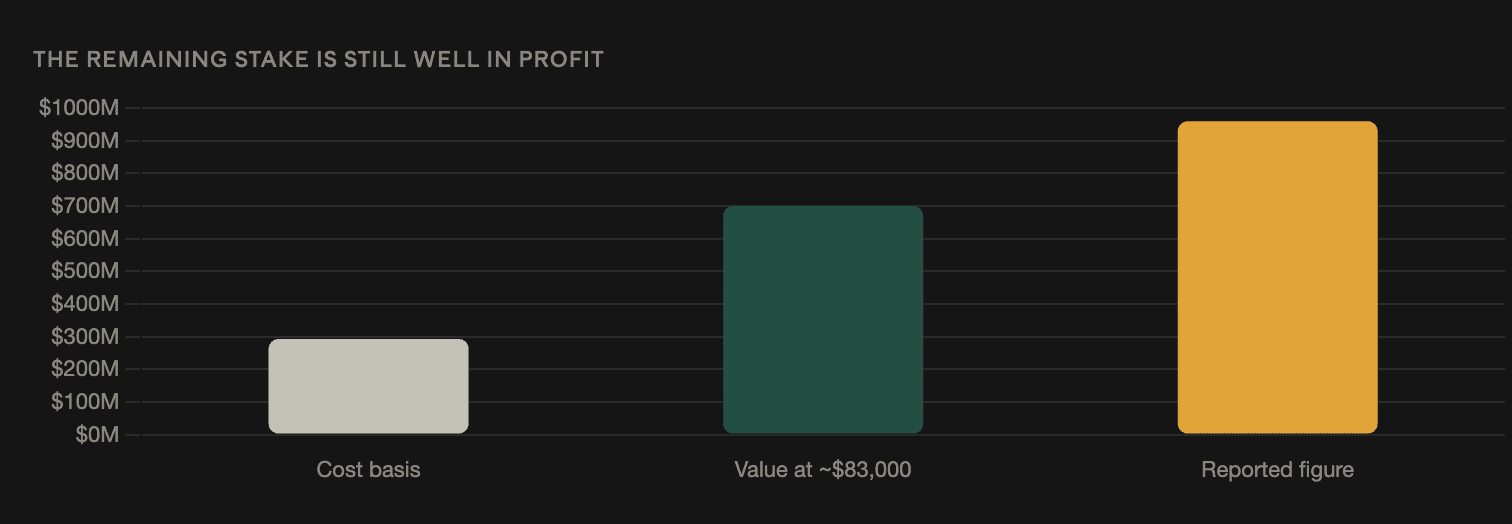
Tesla’s 8,430 BTC position — worth ~$700M at current prices — has been unchanged for more than four years. The company bought $1.5B in February 2021 (~43,200 BTC at ~$34,700 average), sold roughly three-quarters across two reductions in 2021-2022, and has been inactive since. A circulating $960M valuation implies ~$113,900/BTC — a stale figure from when Bitcoin was near its $126,080 record; the actual current value is ~$700M. Tesla’s remaining position is up ~139% from its cost basis of ~$293M. Critically, Tesla held through the FTX collapse — one of the worst liquidity events in crypto history — without reducing. That makes it a different kind of corporate holder from Strategy (845,050 BTC with a capital structure built around accumulation) or Bitmine (5.93M ETH representing ~4.9% of supply). Tesla bought once, trimmed in the first 15 months, and has sat still — placing it squarely in the long-term holder cohort that now controls 80% of supply.
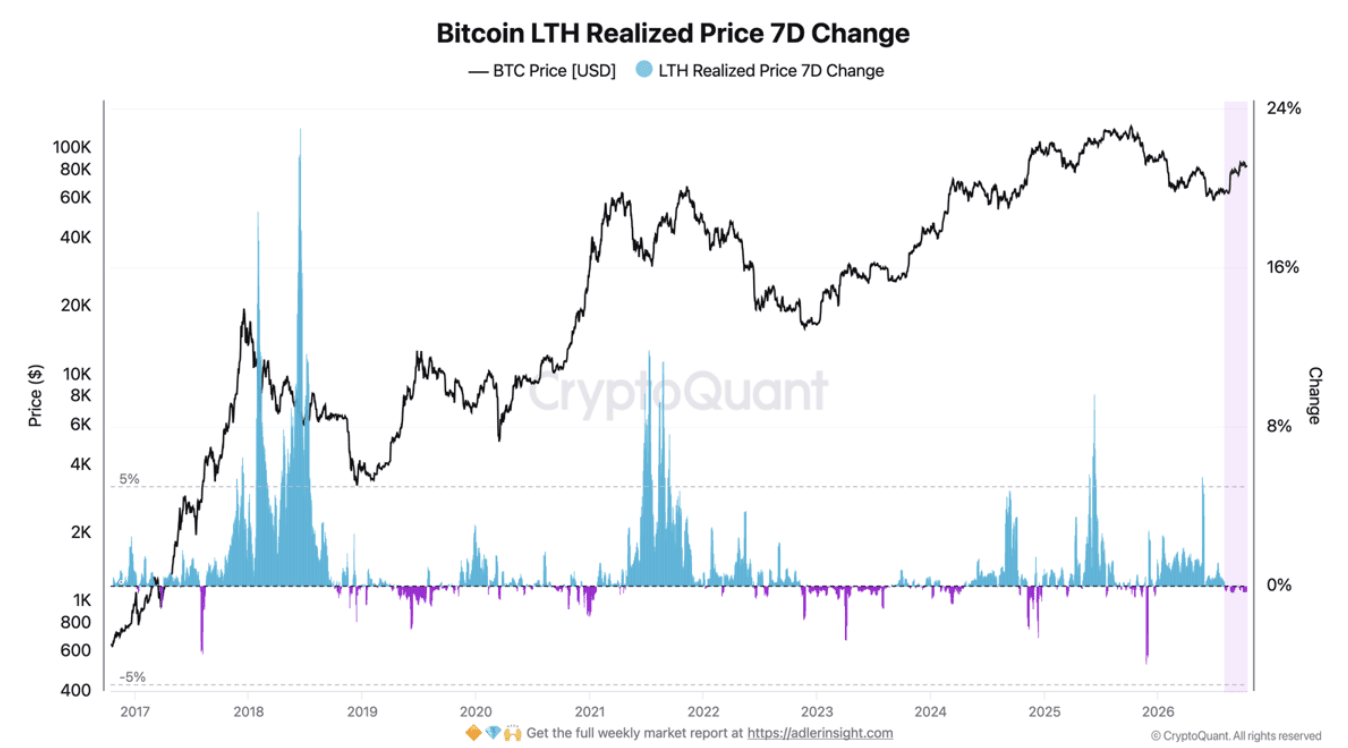
Bitcoin Long-Term Holders Hold a 72% Cushion Above $48,600
LTH average cost basis: $48,600 vs Bitcoin’s $83,600 — a 72% cushion, down from 76% a week ago as Bitcoin fell from $85,800 while holders held still. Bitcoin would need to fall 42% from current levels before the average LTH moves into loss territory. The cost basis has been declining since August 1 (negative 60 of 74 days, ~81% of the period) despite the long-term holder cohort growing to an all-time 80% of supply — the two readings fit together: old cheap coins stay put while newer expensive ones are distributed, expanding the cohort in size while pulling its average cost lower. Last week’s selling (47,800 BTC, most at a loss per LTH SOPR) is gradual distribution rather than a rush for the exit — the largest weekly cost basis decline was 0.34% on August 25; current reading is -0.06%, near flat. More negative readings signal acceleration; a return above zero signals accumulation resuming.
BTC Dominance Back at 60% as 90% of Altcoins Fail to Recover
Bitcoin dominance rebounded to 60.28% — above the 59.2% it started September’s altcoin rotation at and well above the ~57% it reached on September 22 when the altcoin season index held above 60 for five consecutive days. During Tuesday’s overnight drop and recovery: Bitcoin fell 2.71% then rebounded 2.84% (recovering the full decline); the median altcoin recovered only 54% of its drop; 153 of 169 tracked assets (90.5%) remained below pre-drop prices after Bitcoin’s bounce. The math: a 2.84% rebound from a lower base returns Bitcoin to its starting point — altcoins recovering 54% of a steeper decline remain considerably further behind than the number suggests. Dominance shifts because capital rotates or because assets move at different speeds — Tuesday was the second kind. Altcoins carrying higher downside beta (falling further, recovering less) is characteristic of both the later speculative phase of a rotation and any risk-off session — one session doesn’t distinguish between them. The relevant test is cumulative altcoin performance since August’s rotation started versus the last two weeks’ momentum.