


Bitcoin climbed back above $83,000 on Tuesday after falling to just under $81,000 at 00:50 UTC, shaking off a selloff in Asian chip stocks and US tech futures.
Ether bounced from five-day lows and XRP turned higher after touching three-week lows. Zcash, Solana and several other major tokens followed the same pattern.
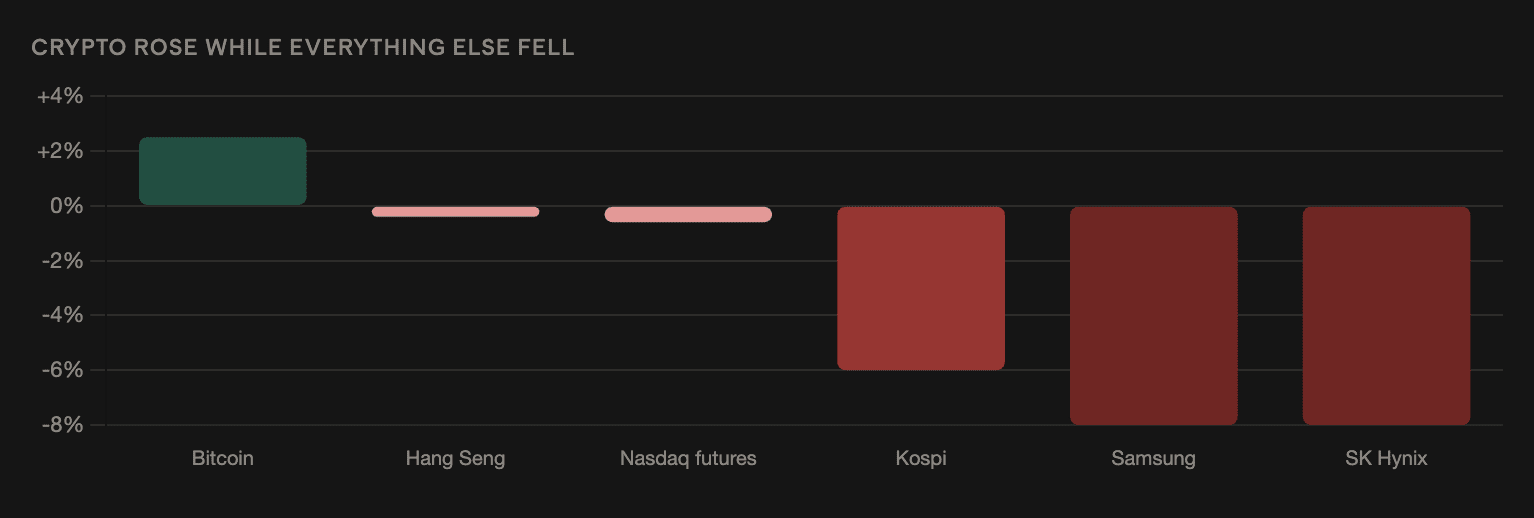
South Korea’s Kospi plunged more than 6% intraday, falling below 6,000 to its lowest level since late July.
The Memory Selloff Has Accelerated Sharply
Samsung Electronics and SK Hynix each fell roughly 8%, extending their losing streaks to five sessions.
That is a marked escalation from Monday, when SK Hynix fell 4.09% alongside SanDisk’s 6.74% and Micron’s 4.31%. The daily move has roughly doubled.
The Kospi below 6,000 puts it about 12% under its September 30 close of 6,838.04 — adding to a third quarter that already delivered a 19.3% decline, the index’s steepest since the first quarter of 2020.
Investors cited AI-related valuation concerns and rising competition from Chinese memory-chip producers.
Chinese Competition Is a Different Argument From Valuation
The two reasons given are not equivalent, and the second is newer.
A valuation concern says the price is wrong. A competition concern says the business is changing. The first resolves when the multiple compresses; the second requires market share to be defended.
Alibaba announced what it called China’s “most powerful AI chip” on September 22, built to compete with Nvidia. If Chinese memory producers are scaling alongside that, the supply-demand tightness Micron described becomes harder to sustain.
Micron guided first quarter revenue to $60–63 billion against $56.77 billion expected on October 1, with CEO Sanjay Mehrotra saying conditions would be “much tighter in fiscal 2027 and 2028 than they were in 2026.” The stock has fallen through that guidance for two weeks.
The Decoupling Is the Notable Part
Bitcoin recovering while the Kospi falls 6% reverses a relationship that held through September.
Crypto majors rose with Asian chip stocks on September 22 after Meta’s Muse agent topped the App Store, and the Kospi rose 1.2% alongside crypto on October 1 after Micron’s guidance beat.
Tuesday broke that. Hang Seng slipped 0.4% and Nasdaq futures fell 0.6%, extending Monday’s 0.78% decline, while Bitcoin added more than $2,000 off its low.
One session is not a trend. Bitcoin’s correlations have been unstable all quarter — its short-window link to the S&P 500 fell to 0.43 from 0.75 in a single session after the Clarity Act vote, and its gold correlation collapsed to 0.28 from 0.69.
Oil Is Holding Its Gains
WTI traded near $92.67, holding most of Monday’s recovery from below $90. Brent hovered around $106 after a three-day rally.
Fresh attacks in Saudi Arabia and continued threats to shipping through the Strait of Hormuz have kept energy uncertainty elevated, with traders weighing supply disruption against expectations of additional Russian diesel exports.
The spread between the benchmarks remains the signal. At roughly $13.33, it has barely narrowed from Monday’s $14.60 and sits far above the normal $2 to $4 range — consistent with a seaborne export constraint rather than a global demand story.
Higher oil raises inflation risk and strengthens the case for Fed hikes, which is a headwind for crypto.
The Dollar Is at a 19-Month High
The Dollar Index held near 102.50, its highest since April last year.
That extends a climb from the 98 and 99 handles in mid-September and 101.81 on October 1. A stronger dollar raises the opportunity cost of holding non-yielding assets and makes dollar-priced assets more expensive for non-dollar buyers.
Bitcoin rising against that backdrop is the second decoupling in the session.
CPI Thursday Is the Catalyst
Traders are positioning for Thursday’s US consumer price index report.
“With US inflation data approaching, I expect institutional investors to focus on adding protection through derivatives and hedging strategies rather than materially reducing their underlying exposure,” said Paul Howard, senior director at market-making firm Wincent.
“This is typically how committed institutional participants manage periods of heightened risk: maintaining their core positions while using derivatives to protect against downside and continuing to treat cryptocurrencies as an asset class capable of generating returns,” Howard added.
The print lands into a split between the Fed’s own projections and market pricing. September minutes showed 16 of 18 officials projecting at least one more hike in 2026, while markets price October odds at just 19% after payrolls added only 29,000 against 90,000 expected.
A hot CPI narrows that gap. A soft one widens it.