

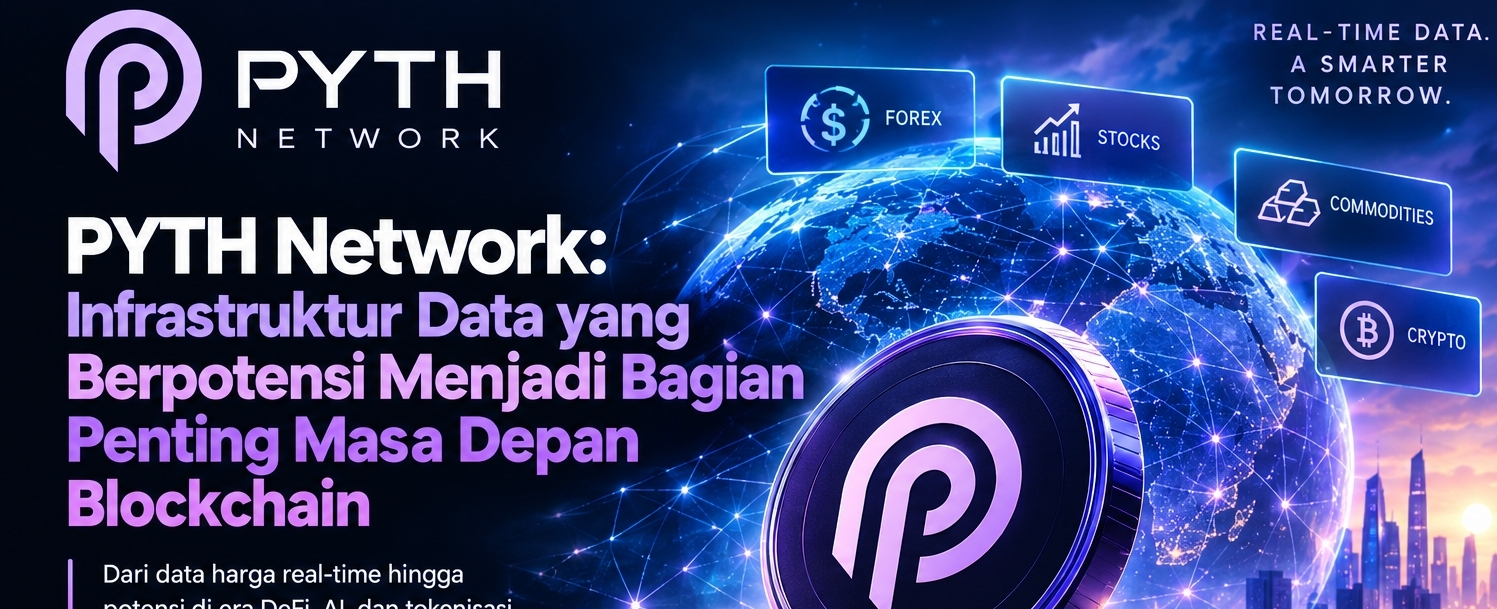

Is the future of crypto only about Bitcoin and rising token prices? No. Behind the blockchain ecosystem is critical infrastructure that enables applications to understand real-world conditions. One example is Pyth Network.
1. Getting to Know PYTH Network
Pyth Network is an oracle network that provides financial data to blockchain applications. Simply put, blockchains need sources of information from outside their networks, such as prices of crypto assets, stocks, currencies, and commodities. This is where oracle technology comes in.
According to its official documentation, Pyth provides data from more than 120 first-party data providers, including exchanges, banks, trading firms, and market makers. Its price data can be used by applications across more than 100 blockchains.
This makes Pyth worth paying attention to: its role is not simply to follow market trends, but to help provide data infrastructure for the digital finance ecosystem.
2. Why Is Pyth Technology Needed?
Imagine a DeFi application that allows users to borrow crypto assets against collateral. The application needs accurate asset prices to calculate collateral values and determine liquidation risk.
Without adequate price data, applications can make incorrect decisions.
Pyth aims to address this need through price feed services that deliver price information to blockchain applications. The technology also has potential applications in digital asset trading, derivatives, and various smart contract-based financial services.
As the tokenization of real-world assets (RWA) continues to grow, the need for reliable financial data could become increasingly important.
However, growth in the sector does not automatically mean that every oracle project will succeed. Pyth still has to compete on data quality, cost, speed, security, and adoption.
3. What Is the PYTH Token Used For?
The PYTH token is a governance token in the Pyth Network ecosystem.
Token holders can stake their tokens to participate in governance and vote on certain proposals, subject to the applicable rules. This governance may cover decisions about oracle update fees, incentives for data providers, and protocol development.
It is important to understand the difference between the success of the technology and the value of its token. A network can be widely used, while its token price still depends on demand, supply, tokenomics, market conditions, and the relationship between product revenue and the token economy.
Therefore, investors should assess not only whether Pyth technology is useful, but also whether that utility can generate sustained demand and economic value for PYTH.
4. PYTH’s Potential Through 2030
From a long-term perspective, several developments are worth monitoring.
First, DeFi growth. A growing number of decentralized finance applications could increase demand for reliable price data.
Second, the tokenization of real-world assets. As stocks, commodities, and other financial instruments are increasingly integrated into blockchain systems, data infrastructure could play a more significant role.
Third, the development of artificial intelligence. AI agents that interact with financial applications may need market data to execute strategies or conduct analysis. However, the use of AI does not automatically guarantee increased demand for Pyth.
Fourth, the expansion of Pyth services. Product development, new integrations, user numbers, and revenue from data services will be stronger indicators than marketing narratives alone.
If these factors develop positively, Pyth could strengthen its position as a financial data infrastructure provider. However, 2030 is not a guaranteed price target, but rather a horizon for evaluating the project’s fundamental progress.
5. Risks Not to Overlook
Investing in PYTH involves risks that should be taken into account.
Competition: Pyth faces other oracle projects that also offer data services.
Token unlocks: The release of previously locked tokens can increase the circulating supply and create selling pressure.
Volatility: The price of PYTH can fall sharply even as its underlying technology continues to develop.
Adoption: Technology integrations do not always lead to sustained usage or strong demand for the token.
Tokenomics: Investors should review the token distribution, release schedule, and latest economic mechanisms.
PYTH has a fixed total supply of 10 billion tokens. Therefore, before making an investment decision, investors should review the token release schedule and changes in the circulating supply using official documentation.
6. A Long-Term Investor’s Approach
Investors who believe in Pyth’s potential should base their decisions on data, not just hope.
Some things to monitor regularly include:
Growth in price feed usage and the number of active integrations.
Product development and revenue from data services.
Changes in PYTH tokenomics and circulating supply.
Competition from other oracle providers.
Crypto market conditions and the ability to withstand losses.
There is no guarantee that the price of PYTH will rise by 2030. Therefore, only invest what you can afford to lose, and avoid putting all your capital into a single asset.
Conclusion: Looking Beyond Today’s PYTH Price
Pyth Network is worth learning about because it focuses on a fundamental need of the blockchain ecosystem: fast and reliable financial data.
In the long term, the development of DeFi, asset tokenization, and digital financial services could create opportunities for oracle infrastructure. However, the success of the technology should be distinguished from the success of an investment in its token.
PYTH is not just a story about today’s price; it is a project that should be assessed based on its utility, adoption, token economics, and ability to compete.
The outlook through 2030 remains uncertain. For investors, the most important tasks are to track fundamental developments, understand the risks, and remain disciplined in making decisions.
This article is for educational purposes and is not a recommendation to buy or sell PYTH.
