Bitcoin front-month implied volatility fell to 33.5% — a five-year low — while traders simultaneously bought $204M in October $78K-$80K puts, describing a market that is long Bitcoin with downside hedges rather than outright bearish. The DXY held near an 18-month high at 102.2 with analysts split on whether it stalls at a long-term trendline or extends an 18-year bull market. Global bond yields have done 178bps of tightening work for central banks, cutting cumulative rate hike expectations from 717bps to 539bps across eight major economies. Ethereum spot ETFs shed $542M last week, $477M from ETHA alone. BNB Chain leads tokenized stocks at $1.2B as the total market hits a record $3.9B. Wednesday’s CPI is the week’s defining data point.
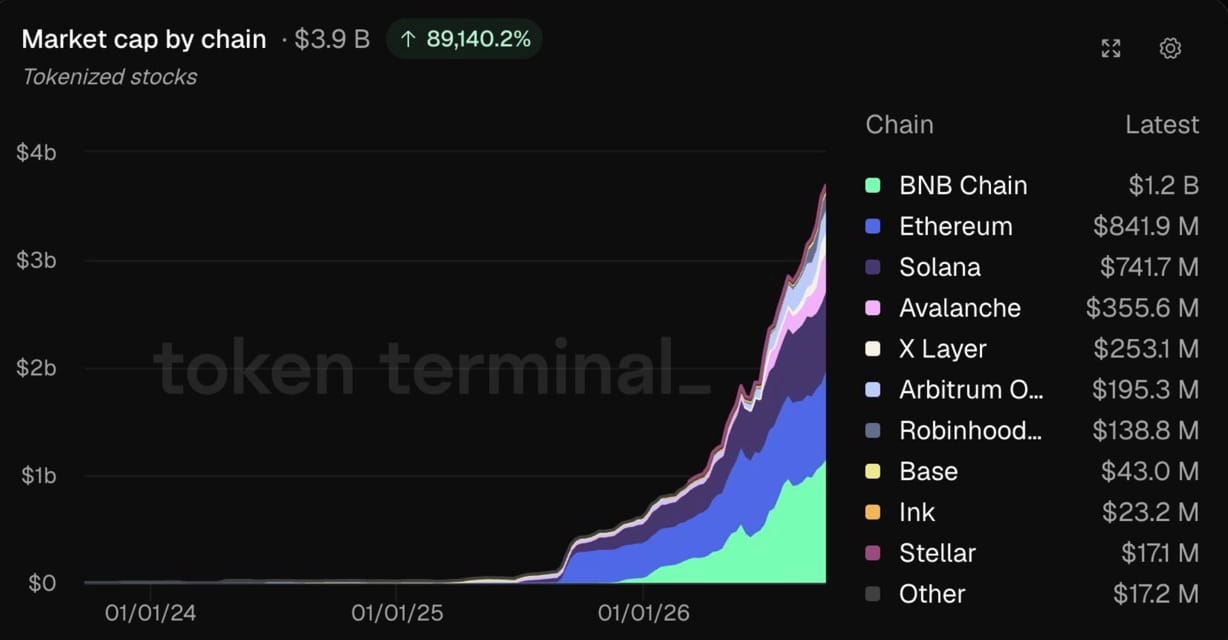
BNB Chain Leads Tokenized Stock Market With $1.2B as Total Market Cap Hits Record $3.9B
BNB Chain holds ~$1.2B in tokenized stock market cap (~31% share), ahead of Ethereum at $841.9M and Solana at $741.7M — the three collectively represent 71% of the $3.9B total. The overall market has grown from $719M in January, a more than fivefold increase in nine months. BNB Chain’s dominance reflects Binance Direct Stocks momentum: the product launched with $1B in holdings and $3B in volume within its first 30 days. The SEC’s conditional five-year exemption opened September 22 for US institutional venues to pilot on-chain stock trading — separate from the offshore volumes driving current BNB Chain numbers but establishing the regulated path that mainstream adoption would require. DTCC’s tokenization service is due in October, NYSE is building a 24/7 tokenized equities venue, and Nasdaq is working on voting-enabled tokenized stock products.
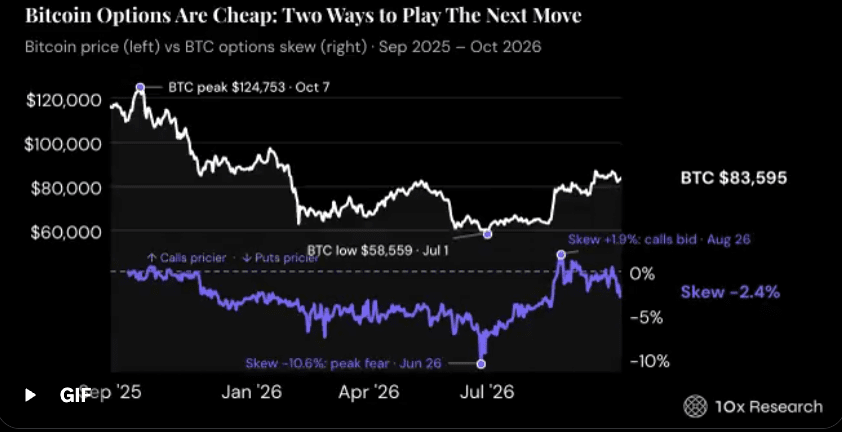
Bitcoin Options Volatility Hits Five-Year Low as Traders Hedge With $204M Put Positions
Bitcoin front-month implied volatility at 33.5% is more than four volatility points below realized volatility — options are pricing in less movement than Bitcoin has recently delivered. Despite the cheap premiums, traders bought $204M in October $78K and $80K puts in block transactions, with options skew falling nearly three volatility points on the week. The 0x Volatility Edge analysis reads this as long-Bitcoin-with-downside-protection rather than outright bearish — holders maintaining exposure while hedging the $80,000 level that FxPro identified as bringing $77,200 support into view. Ethereum’s derivatives picture is the inverse: implied volatility above realized volatility, with call selling dominating — traders overwriting upside exposure, the structure typical of a market expecting sideways-to-lower price action. The implied-below-realized gap for Bitcoin is the setup that historically precedes volatility expansion; direction depends on whether CPI Wednesday delivers a hawkish or dovish surprise.
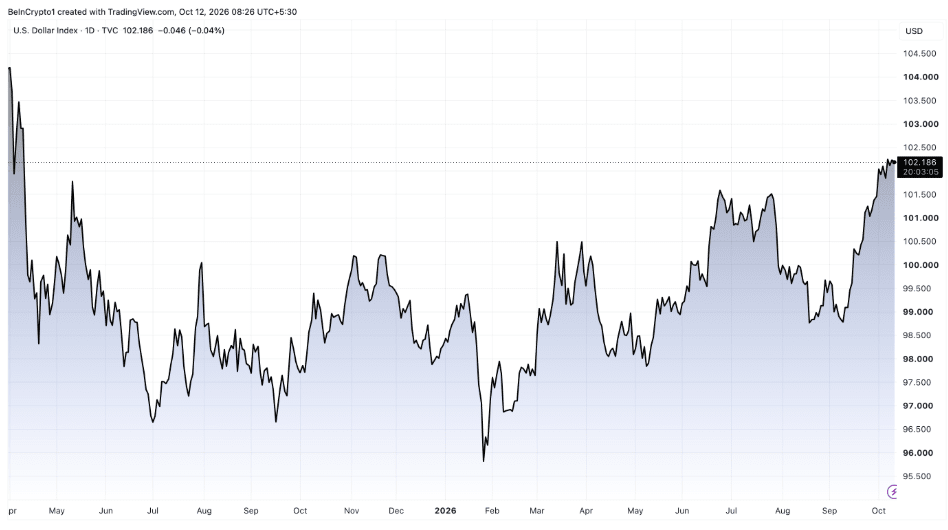
Dollar’s 18-Month High Leaves Analysts Arguing Over One Trendline
The DXY held ~102.2 Monday — near its 18-month peak — as analysts debate whether the rally stalls at a long-term trendline or extends an 18-year bull market. The dollar’s advance from the 98-99 range in mid-September to 102.2 reflects Fed tightening expectations, the energy-driven inflation shock, and European political risk (EUR/USD Morgan Stanley target: $1.10 from $1.14). Bitcoin’s historical inverse relationship with the dollar is the transmission: DXY at 102.2 is a sustained headwind rather than a daily fluctuation. Barclays sees room for a pullback if Wednesday’s CPI cools — Nomura forecasts September core CPI at 0.227% MoM vs August’s 0.290%, which would support Citi’s thesis that the Fed’s tightening case is weakening. If core cools while gasoline lifts headline (Nomura: ~+0.58% MoM on energy), the DXY reaction function becomes ambiguous — the same split that defined the PCE session.
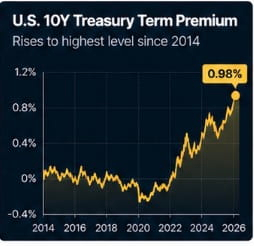
Interest-rate swaps across eight major economies now imply ~539bps of cumulative hikes, down from a September peak of 717bps — bond market tightening has substituted for 178bps of central bank action. The US 10-year term premium reached ~0.98 percentage points, its highest since 2014, as fiscal uncertainty, government borrowing requirements, and AI infrastructure investment compete for long-duration capital. Bitunix’s key distinction for risk assets: reduced rate hike expectations don’t translate into easier financial conditions when long-term yields remain at 2002-2007 highs — the yield level is the constraint, not just the direction of travel. St. Louis Fed’s Musalem said further tightening may be necessary over the next six to nine months. Wednesday’s CPI is the immediate arbiter: if core continues cooling toward the 0.227% MoM Nomura forecasts (vs 0.29% in August), the bond market’s self-tightening argument gains credibility and the December hike case weakens.
Ethereum Spot ETFs See $542 Million Net Outflow Last Week, BlackRock's ETHA Leads
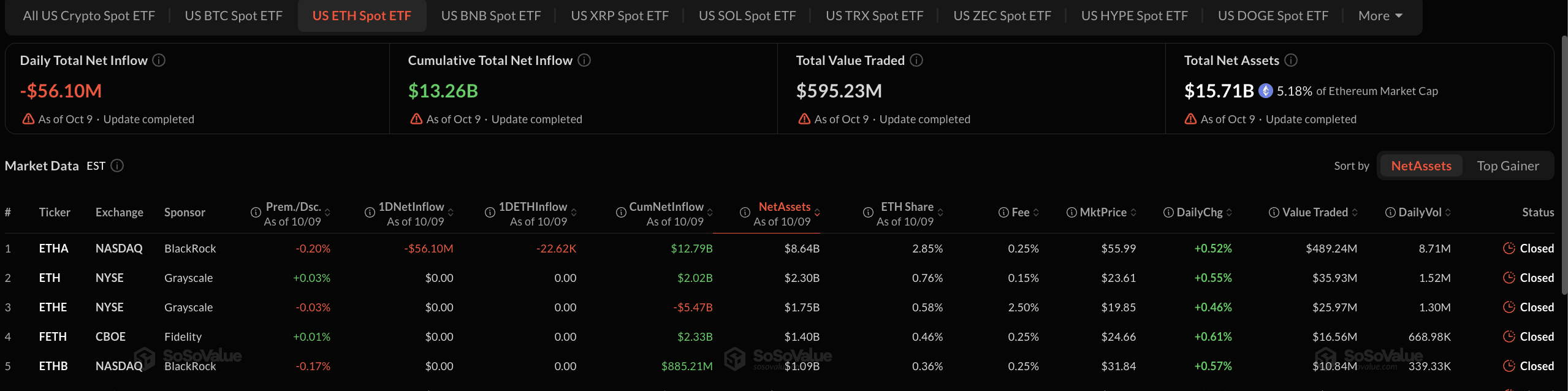
Ethereum spot ETFs recorded $542M in net outflows for the week of October 5-9, with BlackRock’s ETHA alone contributing $477M — 88% of the total. Grayscale’s ETHE shed $31.89M; Morgan Stanley’s MSSE was the only fund with meaningful inflows at $1.32M. Total Ethereum ETF net assets stand at $15.71B (5.18% of ETH’s total market value) with cumulative net inflows of $13.26B. ETHA’s cumulative net inflow reached $12.79B despite the weekly outflow, reflecting its dominant position in the complex. The $542M weekly Ethereum outflow follows Bitcoin ETFs’ $729M two-day outflow last week — both sets of withdrawals coinciding with the market’s move from $87,300 toward $80,300. One data point running the other way: 0x Volatility Edge noted a report that a major corporate Ethereum buyer is expected to suspend purchases within weeks — if confirmed, Bitmine (which has been accumulating 10,000+ ETH weekly) would be the most visible candidate given its 5.93M ETH position.