



Key Takeaways
Global bond market losses are driving up borrowing costs, potentially reducing the need for additional central bank rate hikes, according to Bitunix analysis.
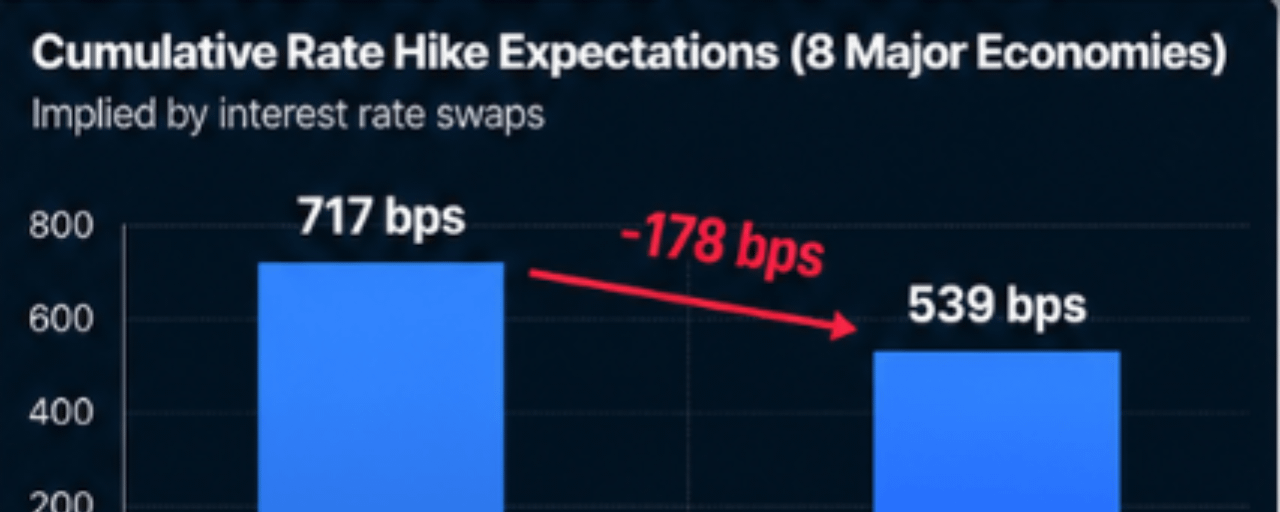
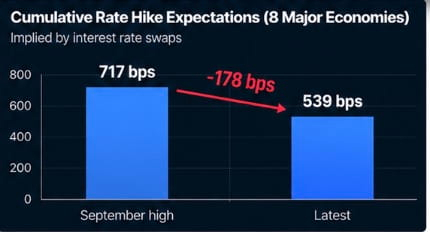
Cumulative rate hike expectations across eight major economies have fallen 178 basis points, from 717 to approximately 539 basis points.
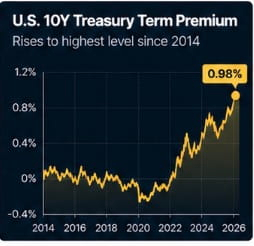
The U.S. 10-year Treasury term premium has risen to approximately 0.98 percentage points, its highest level since 2014.
Nomura forecasts September U.S. core CPI growth of 0.227% month-on-month, while higher gasoline prices could lift headline inflation.
Persistent energy inflation could force central banks to tighten policy further despite already restrictive financing conditions.
Rising Bond Yields Tighten Financial Conditions Without Rate Hikes
The global bond market sell-off is creating a form of market-driven monetary tightening, as rising long-term yields increase borrowing costs for households and businesses, according to an October 12 analysis from Bitunix.
Higher yields are raising mortgage rates, corporate financing costs and borrowing expenses in high-yield credit markets, potentially weakening economic demand without additional central bank intervention.
Interest-rate swaps across eight major economies now imply approximately 539 basis points of cumulative rate hikes, down from a September peak of 717 basis points.
The 178-basis-point decline suggests investors are reassessing how much additional policy tightening may be necessary as bond markets independently restrict financial conditions.
U.S. Treasury Term Premium Reaches Highest Level Since 2014
The sell-off also reflects factors beyond expectations for central bank interest rates.
According to the analysis, the U.S. 10-year Treasury term premium has climbed to approximately 0.98 percentage points, its highest level since 2014.
The increase indicates that investors are demanding greater compensation for holding longer-term government debt.
Government borrowing requirements, fiscal uncertainty and investment in AI infrastructure are among the factors contributing to upward pressure on yields.
Although higher yields have attracted renewed demand at recent Treasury auctions, concerns surrounding long-term debt supply remain.
U.S. CPI Data Could Determine Fed's Next Move
Upcoming U.S. inflation data will be important in assessing whether tighter financial conditions can reduce the need for further Federal Reserve rate increases.
Nomura expects September core CPI to rise 0.227% month-on-month, compared with 0.290% in August.
However, a projected 9.3% increase in gasoline prices could push headline CPI approximately 0.58% higher on the month.
This divergence would complicate the Fed's outlook, particularly if higher energy costs begin spreading into underlying inflation.
St. Louis Fed President Alberto Musalem has also indicated that further policy tightening may be necessary over the next six to nine months.
What Higher Treasury Yields Mean for Bitcoin and Risk Assets
The implications for financial markets depend on whether elevated borrowing costs successfully moderate inflation and economic activity.
If higher yields slow housing demand, corporate investment and consumer spending, central banks may have less reason to raise policy rates further.
However, renewed inflation pressure could result in high market borrowing costs and additional central bank tightening occurring simultaneously.
For Bitcoin and other risk-sensitive assets, this distinction matters: reduced expectations for policy rate hikes do not necessarily translate into easier financial conditions when long-term Treasury yields remain elevated.
The key question is whether bond market tightening will sufficiently cool demand before persistent inflation requires further monetary policy action.