




As Web3, RWAs, and AI agents develop rapidly, the industry continues to face a fundamental contradiction: on-chain tokens and asset credentials are immutable, but the documents that substantiate the authenticity of those assets remain hosted on centralized cloud servers. The tokens themselves are secure and trustworthy, but the property ownership documents, valuation reports, and AI memory datasets behind them can be modified or deleted, creating a disconnect where “on-chain data is trustworthy, but off-chain evidence is not.”
Warm Storage Service, launched by Filecoin Onchain Cloud, was designed to address this pain point. Filecoin recently published another post introducing the product’s core mechanism: within the Filecoin Warm Storage Service, storage providers must prove every hour that users’ data exists. The proof is verified on-chain and takes only seconds to generate. As for pricing, one copy costs $2.50 per TiB per month, and the service requires at least two copies to be stored.
1. What Is Filecoin Warm Storage? A Breakdown of the Underlying Technology
Many people confuse Warm Storage with the traditional Filecoin storage they’re familiar with. First, let’s clarify how the two differ.
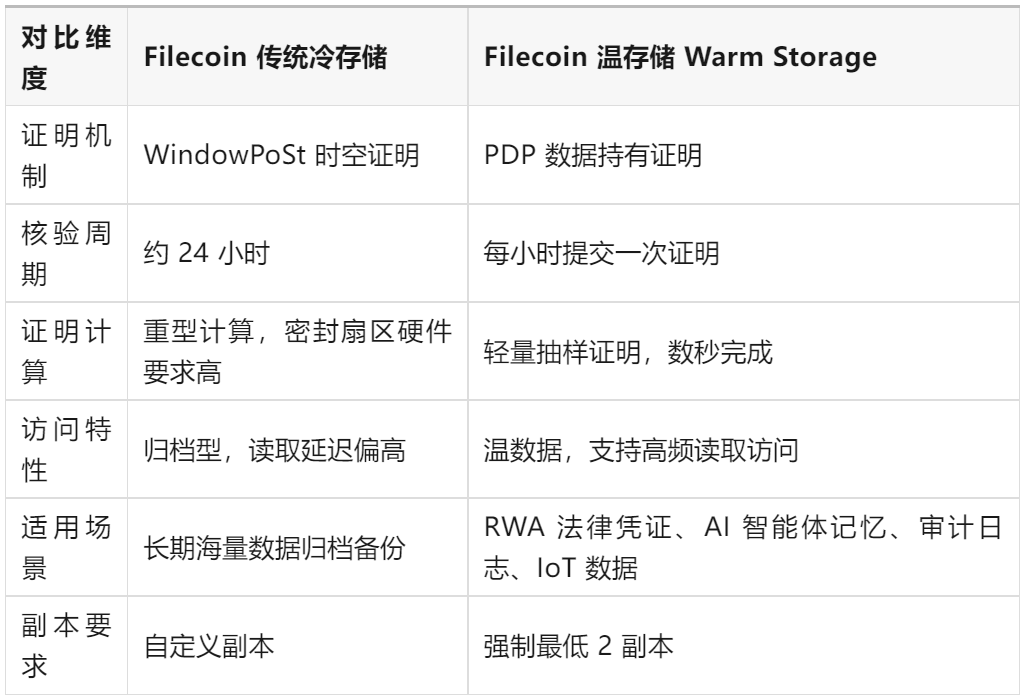
Filecoin’s native network initially focused on cold storage, relying on the WindowPoSt proof-of-spacetime mechanism. This mechanism suits static data that is archived long term and rarely accessed. Its proof cycles are long, while sealing and proof generation require substantial computation and incur high hardware costs. Cold storage is well suited to preserving massive amounts of data over the long term, but has a clear drawback: proofs are generated on a 24-hour cycle, making it unsuitable for applications that require frequent verification and on-demand access.
Warm Storage is a new storage tier in the Filecoin Onchain Cloud product line, powered by PDP (Proof of Data Possession).
Verification frequency: Storage providers submit a Proof of Data Possession every hour, proving that the files remain intact on their servers;
Proof efficiency: PDP is a lightweight proof that can be generated in seconds and submitted onchain for verification;
Core principle: Unlike WindowPoSt, which requires intensive computation across an entire sector, PDP only checks randomly sampled data segments to confirm that the storage provider retains the complete original file.
The three core capabilities as defined by Filecoin:
Verifiable Storage
Onchain Proofs of Data Possession ensure that data remains verifiable throughout its lifecycle and help keep it secure. Anyone can independently verify onchain that a file has not been lost or tampered with. If even one byte of the file changes, its cryptographic fingerprint, the CID, changes, and verification fails immediately.
Service Level Agreements (SLAs) Onchain
Storage service agreements are enforced automatically through smart contracts. If a storage provider fails to submit proofs on time, the breach conditions are triggered and the smart contract automatically stops payment, helping ensure that storage nodes provide reliable service.
Easy Integration
Easy-to-use SDKs and APIs let developers embed verifiable storage directly into their applications, DApps, and AI agent projects, without having to integrate with the underlying storage network from scratch.
Pricing: $2.5 per TiB per month for a single replica, with a minimum requirement of two replicas—meaning a minimum cost of $5 per TiB per month. Payments are streamed through Filecoin Pay and settled continuously based on actual storage duration, so there’s no need to prepay the entire amount upfront.
2. Launch Timeline: From Announcement to Ecosystem Adoption
November 18, 2025
: Filecoin published its official blog post, “Introducing Filecoin Onchain Cloud,” formally announcing Warm Storage and opening an early developer preview. At this stage, the product was primarily aimed at ecosystem developers testing PDP proofs, the SDK, and smart contract SLA mechanisms.
Late 2025
: The product entered developer testing. Ecosystem service providers such as Akave and Storacha began integrating with the underlying capabilities and building managed services for end users.
Throughout 2026
: Continued development and refinement, with improvements to the SDK and Filecoin Pay streaming payments, and further development of onchain SLA breach mechanisms. Ecosystem projects began small-scale commercial deployments across use cases such as AI datasets, RWA asset certificates, and IoT logs.
October 2026
: Filecoin’s official X account published a post explaining the core rules of Warm Storage once again. This is the official announcement covered in this article, continuing to promote this verifiable storage solution.
⚠️ Warm Storage does not replace Filecoin’s existing cold storage; it adds a new storage tier. Cold storage is for long-term archiving, while Warm Storage is for data that needs frequent access and frequent onchain verification. The two are complementary.
3. Which Projects Are Already Using Warm Storage?
Warm Storage is aimed primarily at two areas with clear demand: RWA tokenization and persistent memory for AI agents. Ecosystem service providers also offer managed services, making it easier for businesses to get started.
Akave Cloud
One of the leading ecosystem service providers to integrate with Filecoin Warm Storage early on. It offers decentralized archival storage powered by Warm Storage for AI, IoT, and enterprise compliance backup use cases. Its focus is data backup with onchain integrity proofs, enabling enterprise customers to audit data authenticity at any time.
Storacha
Its Forge product is compatible with the IPFS protocol and uses Filecoin Warm Storage under the hood to provide high-throughput, verifiable storage. It offers developers a managed interface, lowering the barrier to integration.
RWA (Real-World Asset) Tokenization Projects
This is the most important use case for Warm Storage. When tokenizing real estate or credit products as RWAs, property deeds, land survey files, tax assessment reports, insurance certificates, and legal agreements can all be stored in Warm Storage. Hourly PDP proofs ensure these legal documents cannot be secretly altered. Buyers, auditors, and regulators can independently verify that the onchain CID matches the original document. This addresses the RWA industry’s biggest pain point: tokens are onchain, but the supporting evidence is stored on centralized servers, where its trustworthiness cannot be guaranteed.
AI Agent Developers
Memories, conversation records, and knowledge bases generated by AI agents can be stored in Warm Storage. Onchain verifiable proofs ensure that AI memories cannot be altered behind the scenes, creating a decentralized persistent memory layer for AI. This was also a key use case demonstrated at the previous Filecoin New York hackathon.
Independent Developers
Developers can use the foc-cli command-line tool or Synapse SDK to integrate natively and embed verifiable storage into DApps and other web applications.
4. Two Integration Options: Native Developer Integration / Managed Service Provider Integration
Option 1: Native developer integration (Synapse SDK /foc-cli)
Ideal for technical teams integrating directly with the Filecoin Onchain Cloud stack:
Upload the original data to generate an IPFS content identifier (CID);
Place a storage order through the API. The smart contract automatically locks in the service terms: at least two replicas, hourly PDP proofs, and streaming payments;
Storage nodes receive the order, generate PDP proofs every hour, and submit them onchain;
Users and auditors can verify the data at any time. If the storage provider loses data, proof verification fails, and the smart contract automatically triggers a breach and stops payment.
Option 2: Managed integration through ecosystem service providers (Akave Cloud, Storacha)
Ideal for businesses and non-technical teams. Service providers offer an S3-compatible interface, delivering an experience similar to traditional cloud storage services such as Alibaba Cloud and AWS. Filecoin Warm Storage is automatically managed behind the scenes, including proofs and replica management. Businesses don’t need to interact with the blockchain stack, making it easier to get started.
Payments use Filecoin Pay streaming payments, with charges based on storage duration, so there’s no need to prepay a large amount upfront.
5. Warm Storage vs. Traditional Filecoin Cold Storage: A Detailed Comparison
6. Technical Value and Limitations: A Balanced Perspective
✅ Core value
It addresses the long-standing lack of an evidence layer in Web3. In the past, many RWA and AI projects deployed asset tokens on public blockchains, but stored the documents proving the assets’ authenticity in centralized clouds. Centralized providers can modify or delete files. The tokens are trusted, but the evidence is not. Warm Storage provides ongoing onchain proofs of data availability: even a one-character change to a file changes its cryptographic fingerprint, the CID, which anyone can independently verify.
⚠️ Limitations
A PDP proof can only show that a complete file exists on a storage node and has not been tampered with. It does not, by itself, give a document legal force. Legal validity still depends on recognition under the relevant national legal framework.
Filecoin Warm Storage is decentralized infrastructure and is not equivalent to commercially available cloud storage registered and compliant with domestic regulations. Users should consider the compliance policies in their jurisdiction.
The price of $2.5 per TiB per month is an early-stage price. Future prices may change in response to supply and demand among storage providers.
Warm Storage fills a crucial gap in the Web3 world: verifiable data. Whether it’s the tokenization of real-world assets (RWA) or decentralized memory for AI agents, both need this kind of infrastructure. Do you think Warm Storage will become a standard part of Web3 infrastructure?
Source: Official media / online news
Disclaimer: The content published by this account is for learning and discussion purposes only. The materials in this article come from publicly available online sources. If there are any copyright concerns, please leave a message and we will correct or remove the content promptly. This article is intended to share market information and does not constitute investment advice.