


A 1% long-shot pick suddenly comes through; a $173 bet could pay out nearly $9,600
According to a report by The Wall Street Journal, U.S. prediction market platform Kalshi is investigating a series of unusual trades related to White House appointments. At least three trades bet on Katie Zacharia, a long-shot candidate with only about a 1% chance of winning at the time, before media reports revealed she would become White House press secretary. The total amount wagered was about $173, with an expected total payout of nearly $9,600—about 55 times the original stake.
Kalshi has confirmed that it is investigating the trades. It has not yet disclosed the traders’ identities or said whether it found any rule violations.
Public trading records show that the first bet, worth about 19 dollars, was placed around 10:42 p.m. Eastern Time on October 8, and it was expected to yield about 1,896 dollars in returns. The next afternoon, around 1:41 p.m., two more trades worth about 74 dollars and 80 dollars entered the market, with expected returns of about 3,689 dollars and 4,023 dollars respectively.
The dispute mainly centers on the timing of the trades. The latter two bets were placed less than 20 minutes before media outlets began reporting around 2 p.m. that Zacharia had been selected. At that time, the Kalshi market still regarded her as an extremely unlikely pick, leading these precisely timed trades to quickly spark suspicions that someone had learned of the unreleased news in advance.
Trump later formally announced the choice, and Kalshi is investigating whether nonpublic information was involved.
U.S. President Donald Trump later confirmed via Truth Social that Zacharia would take over as White House press secretary, replacing Karoline Leavitt, who left in August. Zacharia previously served as a senior communications adviser at Trump Media & Technology Group and had also worked in public affairs at the U.S. Department of Homeland Security.
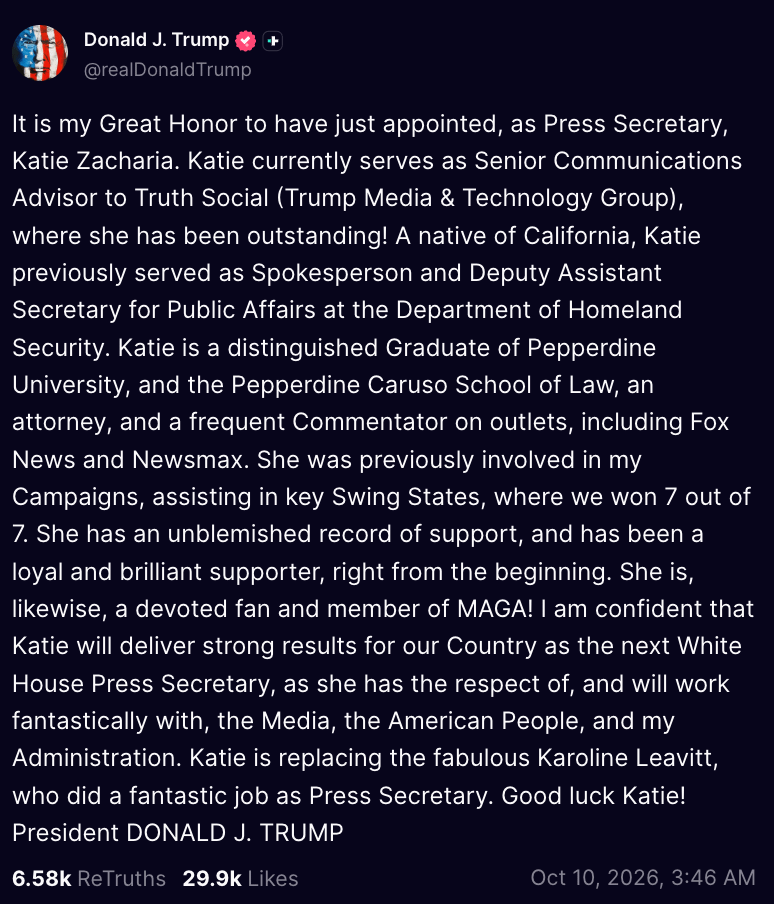 Image source: Truth Social/@realDonaldTrump Trump later confirmed via Truth Social that Zacharia would take over as White House press secretary.
Kalshi’s event contracts let traders buy "Yes" or "No" positions on a specific outcome. If the prediction comes true, the "Yes" contract settles at 1 dollar per contract. Therefore, when a contract price is only about 1 cent, it roughly reflects the market assigning the event about a 1% chance. Once an underdog outcome materializes, the return multiple can rise sharply.
At present, Kalshi has only confirmed that it is reviewing the related trades and has not accused any trader of wrongdoing. Regulators have also not publicly determined that these bets involved insider information.
Market participants may still have correctly guessed the outcome through public information, news analysis, or personal judgment, so precise trading timing alone cannot directly prove a violation. The investigation will focus on the trader’s identity, the source of the information, and whether unreleased White House personnel news was obtained through official duties or private relationships.
There is already a precedent inside the White House: a teleprompter operator once profited by betting on Trump’s speech script.
This incident has attracted intense attention and is also connected to cases Kalshi handled this year involving White House-related personnel betting using job-related information.
Former White House teleprompter operator Gabriel Perez had early access to Trump’s speech content and later bet on Kalshi’s "Mention Markets" on whether the president would say specific words. In August this year, the U.S. Commodity Futures Trading Commission (CFTC) reached a settlement with Perez, requiring him to surrender about 107,539 dollars in trading profits, pay an additional 65,000 dollars in civil penalties, and accept a 3-year trading ban.
Regulators determined at the time that Perez used nonpublic information obtained during his work to trade. Kalshi also assisted in the related investigation.
Related news: Made insider trades on Kalshi using Trump’s speech script! Former White House teleprompter operator fined 170,000 dollars
This year, the platform began requiring traders in some high-risk markets to disclose employer information, hoping to identify accounts that may have obtained sensitive information through their jobs. Kalshi previously said it had launched more than 150 internal investigations in the first quarter of this year and referred more than 20 cases to law enforcement.
Another former federal representative, George Santos, was also permanently banned from the platform for involvement in Kalshi market trading. As political event contracts grow rapidly, trade monitoring, conflicts of interest, and the use of nonpublic information have gradually become important regulatory issues for prediction markets.
Related news: Fined 71,000 dollars for insider trading involvement! Prediction market Kalshi imposes a "lifetime ban" on former lawmaker
As prediction markets expand rapidly, insider information has become a new regulatory challenge.
Prediction markets such as Kalshi have grown rapidly in recent years, with trading expanding from elections, political appointments, and economic data to sports and entertainment events. Prices in these markets can reflect traders’ judgments about the probability of an event happening in real time. But when it involves White House appointments, policy details, or unreleased government information, people with inside information may gain an informational advantage that ordinary market participants cannot easily have.
The White House had also previously reminded staff not to use nonpublic information for private gain. The U.S. Congress and the CFTC are likewise continuing to focus on trade monitoring, identity verification, and unusual position issues in prediction markets.
The amount invested in this unusual trade was only about 173 dollars, but the extremely low market probability, the entry time close to when the news was reported by the media, and the potential total return of about 55 times quickly drew attention.
Kalshi’s follow-up investigation will further confirm how the trader learned that Zacharia might be selected and whether the information came from public channels. If someone is found to have traded using unreleased government information, the case could also involve platform rules and regulatory handling by the CFTC.
"A surprise bet turned into 55x gains and sparked insider suspicions; Kalshi urgently investigates unusual trading in White House press secretary bets" This article was first published by "Crypto City".