

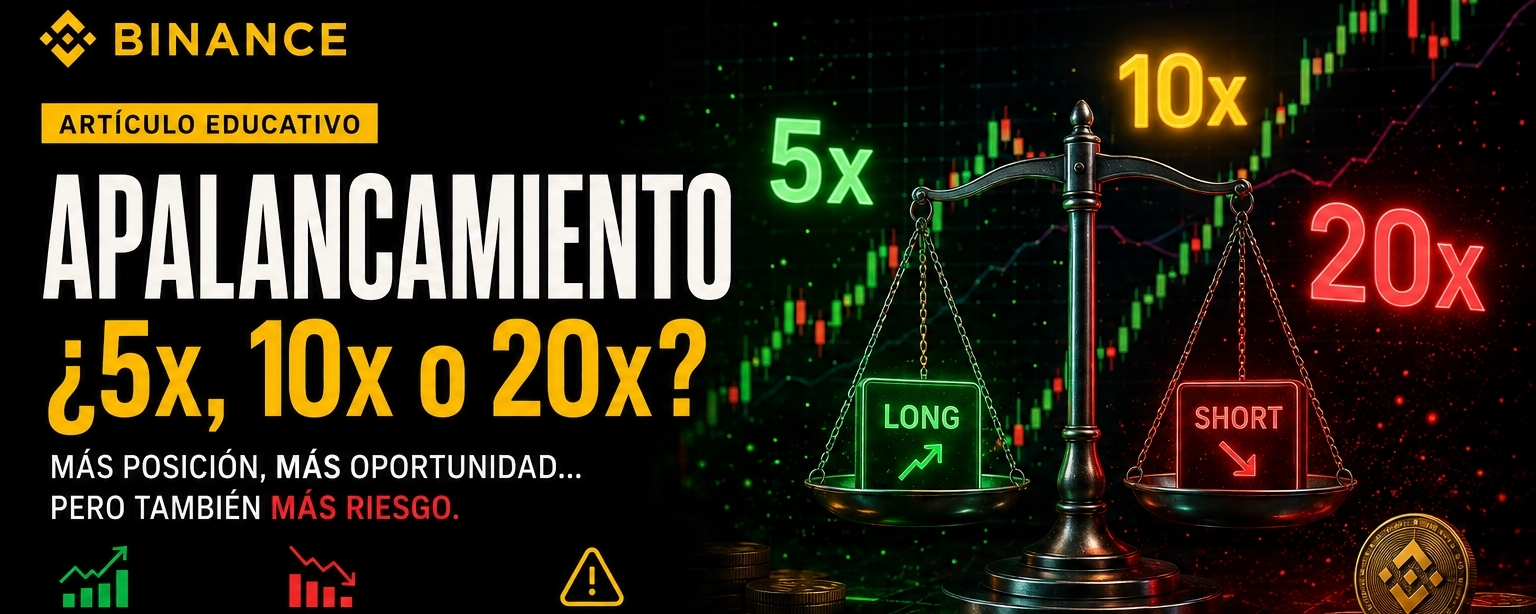

In previous articles, we talked about Spot and learned the basics of Futures.
Now let’s take it one step further.
You’ve probably seen trades with 5x, 10x, 20x, or even 50x leverage. But do you know what those numbers really mean?
🤔 Can you open a US$1,000 position with US$100?
🤔 If you use 20x leverage, do you earn twenty times more?
🤔 And what happens if the market moves against you?
Today, we’ll answer these questions with simple examples and numbers so you can understand them without having to trade.
🟡 1. WHAT IS LEVERAGE?
Leverage is a tool that lets you control a position worth more than the margin you contribute.
In other words, your capital acts as margin to open a larger position.
Let’s imagine you have US$100 available to trade.
Without leverage, a US$100 position gives you approximately US$100 of market exposure.
But with leverage, the relationship changes:
🔹 5x: US$100 margin → US$500 position.
🔹 10x: US$100 margin → US$1,000 position.
🔹 20x: US$100 margin → US$2,000 position.
🔹 50x: US$100 margin → US$5,000 position.
These are simplified examples that assume you use the full US$100 as initial margin, without accounting for costs or other trading requirements.
And keep one important thing in mind:
A US$1,000 position doesn’t mean you have US$1,000 of your own money.
In this example, your US$100 is the margin you contribute to maintain a larger position.
Leverage increases your market exposure and, with it, the effect price movements have on your capital.
📊 2. COMPARISON: WHAT HAPPENS WITH US$100?
Let’s imagine you open a Long position in BTC and the price rises by 1%.
To understand the difference, let’s compare three scenarios.
Scenario A: 5x leverage
Your margin is US$100, and your position is worth US$500.
If the price rises by 1%, the approximate gross profit would be US$5.
Scenario B: 10x leverage
Your margin is still US$100, but the position is worth US$1,000.
If the price rises by 1%, the approximate gross profit would be US$10.
Scenario C: 20x leverage
Your margin remains US$100, and the position is worth US$2,000.
If the price rises by 1%, the approximate gross profit would be US$20.
Look at the difference:
LeveragePositionResult if price rises 1%5xUS$500+US$510xUS$1,000+US$1020xUS$2,000+US$20
The results are before fees, funding, and other costs, and assume the position stays the same size.
Can you see what’s happening?
With the same margin, a 1% price movement produces different results because each position has a different value.
But the most important part is still missing.
🔴 3. WHAT HAPPENS IF THE PRICE DROPS?
Now let’s keep the same examples, but imagine that BTC drops by 1% and you’re still in a Long position.
LeveragePositionResult if price drops 1%5xUS$500−US$510xUS$1,000−US$1020xUS$2,000−US$20
With US$100 in initial margin:
📉 With 5x, you’d lose approximately 5% of that margin.
📉 With 10x, you’d lose approximately 10%.
📉 With 20x, you’d lose approximately 20%.
All of this is before costs and under the same assumptions as the previous example.
Notice this: the price only fell by 1%, but at 20x, the gross loss is equal to 20% of the initial margin.
And if the market continues moving against you, your losses can keep growing.
Leverage amplifies the effect of market movements, both in your favor and against you.
It doesn’t turn a trade into a winning one. Nor does it let you know in advance which way the price will move.
⚠️ 4. CAN YOU LOSE EVERYTHING WITH A 5% DROP AT 20x?
This point deserves a lot of attention.
In our example, a US$2,000 position with US$100 in margin loses approximately US$100 if the price moves 5% against you, assuming the position size stays constant.
That’s equal to 100% of the initial margin.
But there’s one key point:
It doesn’t mean you can calmly expect a 5% drop before liquidation happens.
In a real trade, liquidation can happen sooner because maintenance margin, fees, the liquidation price, and other contract conditions come into play.
That’s why you shouldn’t use these percentages as if they were an exact liquidation-price calculator.
In Futures, losing money and being liquidated are related concepts, but they’re not exactly the same thing.
We’ll dedicate a full article to liquidation to understand what causes it and how it works.
🧠 5. SO, WHICH IS BETTER: 5x, 10x, OR 20x?
There’s no one number that’s best for everyone.
It depends on your strategy, position size, the risk you’re willing to take, and how you manage your capital.
But there’s one fundamental thing you need to understand:
The higher the leverage, the lower the initial margin required to control a position of a given size. This also means that if you keep the same margin and increase your leverage, you’re increasing your market exposure.
And the greater that exposure, the greater the impact of a given price movement on your margin.
That’s why I wouldn’t choose leverage based only on how much I could make.
First, I’d consider how much I could lose.
Also remember that using lower leverage doesn’t guarantee a trade will be safe. A position that’s too large can result in significant losses even with low leverage.
🚨 6. A VERY COMMON BEGINNER’S MISTAKE
Imagine someone sees a post where another person shows a significant profit using 20x.
So think about this:
“If I use 50x, I’ll make even more.”
But that conclusion ignores a fundamental part of the problem: risk.
If the price moves against you, a position with higher leverage can use up your available margin much faster.
Also, a screenshot showing a profit doesn’t necessarily show you the previous losses, failed trades, or the risk that person took.
Don’t confuse a posted profit with a strategy you can repeat.
And don’t feel that you need to use leverage to learn about cryptocurrencies.
You can study the charts, practice with hypothetical examples, and learn how the platform works without risking real money.
🔍 7. NOW I WANT YOU TO TRY AN EXERCISE
Before moving on to the next concept, I suggest you take a look at two other markets.
👇 Explore the ADA/USDT and AVAX/USDT widgets to see how their prices move.


You don’t need to open any trades.
The idea is to look at the charts and consider a hypothetical scenario.
If you had US$100 in margin and opened a US$1,000 position with 10x leverage:
📈 What would happen if the price rose by 2%?
📉 What would happen if it dropped by 2%?
Try to calculate it before you keep reading.
The answer, excluding costs and assuming the position size stays constant, is a gross profit of US$20 in the first scenario and a gross loss of US$20 in the second.
Did you calculate it correctly?
These exercises help you understand the relationship between position size and the result, without having to put money at risk.
📚 8. LET’S KEEP LEARNING TOGETHER
In this series, we’re moving forward step by step:
🟢 Spot: buying and selling cryptocurrencies.
🔴 Futures: trading contracts linked to an asset’s price.
📈 Leverage: controlling positions worth more than the margin contributed.
And now, here’s another concept you need to know:
💰 WHAT IS MARGIN IN FUTURES?
We’ll explain what initial margin is, what maintenance margin is, and why not all the money you see in your account works the same way.
We’ll take a closer look at the liquidation price, Funding Rate, and risk management later.
👉 If you’re interested in learning these concepts from scratch, follow me or subscribe to my content on Binance Square to keep up with upcoming articles.
❤️ If you found this useful, you can leave a Like and share it with someone else who’s learning too.
💬 NOW IT’S YOUR TURN
I’d like to know what you’d like to understand better:
🟢 A) How to calculate profits and losses.
🟡 B) What margin is and how it works.
🔴 C) Why a position gets liquidated.
🔵 D) How leverage works in a real trade.
Leave your answer in the comments. If you’re just starting out, you can also tell me which concept you find most difficult.
The idea is to learn together, using simple examples and without needing to risk money to prove anything.
Because before thinking about how much you can make, you need to understand how much you can lose.
#Binance #BinanceSquare #Crypto #Futures #Bitcoin #ADA #AVAX #USDT #LearnCrypto