

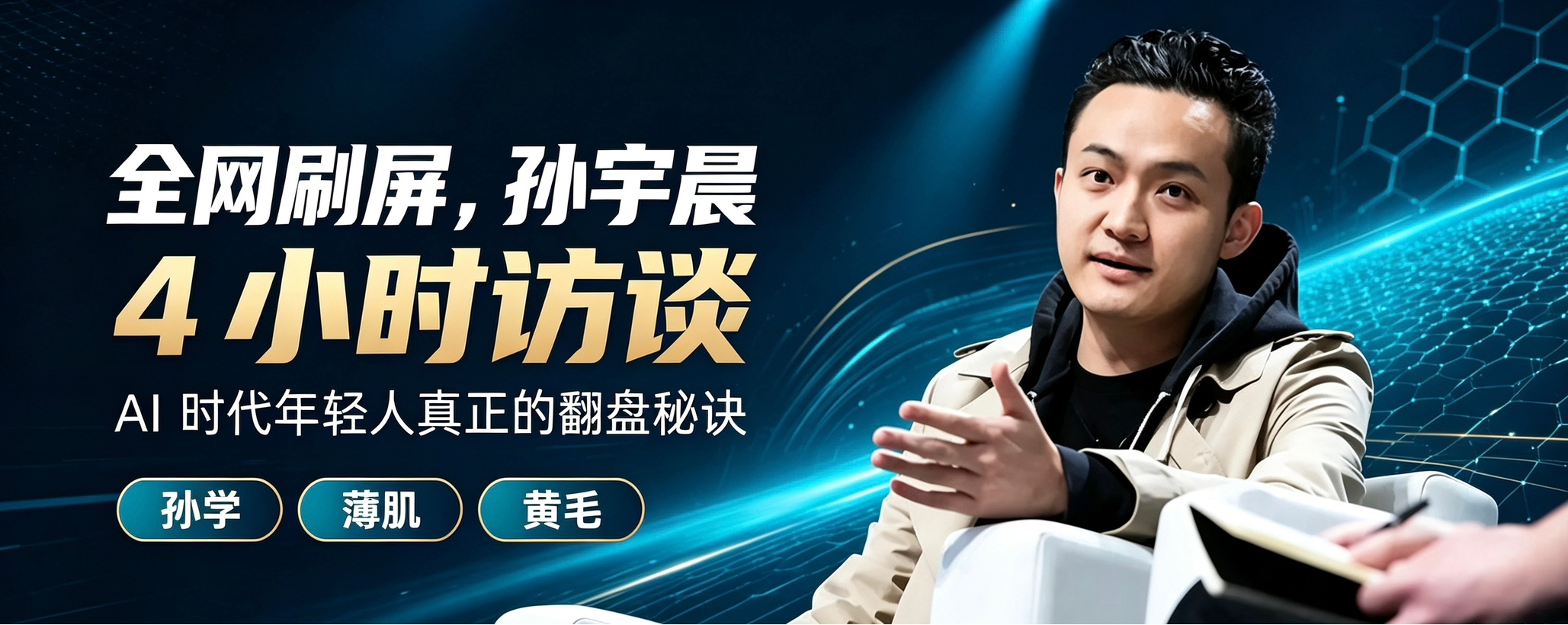

If you’re interested in personal growth, have you been seeing short video clips from Justin Sun’s four-hour podcast popping up in your feed these past couple of days?
A blog post featuring a roughly 4.5-hour in-depth conversation between Justin Sun (founder of TRON) and Alan Shao ("How Can Young People Seize Opportunities in the AI Era?") was recently published across the internet. Justin Sun shared a lot of advice for young people today. The conversation is long and packed with valuable insights. I’ve distilled the key points he made for young people throughout the interview to explore how ordinary young people should think about opportunities and build their own foundational systems amid the AI wave.
This interview wasn’t about crypto or investing. Instead, it offered a framework for personal growth from an ordinary person’s perspective. Here are the key recommendations I’ve distilled:
1. Reading the times: This is the best era yet for young people
AI has made the cost of almost every product and service very cheap. The only things that are truly valuable are lifespan and health.
Youth itself is wealth. Once you get old, you’re “off the ride,” and you may no longer be in a position to take part in many trends and opportunities. Some people may be rich in material terms but poor in health. Health is the one factor that can veto everything else: without it, no matter how many opportunities come your way, you can’t seize them.
2. Build three foundational “operating systems”: Sunology + lean muscle + Blondie (zero-cost starting point)
Even if you have less than 1,000 yuan in monthly disposable income and only a phone, you can get started right away:
Sunology: Upgrade your understanding. First arm yourself with theory and learn about wealth, freedom, and opportunity (the updated core idea: freedom first, then wealth; wealth is a by-product of freedom). Keep updating your version; never roll back.
Lean muscle: strength training + proactive health management (deadlifts, squats, etc.; manage body fat and build muscle). Muscle is like a “bank account, strategic reserve, or cash” for your body, and is the foundation of long-term energy and longevity. In the AI era, good health is priceless.
Blondie: Block out outside noise, ridicule, and envy. Once you start putting this approach into practice, people may question you, but what others say doesn’t matter. If you believe it’s the right thing to do, see it through.
These three zero-cost systems for upgrading your understanding and actions can be used by China’s 20-to-40-year-olds (around 400 million people). Install all three first, then think about starting a business and looking for opportunities.
3. “AI-ify” your whole life (key practical recommendations)
Use free or low-cost AI tools (such as Zhipu, Kimi, tools like Claude Code, or B.ai) to digitize all your health, diet, sleep, training, learning, and work data, and save it in local Markdown files.
After collecting data for 2–4 months, feed it to several top AI models (Claude, OpenAI, and Chinese models) for cross-analysis. Let them point you in a direction and show you how to make money. Keep your data local and switch between APIs to avoid becoming dependent on a single platform.
Trust AI completely as your primary resource, while keeping your own judgment and continuously tuning it—adjusting things over time, just like training a model. The old saying, “If you can talk to Doubao, don’t talk on WeChat,” has been upgraded to using APIs to talk to AI around the world.
A phone is enough; a computer isn’t necessary. You can AI-ify your personal system at no cost.
4. Don’t decide too early. First “open the map” to see the big picture, then make your move.
Never use your limited understanding of the world to decide too early, “This is what I’m going to do with my life.” See more, listen more, and learn more. Broaden your horizons first.
Use AI as your scout, placing markers across the whole map. Ask AI to assess the trends and employment prospects over the next decade for hundreds of majors and industries, build a complete frame of reference, and then make your choice. Put simply: look around and do your research early on; don’t rush in. When an opportunity appears that far surpasses your benchmarks, act decisively.
Look for business opportunities with a global outlook. Serve 8 billion people and meet the new needs of the AI era instead of getting trapped in cutthroat competition in your local market. AI has greatly reduced language and information barriers, so ordinary people can also connect with global opportunities.
Preserve liquidity and stay nimble. Before 30, try not to buy a house or car, or get married, so your assets and life choices aren’t locked in too early. “Move with the grass,” and be ready to change direction at any time. Keep your ego small; don’t let minor past successes hold you back. Young people starting from zero have the advantage of no baggage from the past.
5. Other points
Understanding determines everything. Blondie, lean muscle, and crypto are ultimately all contests of understanding. The more information you accumulate, the closer your judgment can get to the truth. There is no innate, fixed “ceiling on intelligence.”
Getting started matters more than figuring out why you should start. The pursuit of meaning may itself be meaningless; the experience is what matters.
Look for fields with vast amounts of data where AI has lowered the barriers to processing it (mathematics, astronomy, biology, health management, payments/stablecoins, etc.), but don’t go all in on a single sector.
Create more and consume less. Keep iterating on yourself and stay adaptable to change.
This perspective is essentially an updated continuation of the “three don’ts” (don’t buy a house, don’t buy a car, don’t get married) and the idea of investing in tech assets from his 2016 book, The Road to Financial Freedom. The 2026 version adds several key elements: personal AI integration, lean muscle, Blondie, and a small ego.
He was also fairly candid in the interview. When discussing life topics like marriage and relationships, he said he’s still figuring things out himself—there are no standard answers.
Of course, these ideas are controversial simply because they come from Sun Yuchen. His resources are worlds apart from those of ordinary people, and not everyone can replicate some of his moves. But I think there’s still value in extracting the parts that don’t depend on resources and rely only on knowledge and action.
Ultimately, at this stage, the worst thing you can do may be to rush into locking yourself into one position. Whether it’s a job, a city, or a way of life, keeping some flexibility matters more than getting a definite answer right away.