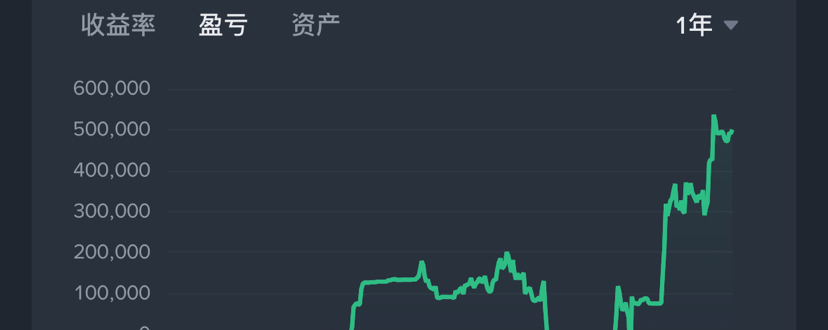

1. If someone keeps blowing up their account, would trading against them make you rich?
If you like this, please like, save, and follow.
The internet's first blogger to trade live with 1 million U explains it all with math. If you want to improve your trading, make sure to watch until the end.
To make money with your account over the long term, you need to do two things *at the same time*.
Both are essential.
1. Positive expected value trades
2. Proper position sizing
If you don't have positive expected value (+EV), you'll lose money no matter how you manage your position size.
Because every trade you make has negative expected value, your long-term results will inevitably converge toward that expectation.
If you lose an average of 0.05% on each trade, after 1,000 trades you’ll have only half your initial capital left. If you use 10x leverage, it’ll take just 100 trades to lose half your capital.
If you have a +EV strategy and system, congratulations—you’ve already passed the hardest hurdle. But if your position sizing is wrong (if your positions are too large), you can still lose money even with positive EV.
I’ve already explained what expected value is in an earlier post, and I’ll also explain how to build a positive-EV strategy in the future.
Below, I’ll use pure mathematics to explain the question I raised at the beginning.
1. If someone keeps blowing up their account, would trading in the opposite direction make you rich?
Answer: You won’t get rich, and you’ll still lose money. Someone who keeps blowing up their account isn’t necessarily a bad trader. Even if they have positive expected value, they can still blow up. Trading against them might actually mean taking trades with negative expected value, and you could still blow up. So there’s no point in trading opposite to the dentist either.
Let me explain:
Suppose you have positive expected value, a 60% win rate, a 40% loss rate, and a 1:1 win/loss ratio. That’s an extremely, extremely good strategy/trade,
Because your expected value is 0.6*1 -0.4*1 = 0.2,
It’s a strategy with a 20% EV,
A +20% EV is almost nonexistent in the real world because it’s just too good,
Even a 3% edge is already very impressive for a top trader.
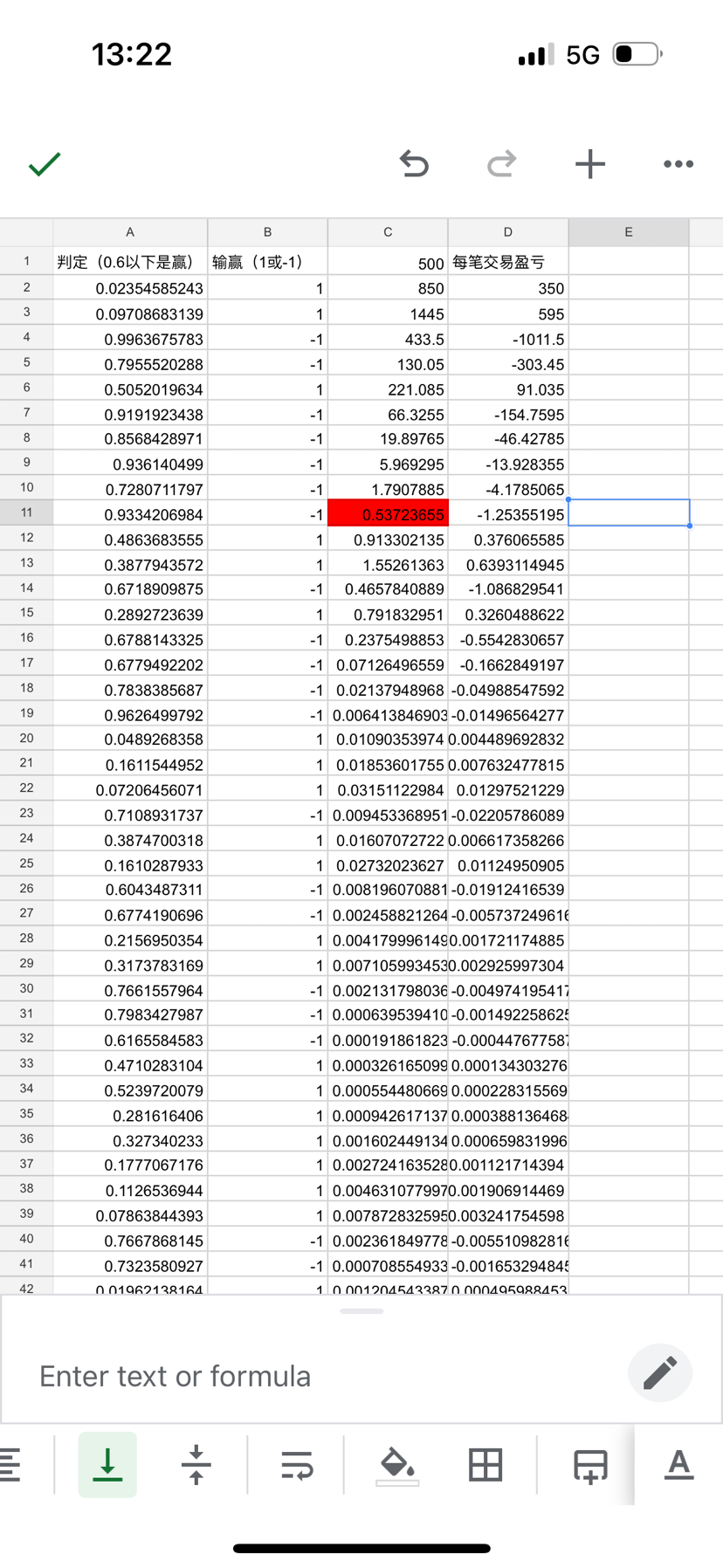
Even if you have a +20% EV, if you risk 70% of your capital on every trade, you’ll see what happens when I simulate it in Excel. First, I’ll generate a random number between 0 and 1. If it’s less than 0.60, that means a win; if it’s greater than 0.60, that means a loss.
Take a look at Figure 1. If you trade like this, you’ll have blown up by your 11th trade. If you don’t believe me, try it yourself in Excel.
The Kelly formula can calculate the position size that mathematically maximizes growth.
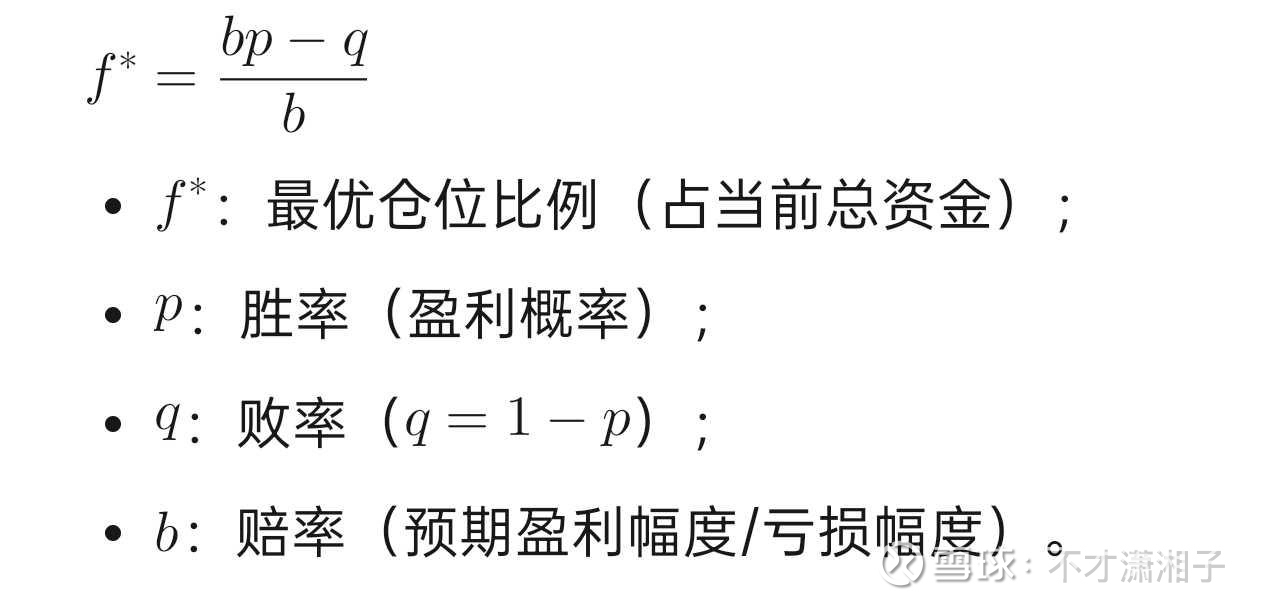
You can try plugging the numbers in to see what the optimal position size is. I’m giving away 50u in red envelopes here, and anyone who can work out the optimal position size can claim one. If you figure it out, please make sure to claim your red envelope and then delete your answer; otherwise, script bots will claim them all in no time.
This formula also shows that if your EV/expected value is negative, then the resulting f* is negative, which means you shouldn’t take the trade.
The chart below clearly shows everyone what happens as f* changes.
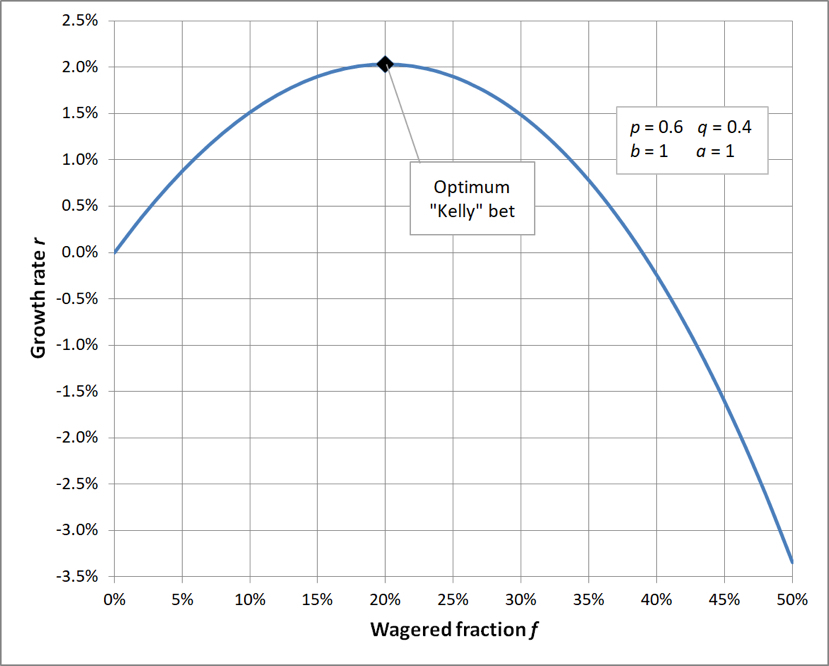
The y-axis represents the growth rate; a value above 0 means the account will grow over the long term. The optimal solution from the Kelly formula is the topmost point. As you can see, if your position size is too large, the growth rate falls below 0 and becomes negative. That’s why even people with trading skills can lose money.
I’ll continue sharing articles to help improve everyone’s trading skills, including the most important topics: how to tell whether a trade has positive expected value, and how to find positive-EV trades and strategies.
If you like this, please like, follow, and tip to show your support. I’m currently giving away red envelopes out of my own pocket to help everyone learn.