

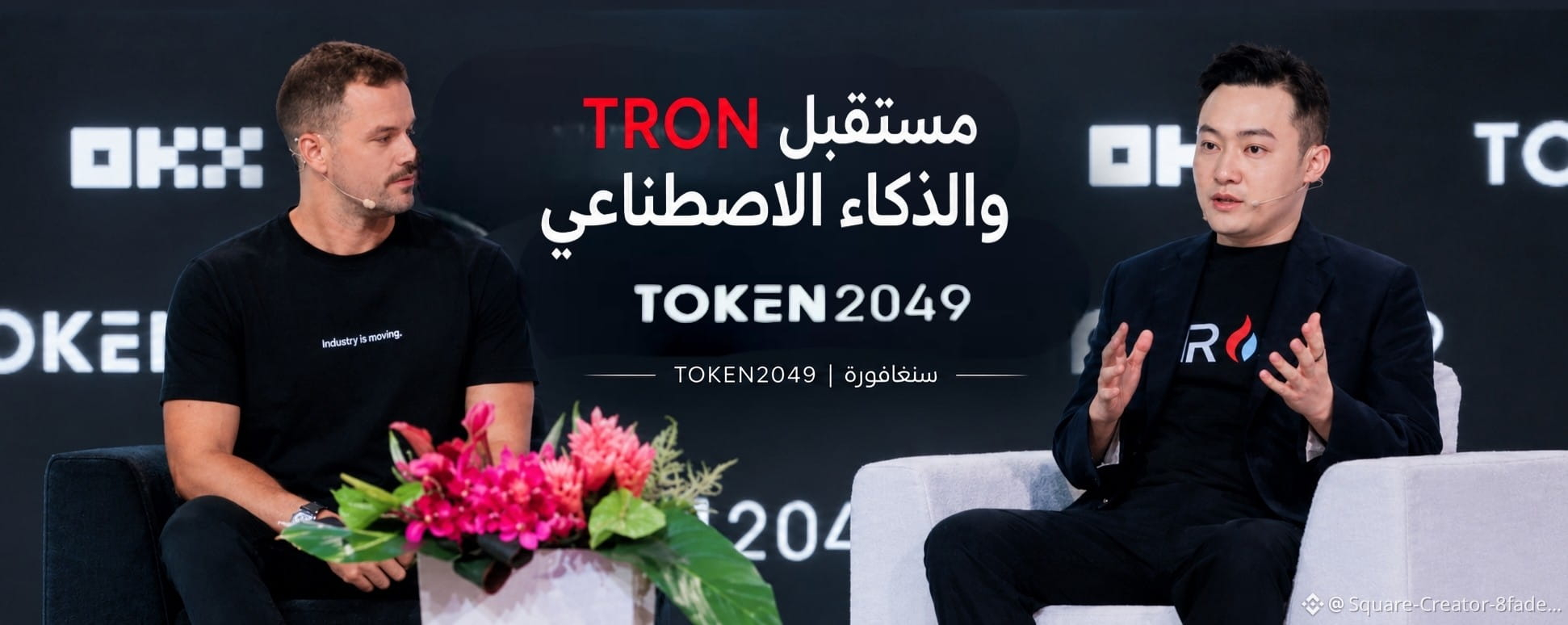

In some conversations, what matters to me is not just what’s said on stage, but the ideas that can be connected to understand the direction technology is heading.
That’s what I found in the conversation between Justin Sun, founder of the TRON network, and Kevin Volonnie, founder of the When Shift Happens podcast, on the main stage at TOKEN2049 Singapore on October 8.
The conversation covered three topics that might seem unrelated at first glance: stablecoins, AI agents, and the Justin Sun Prize for mathematical research. But viewed together, they share a connection worth considering: how do we build technologies that do more than demonstrate their potential—technologies that are usable and dependable?
From everyday transfers to a broader digital economy
When we talk about the TRON network, stablecoins are a key part of the picture, particularly when it comes to transferring money and using it for everyday transactions.
During the conversation, Justin Sun returned to a simple but important idea: people use technology when they find real value in it, not merely because it is new or interesting.
For me, this idea helps us look at blockchain use in a different way. A network’s success depends not only on what it can do technologically, but also on how well it meets real needs—from ease of access to the service to transaction costs and reliability.
As applications continue to evolve, new needs emerge. That is when developing infrastructure becomes essential to keep pace with what users demand.
But what if the user were no longer always a person sitting in front of their wallet and clicking the transfer button?
When AI becomes part of the movement of money
This is the part of the conversation I see as most relevant to what we may witness in the coming years.
AI agents are not just tools that answer questions; they are systems that can carry out specific tasks, access services, purchase computing resources, and even make payments within permissions set by the user.
For these systems to work in practice, they will need more than an intelligent model. They will need infrastructure that is available around the clock, payment methods suited to the transactions software carries out, and clear mechanisms for managing identity and settling transactions.
This is where the idea intersects with TRON’s experience in stablecoin transfers. If AI systems begin carrying out transactions on their own, they will need reliable ways to move value—not just the ability to make decisions.
Justin Sun also mentioned B.AI, a platform for routing AI operations within the TRON ecosystem.
But there’s one point we can’t ignore: giving AI the ability to make payments doesn’t mean giving it unlimited freedom. Permissions and spending limits must be clearly defined, and transactions must be traceable and auditable.
In my view, this aspect matters as much as the technology itself. Moving from systems that assist us to systems that carry out transactions on our behalf requires trust built on clear safeguards, not just promises.
From blockchain to its mathematical foundations
The conversation’s third topic seemed different on the surface, but it adds another dimension to the bigger picture.
On September 16, 2026, the Justin Sun Prize was announced, alongside the release of 66 mathematical problems in the prize’s first batch. The initiative focuses on supporting foundational mathematical research and the formal verification of proofs, while welcoming contributions from independent researchers, teams, and AI systems, with submissions judged on the quality of the work and the rigor of its verification.
This topic may seem far removed from stablecoins and payments, but mathematics and rigorous verification are among the foundations on which many modern technologies, including blockchain, are built.
What I find important here is the focus on what lies behind the applications we use. While we often focus on the end product, there is foundational research whose benefits may not be immediately apparent but can help open up new avenues for future progress.
Justin Sun spoke about the prize as a way to give back to mathematics, which helped build the foundations needed for blockchain technologies.
What stood out to me in this conversation?
For me, the importance of these topics lies not only in each one on its own, but also in the bigger picture that emerges when we consider them together.
Stablecoins are tied to everyday financial needs, AI agents could pave the way for systems that automatically handle payments and tasks, and the Justin Sun Prize supports mathematical research and the rigorous verification of results that could contribute to future technological progress.
This doesn’t mean all these applications are fully realized today. But bringing them together in one conversation highlights the kinds of questions the tech sector is starting to focus on: How do we expand adoption? How do we maintain reliability? And how do we support the foundations that future progress will depend on?
Justin Sun’s remarks also touched on AI’s potential to improve health and deliver broader benefits to people. This adds another dimension to the discussion: technology’s value is measured not only by its capabilities, but also by what it can do when used to solve real problems.
What I believe is worth watching as the TRON network and the digital economy as a whole evolve is how financial infrastructure integrates with more autonomous systems, alongside a continued focus on research, verification, and security.
The future is shaped not by a single idea, but by technologies that can work together and by foundations that make it possible to rely on them.