




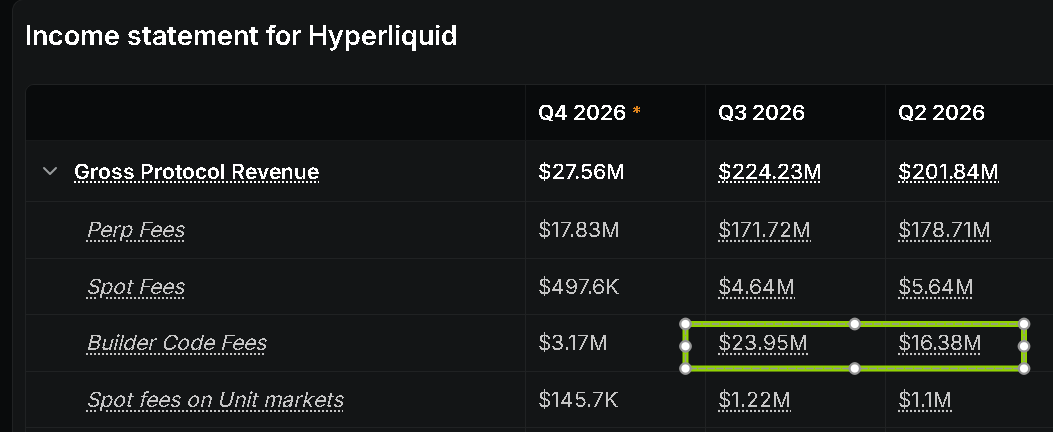
One expense in Hyperliquid’s third-quarter revenue figures stands out for its significant growth: Builder Code Fees rose from $16.38 million in the second quarter to $23.95 million.
That’s an increase of $7.57 million in a single quarter, or about 46.2% quarter over quarter.
To clarify, this money is shared with third-party apps. For example, fomo uses Hyperliquid as the underlying infrastructure for its on-chain contracts. When users trade through fomo, some of the fees go to fomo, while the rest are underlying transaction fees collected by Hyperliquid.
Users stay on the platform they’re familiar with, fomo provides the trading interface, and Hyperliquid handles execution on the backend. Each side has a way to earn fees—a win-win.
1. How this business works
For a platform that already controls users’ wallets or trading experience, offering perpetual trading doesn’t mean it has to build an entire trading market from scratch.
It can tap into Hyperliquid’s existing liquidity markets, allowing it to focus on its own user interface, account experience, and trading tools.
For Hyperliquid, there’s also no need to require every user to visit its own trading page first.
A user might simply open an app they already use to trade (whether or not it’s decentralized), while the order ultimately goes through Hyperliquid.
In Q3, this business generated $23.94 million in fees. Looking at the period of more than a year covered by this table, it has been one of the steadiest performers among Hyperliquid’s businesses.
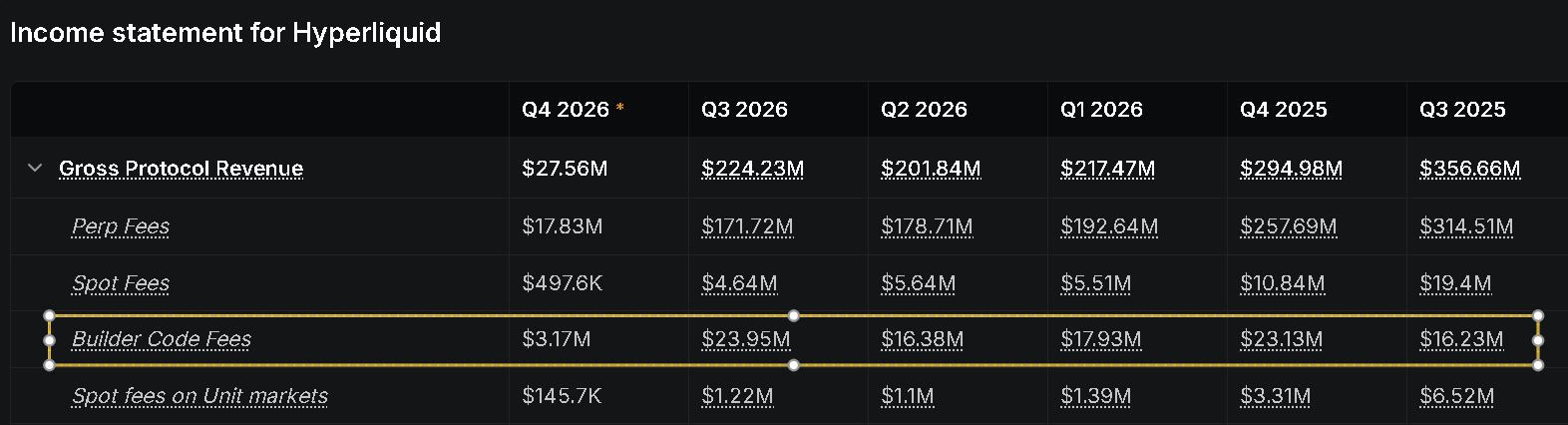
In DeFiLlama’s quarterly table, builder fees appear on both the revenue and cost sides. This also needs some explanation.
It describes who receives the fee: when an app routes trades through Hyperliquid, the app ultimately keeps this additional fee.
This is a different economic arrangement from Hyperliquid using its existing revenue to subsidize developers.
Hyperliquid doesn’t keep any of this additional fee. The protocol earns revenue from the base trading fees generated by trades through these apps. Those fees are included in the protocol’s total contract fees and aren’t broken out separately.
2. Which apps contributed revenue here?
What I find most remarkable is that the apps contributing these fees haven’t remained the same from quarter to quarter.
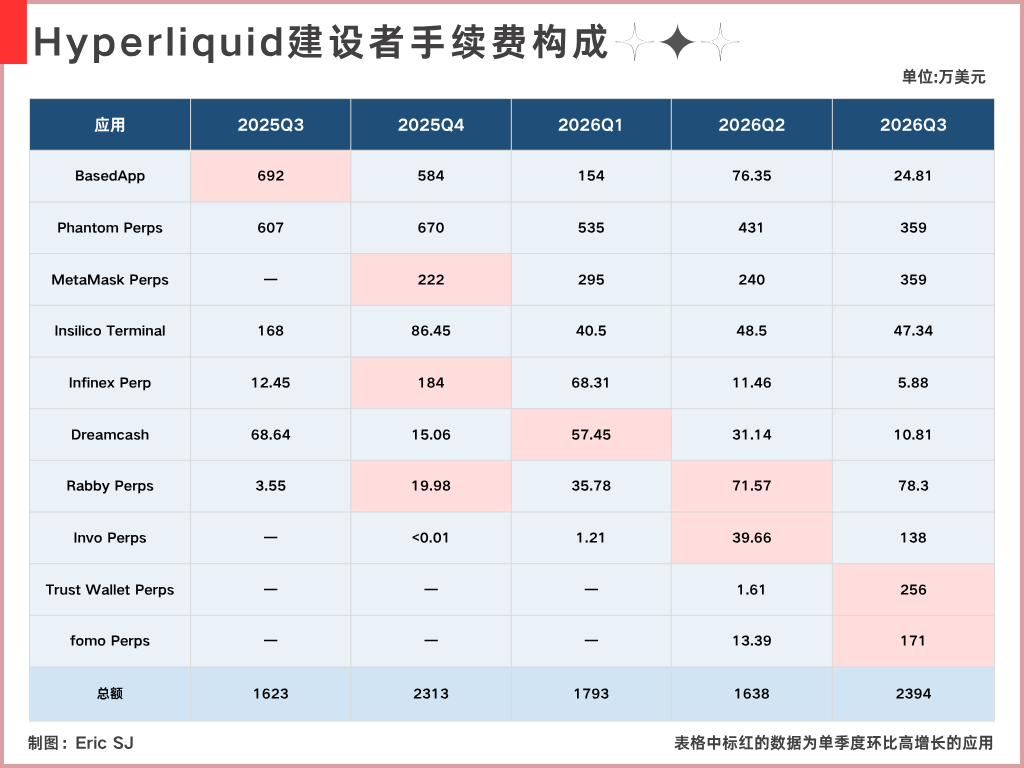
The main increase in builder fees in Q3 came from Trust Wallet, fomo, MetaMask, and Invo;
Trust and Fomo in particular saw remarkable growth quarter over quarter from Q2, while established platforms such as Phantom and Based saw revenue decline quarter over quarter in Q3. In Q3 last year, BasedApp and Phantom generated $6.92 million and $6.07 million in builder fees, respectively—a combined total of about $12.99 million, or 80% of all builder fees that quarter.
By Q3 this year, BasedApp was down to about $248,100, while Phantom had fallen to $3.59 million. Together they generated about $3.84 million, reducing their share of the quarterly total to around 16%.
If Hyperliquid’s business in this area had relied mainly on these two apps over the past year, it would also have faced significant downside pressure.
Fortunately, these fees appear to be in a similar range, even as the mix has continued to change.
This distinction directly affects how we understand the sustainability of the revenue.
If all revenue is tied to one popular app, changes in that app’s popularity will directly drag down revenue, making it vulnerable.
What we can see now is that while revenue from existing apps has declined, other entry points are still increasing their fee volume and growing rapidly.
3. A new revenue stream: a share of USDC reserve yield
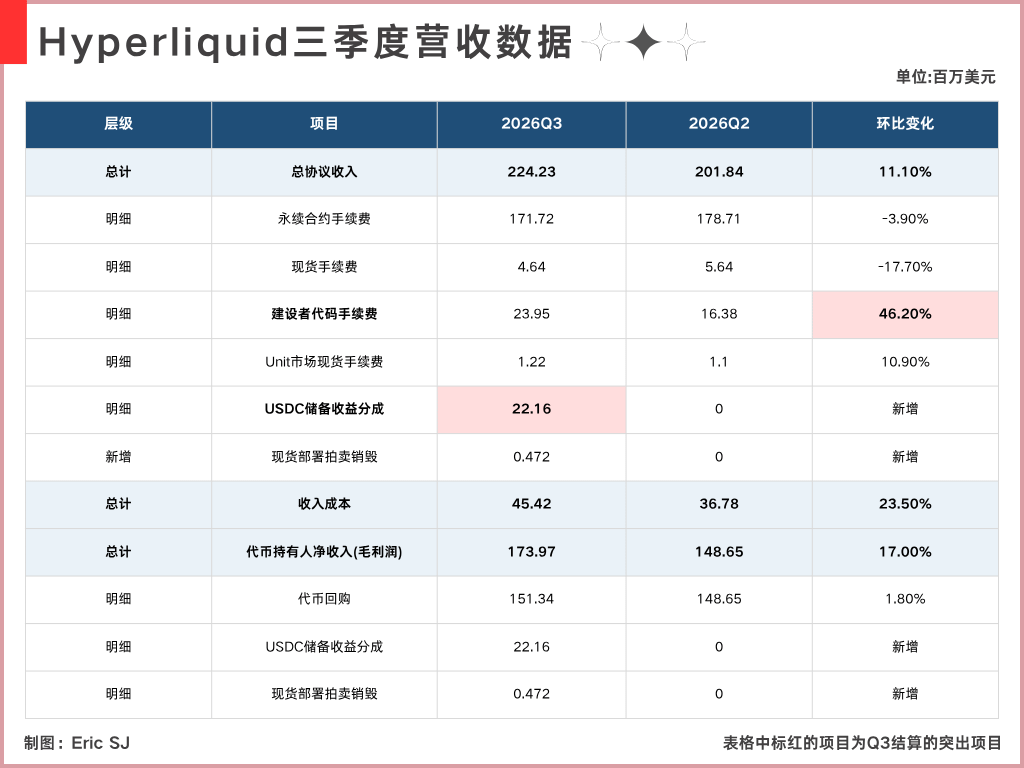
As shown above, Hyperliquid had another new revenue stream in Q3 that the protocol itself can earn from: a share of USDC reserve yield.
In DeFiLlama’s table, this is labeled “AQAv2 · USDC yield.” The amount shown for Q3 is $22.16 million, compared with zero in Q2.
This isn’t an extra fee users pay when they trade. It comes from sharing the yield generated by the dollar reserves backing USDC.
According to the official explanation, the protocol receives about 90% of the reserve yield after cost adjustments. Under the rules, this revenue is transferred to the Assistance Fund to support $HYPE buybacks.
For Hyperliquid and Circle, it’s a win-win as well.
More notably, this new revenue was almost equal to the entire quarter-over-quarter increase in total Q3 revenue.
Excluding this for now, the total revenue shown in the table for Q3 was $202.07 million, up just about 0.1% from Q2—essentially flat. The newly added reserve yield made a clear difference to the quarterly figures.
Overall, in my view, the clearest change for Hyperliquid in Q3 was the significant expansion of its revenue sources.
1. More third-party apps collected more builder fees,
2. The protocol has also started sharing in USDC reserve yield
But there’s a corresponding concern: without these additional sources of revenue (especially the yield on USDC reserves), Q3 revenue would have been trending downward. Crypto markets broadly recovered in Q3, and under normal circumstances, market sentiment should have improved too. Yet core revenue didn’t grow accordingly, which is a somewhat puzzling data point to me.
That’s it.