

The Liquidity Dilemma Facing Privacy Assets
While the market’s attention was fixed on ZEC, whose price had multiplied several times in just a few days, sharp-eyed on-chain investors quietly followed the flow of funds upstream to find the real toll collector behind it.
Dig a little deeper and you’ll find that the one quietly matching orders, clearing and settling trades, and collecting fees behind ZEC is none other than NEAR Protocol, a veteran public blockchain that has now fully transformed.
Major Exchanges Weigh Delistings, Threatening to Cut Off Their Lifeline
Amid mounting regulatory pressure around the world, major exchanges including Binance and OKX have put delisting privacy coins such as ZEC and XMR on the table. These coins are also increasingly becoming a top target for regulators seeking to prevent money laundering.
If major exchanges delist ZEC, not only could existing token holders panic-sell, but the flow of funds into the privacy ecosystem would also be cut off, pushing these assets straight to the edge of a liquidity cliff.
Image source: Binance Square
Insufficient market makers and on-chain funds
Worse still, if Binance were to delist ZEC, institutions involved in ZEC market making might also announce that they were halting liquidity provision out of regulatory concerns, then sell off their privacy token holdings and exit the market-making sector.
On-chain, ZEC’s use of a UTXO chain rather than the EVM chains used by most projects makes it inherently incompatible with market makers in ecosystems such as EVM and Solana. For various reasons, liquidity remains extremely poor even on-chain.
The cumbersome steps involved in traditional cross-chain bridges
To address the isolation problem, ZEC holders who wanted to convert their assets into stablecoins or assets on other major blockchains previously had to rely on highly complex, multi-step third-party cross-chain bridging solutions.
These bridging processes often require users to sign multiple times, wait through lengthy block confirmation periods, and switch back and forth between the wallet ecosystems of different blockchains. They may even have to bear the systemic risk of cross-chain smart contracts being repeatedly hacked and drained of funds.
The architecture and settlement role of NEAR Intents
As privacy tokens like ZEC have gradually been abandoned by the market due to liquidity issues, NEAR has successfully entered the privacy ecosystem through NEAR Intents, a core product in its chain abstraction architecture.
NEAR eliminates all the difficulties associated with traditional cross-chain bridges, instead leveraging external market-making resources and on-chain settlement verification to enable privacy tokens like ZEC to move across chains and trade smoothly.
Eliminating cumbersome cross-chain operations
With the NEAR Intents architecture, users initiating a transaction through the front end do not need to understand the underlying communication protocols or transfer steps of different blockchains. They only need to provide a single digital signature for the desired transaction outcome.
For example, users can explicitly state that they want to exchange a specific amount of Bitcoin, Solana, or a dollar-pegged stablecoin for ZEC. This outcome-oriented, declarative mechanism simplifies the complex asset-locking, gas-fee adjustment, and other steps involved in traditional cross-chain transactions.
An auction-based Solver network takes over market making
When users submit a request, the NEAR ecosystem sends it directly to Solvers for auction-based matching. These Solvers have powerful liquidity aggregation capabilities, allowing them to assess liquidity depth in real time and provide market making.
The selected Solver that offers the best quote uses its own reserves to advance the assets and complete the off-chain routing and matching, ensuring users can execute large exchanges at the most competitive rates.
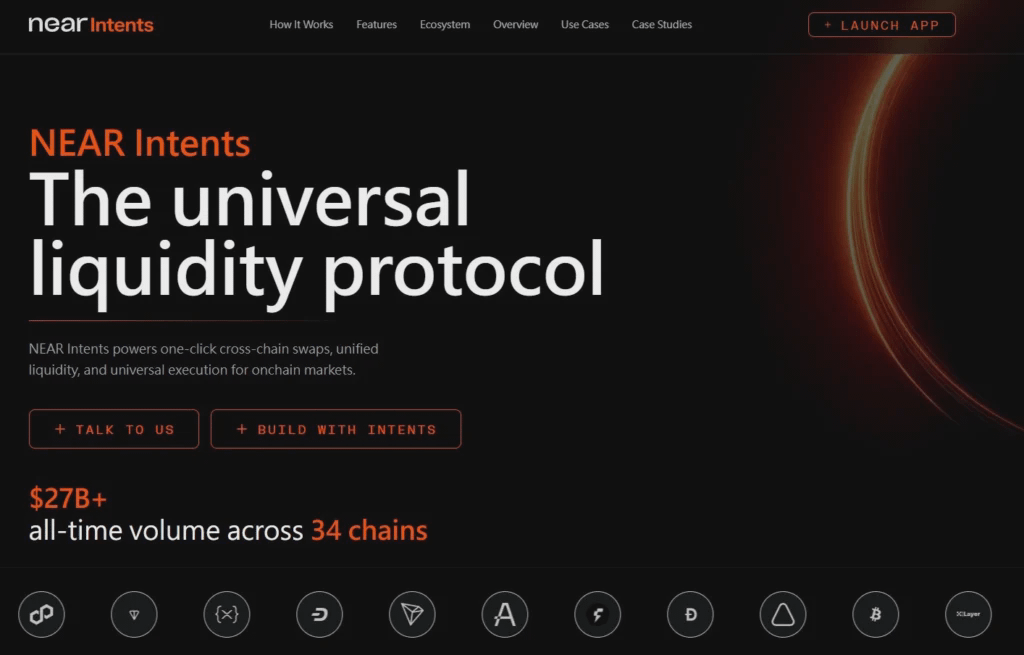
Atomic verification safeguards funds
Although route matching and fund allocation are quickly handled off-chain by competing Solvers, final settlement and confirmation rely heavily on strict oversight by smart contracts on the NEAR chain.
During the final settlement stage, smart contracts on the NEAR chain automatically perform atomic verification, precisely comparing the Solver’s actual asset flows with the transaction originally requested by the user. The settlement contract will only release the funds if the transaction meets the user’s slippage and amount requirements.
This report is for informational purposes only and does not constitute any form of investment advice or basis for making investment decisions. The data, analysis, and opinions cited herein are based on the author’s research and publicly available sources, and may be uncertain or subject to change at any time. Readers should make investment decisions carefully, taking their own circumstances and risk tolerance into account. For further guidance, consider seeking advice from a professional adviser.