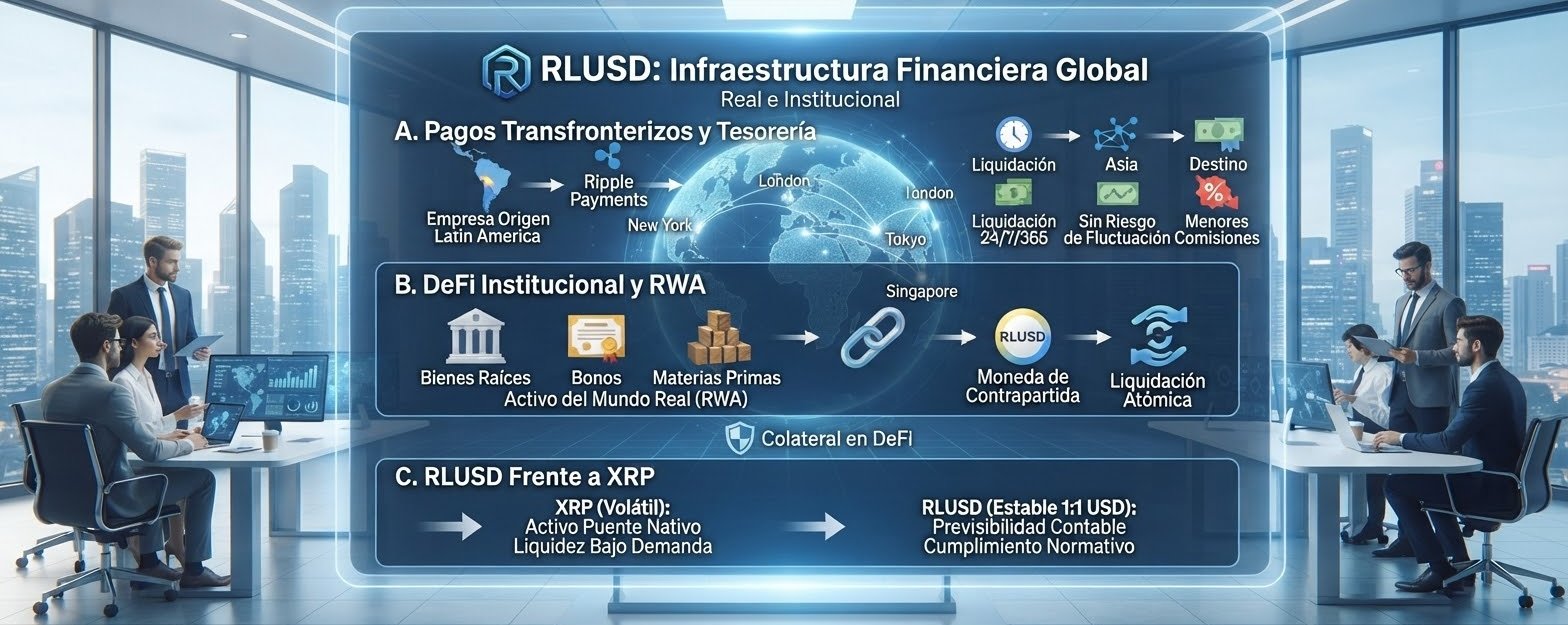

The real value of Ripple USD (RLUSD) lies in transforming traditional financial infrastructure and global corporate flows. Unlike retail stablecoins, RLUSD is integrated into scenarios with high economic and institutional requirements.
A. Cross-Border Payments and Treasury Optimization
The traditional system (like the SWIFT network) is slow, costly, and depends on banking hours. RLUSD eliminates these frictions through two pillars:
24/7/365 Settlement: Remittance transfers and instant settlement of international invoices through Ripple Payments.
Capital Efficiency: Eliminates the need to immobilize funds in pre-funded accounts (nostro/vostro) abroad.
B. Institutional DeFi and Real-World Assets (RWA)
Tokenizing bonds, real estate, and commodities requires regulated financial bridges. RLUSD operates on two key fronts:
Settlement Currency: Works as the ideal counterparty for the atomic buy-sell of RWA tokens.
Regulated Collateral: Provides the legal certainty needed to back loans in institutional DeFi markets.
C. Functional Distinction: RLUSD vs. XRP
FeatureXRPRLUSDNatureDecentralized native asset. Dollar-pegged stablecoin (1:1).Main FunctionOn-demand liquidity bridge. Accounting predictability and compliance.Risk ProfileMarket volatility. Stable value and 100% audited.
Block Infographic
[Insert your image here: image_0.png]
Legend: Institutional use cases for RLUSD: payment optimization, RWA settlement, and its coexistence with XRP.
Conclusion
The utility of RLUSD goes beyond retail exchanges. By resolving bottlenecks in international payments and serving as a cog for RWAs, it positions itself as the ultimate tool for enterprise-wide mass adoption.
📱 Social Media Outreach Kit
How does #RLUSD redefine the global financial infrastructure? 🏦🔗
Beyond trading, Ripple’s stablecoin transforms cross-border payments and powers Real-World Assets (#RWA) in institutional DeFi.
We analyze their real use cases and their key difference versus #XRP . 👇#Ripple #Fintech #Tokenizacion #Blockchain $RLUSD $XRP