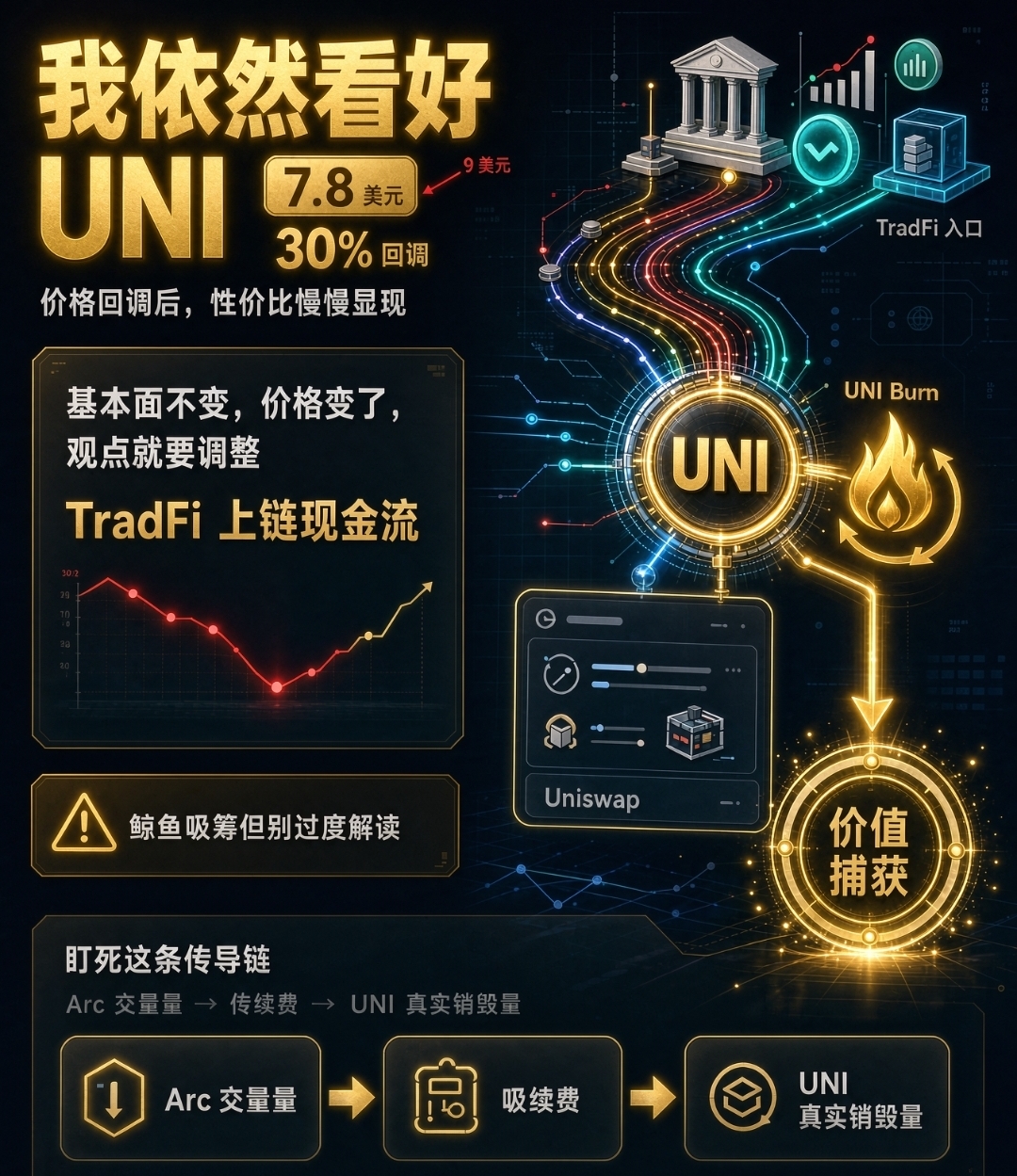
When UNI was at $9, I did think it was expensive—a market cap of $8 billion felt like a full valuation for a DeFi veteran. But now that the price has fallen back to around $7.80, down 30% from its peak, my view has changed accordingly.
This has made me even more certain of one principle: a project’s quality and whether you’re paying too much for it are two separate questions. When the fundamentals stay the same but the price changes, the valuation changes, and of course your view should adjust accordingly. Stubbornly clinging to a judgment isn’t faith—it’s fixation.
On the concern about “bundling the Robinhood chain”
Many people attribute UNI’s recent drop to its close ties with Robinhood Chain—if the RH chain loses steam, UNI is doomed too. I don’t agree with this linear reasoning.
Look at it from another angle: it’s precisely this “connection” that gives UNI a potential source of scarcity—it can capture cash flows from TradFi assets moving on-chain.
Trading fees generated by the Uniswap protocol are already flowing back to UNI holders through the burn mechanism. More importantly, if fees from every version of Circle’s Arc ecosystem—v2, v3, and v4—can be integrated, then every transaction on Arc involving stablecoin settlements, institutional asset transfers, or tokenized real-world assets (RWA) could, in theory, contribute to ongoing UNI burns.
This isn’t wishful thinking. It’s a paradigm shift from a “governance token” to a “cash-flow token.”
Three data points matter more than any prediction
I’m not going to hype up how much revenue Arc could bring in right now—that wouldn’t be responsible. What’s really worth watching closely is this flow-through chain:
Arc on-chain trading volume → fees actually collected → actual amount of UNI burned
All three steps have to work; if even one link is missing, the thesis falls apart. The first two steps need to be in place before the third matters. So rather than listening to people make grand promises, check the on-chain trends in these three metrics regularly.
Holder composition: accumulation is happening, but don’t read too much into it
On-chain data shows that whale addresses have accumulated approximately 1.13 million UNI since September 28. In addition, one large holder previously invested about $24.2 million to buy 3.125 million UNI.
But we need to deduplicate the data here: these 3.125 million tokens are actually held across five wallets controlled by the same person, so they shouldn’t be counted as five independent bullish holders. One of the most common mistakes in on-chain analysis is treating split addresses as new participants.
More importantly, even after accounting for this accumulation, the whale group’s total holdings are still below their level in early September. This suggests that holdings have not truly reconcentrated yet, and the holder base is still being shaken out. In the short term, we’ll likely see more choppy bottoming.
My core view
There’s only one reason UNI is truly worth betting on:
Can real trading volume from traditional finance enter the Uniswap ecosystem at scale? And once it does, what proportion can accrue to UNI through the burn mechanism?
Once this chain of events is in place, the logic behind UNI’s value capture will be completely rewritten—from a token “propped up by liquidity mining and governance narratives” to an asset “backed by real protocol revenue.” At that point, a market cap in the tens of billions of dollars would be entirely plausible.
Until then, I won’t make buy calls; I’ll just keep watching.