
#uni
uni
8.8M views
31,854 Discussing
Hot
Latest

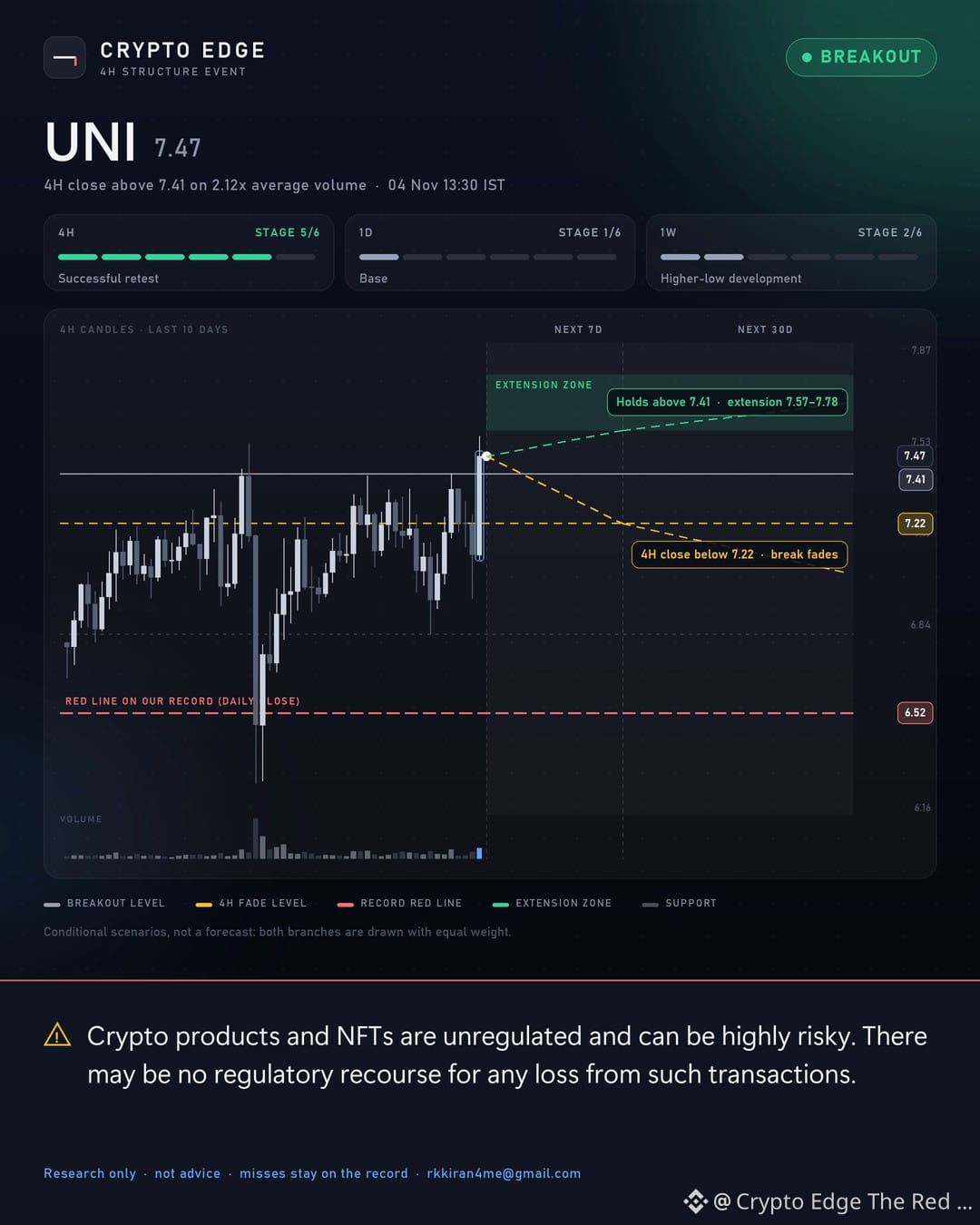
$UNI is pushing through resistance on the 4H chart 👀
Price is around 7.47, after a 4H close above 7.41 on about 2.1x its usual volume. That level matters because price turned lower there before, so I'm watching whether it holds rather than chasing the move.
If #UNI holds above 7.41, the chart suggests room toward the 7.57–7.78 area. If it slips back under 7.22 on a 4H close, the break has failed and a pullback toward 6.81 could follow.
On the record, UNI's setup is still judged on one line only: a daily close below 6.52.
Real break or fakeout on UNI? Drop your read 👇
Research, not advice. #CryptoEdge #MarketStructure
Full track record: https://cryptoedge-therecord.rkkiran4me.workers.dev
1
622

·
--

Article
UNI is not just a DeFi token. ItUNI is not just a DeFi token. It represents voting power over one of crypto's largest decentralized trading protocols.
But here's the overlooked tradeoff: public blockchain voting does not automatically mean equal influence. That's not an oversight. It's a structural choice.
Uniswap prioritizes transparent governance, allowing UNI holders to vote on protocol changes, treasury allocations, and fee parameters. Yet voting power depends on token holdings and delegation. Smaller holders can participate, but their influence may be limited.
The mechanism is publicly verifiable. Governance proposals, voting results, token supply, and execution contracts can be examined onchain. Anyone can independently track decisions without relying entirely on private reports.
However, transparency has its limitations. Public voting records reveal who holds influence and how decisions are made, but they don't guarantee broad participation or independent control. There is no periodic auditor certifying that governance influence is fairly distributed.
Compare AAVE, which also uses public governance, Snapshot discussions, onchain voting, and execution safeguards. More procedural transparency, in exchange for additional complexity.
Neither approach removes counterparty risk. Uniswap relies on transparent, token-weighted governance. AAVE relies on a similarly public system with additional governance stages and safeguards.
Both expose decisions to scrutiny, but neither guarantees decentralization in practice.
Which risk worries you more: concentrated voting power in a transparent system, or trusting governance safeguards that remain depe
ndent on people? #UNI $UNI
UNI is not just a DeFi token. It
UNI is not just a DeFi token. It represents voting power over one of crypto's largest decentralized trading protocols.
But here's the overlooked tradeoff: public blockchain voting does not automatically mean equal influence. That's not an oversight. It's a structural choice.
Uniswap prioritizes transparent governance, allowing UNI holders to vote on protocol changes, treasury allocations, and fee parameters. Yet voting power depends on token holdings and delegation. Smaller holders can participate, but their influence may be limited.
The mechanism is publicly verifiable. Governance proposals, voting results, token supply, and execution contracts can be examined onchain. Anyone can independently track decisions without relying entirely on private reports.
However, transparency has its limitations. Public voting records reveal who holds influence and how decisions are made, but they don't guarantee broad participation or independent control. There is no periodic auditor certifying that governance influence is fairly distributed.
Compare AAVE, which also uses public governance, Snapshot discussions, onchain voting, and execution safeguards. More procedural transparency, in exchange for additional complexity.
Neither approach removes counterparty risk. Uniswap relies on transparent, token-weighted governance. AAVE relies on a similarly public system with additional governance stages and safeguards.
Both expose decisions to scrutiny, but neither guarantees decentralization in practice.
Which risk worries you more: concentrated voting power in a transparent system, or trusting governance safeguards that remain depe
ndent on people? #UNI $UNI
365
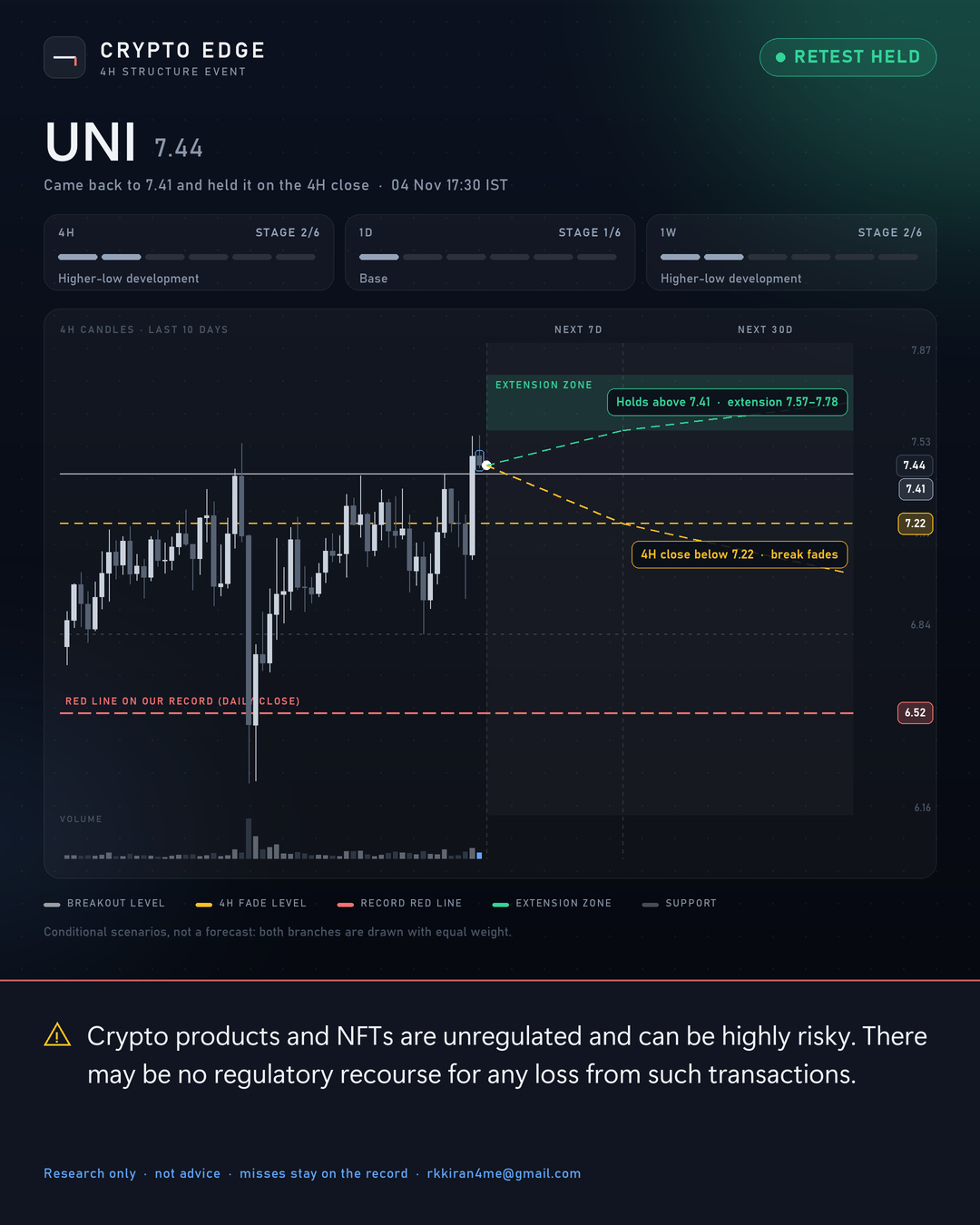
$UNI came back to retest its 4H breakout - and held 👀
Price dipped back to around 7.41 - the level it broke through - and the 4H candle closed back above it at 7.44. That's the retest holding, which is what I wanted to see instead of a quick fade.
If #UNI keeps closing above 7.41, the 7.57–7.78 area is the next zone on the chart. A 4H close back under 7.22 would turn this into a fade.
On the record, UNI's setup is still judged on one line only: a daily close below 6.52.
Original breakout post: https://www.binance.com/square/post/384566668684675
Level held - does UNI print a new higher high from here? 👇
Research, not advice. #CryptoEdge #MarketStructure
Full track record: https://cryptoedge-therecord.rkkiran4me.workers.dev
78

·
--
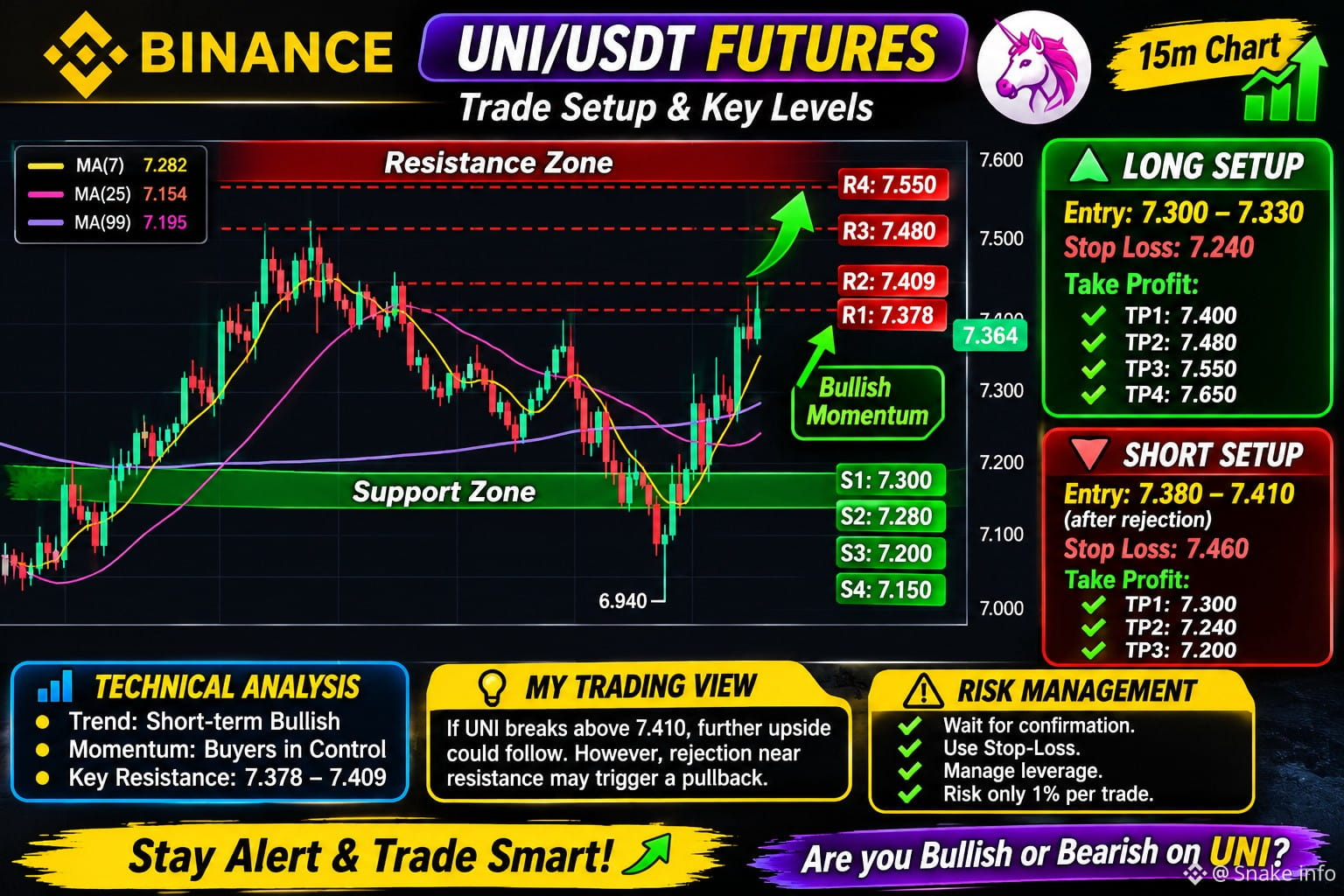
🚀$UNI /USDT FUTURES TRADE SETUP | BULLISH MOMENTUM! 🔥
$UNI is showing strong buying pressure on the 15-minute chart. Bulls are attempting to push the price toward the next resistance zone. 📈
💰 Current Price: 7.364 USDT
🟢 LONG TRADE SETUP
Entry Zone: 7.300 – 7.330
Stop Loss: 7.240
🎯 LONG TARGETS
TP1: 7.400
TP2: 7.480
TP3: 7.550
TP4: 7.650
🔴 SUPPORT LEVELS
S1: 7.300
S2: 7.280
S3: 7.200
S4: 7.150
⚠️ RESISTANCE LEVELS
R1: 7.378
R2: 7.409
R3: 7.480
R4: 7.550
🔻 ALTERNATIVE SHORT SETUP
Entry: 7.380 – 7.410 (only after bearish rejection)
Stop Loss: 7.460
TP1: 7.300
TP2: 7.240
TP3: 7.200
📊 TECHNICAL ANALYSIS
Timeframe: 15 Minutes
MA7: 7.282
MA25: 7.154
MA99: 7.195
Trend: Short-term bullish
Momentum: Buyers currently in control.
🔥 MY TRADING VIEW:
If UNI breaks above 7.410 with strong volume and confirms the breakout, further upside could follow.
However, rejection near resistance could trigger a short-term pullback.
⚠️ Always use stop-loss protection and manage leverage carefully. Wait for confirmation before entering.
💬 ARE YOU BULLISH OR BEARISH ON UNI?
#UNI #UNIUSDT #BinanceFutures #CryptoTrading
CLICK TO BELOW TRADE👇
$UNI
{future}(UNIUSDT)
🚀$UNI /USDT FUTURES TRADE SETUP | BULLISH MOMENTUM! 🔥
$UNI is showing strong buying pressure on the 15-minute chart. Bulls are attempting to push the price toward the next resistance zone. 📈
💰 Current Price: 7.364 USDT
🟢 LONG TRADE SETUP
Entry Zone: 7.300 – 7.330
Stop Loss: 7.240
🎯 LONG TARGETS
TP1: 7.400
TP2: 7.480
TP3: 7.550
TP4: 7.650
🔴 SUPPORT LEVELS
S1: 7.300
S2: 7.280
S3: 7.200
S4: 7.150
⚠️ RESISTANCE LEVELS
R1: 7.378
R2: 7.409
R3: 7.480
R4: 7.550
🔻 ALTERNATIVE SHORT SETUP
Entry: 7.380 – 7.410 (only after bearish rejection)
Stop Loss: 7.460
TP1: 7.300
TP2: 7.240
TP3: 7.200
📊 TECHNICAL ANALYSIS
Timeframe: 15 Minutes
MA7: 7.282
MA25: 7.154
MA99: 7.195
Trend: Short-term bullish
Momentum: Buyers currently in control.
🔥 MY TRADING VIEW:
If UNI breaks above 7.410 with strong volume and confirms the breakout, further upside could follow.
However, rejection near resistance could trigger a short-term pullback.
⚠️ Always use stop-loss protection and manage leverage carefully. Wait for confirmation before entering.
💬 ARE YOU BULLISH OR BEARISH ON UNI?
#UNI #UNIUSDT #BinanceFutures #CryptoTrading
CLICK TO BELOW TRADE👇
$UNI
1
56
·
--
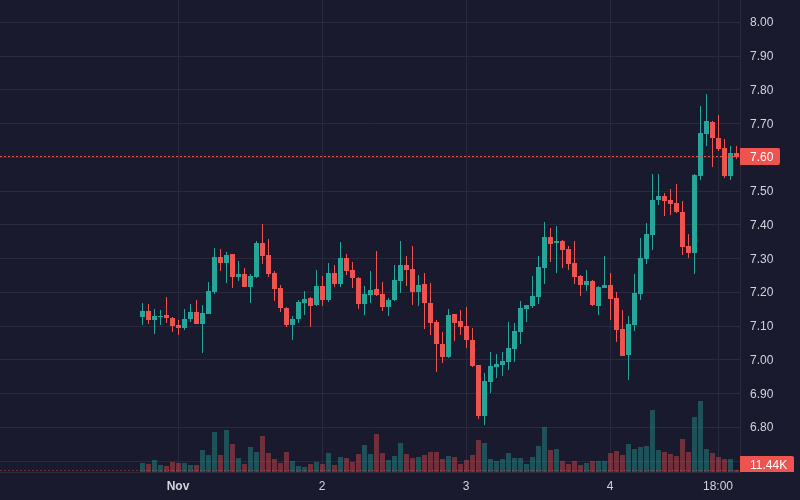
$UNI UNI is showing bullish movement: 5.25% (Crypto).
Volume: 64.90M | Last: $7.60
Key signals: strong momentum, high volatility, high trader activity.
Bias Daily: BULLISH 🟢 | Weekly: BULLISH 🟢
UNI gained 4.37% over 24h, reaching a $7.70 high before cooling to $7.55 amid milestone trading volumes.
**Milestone volume & deployment (High)**: Processed $20B+ in all-time Stock Token volume alongside the StablePair Hook launch → bolstered protocol leadership and DeFi sentiment
- **Institutional accumulation (Medium)**: Whale withdrew 521,501 UNI (~$3.69M) from a major CEX → curtailed circulating float
- **Spot capital expansion (Medium)**: Cumulative 24h net inflow of +$9.1M, highlighted by an hourly +$6.2M surge → pushed UNI from $7.01 to a peak of $7.70
#UNI #BinanceIncidentReport #BinanceSquare #TRUMP #Crypto
5

·
--
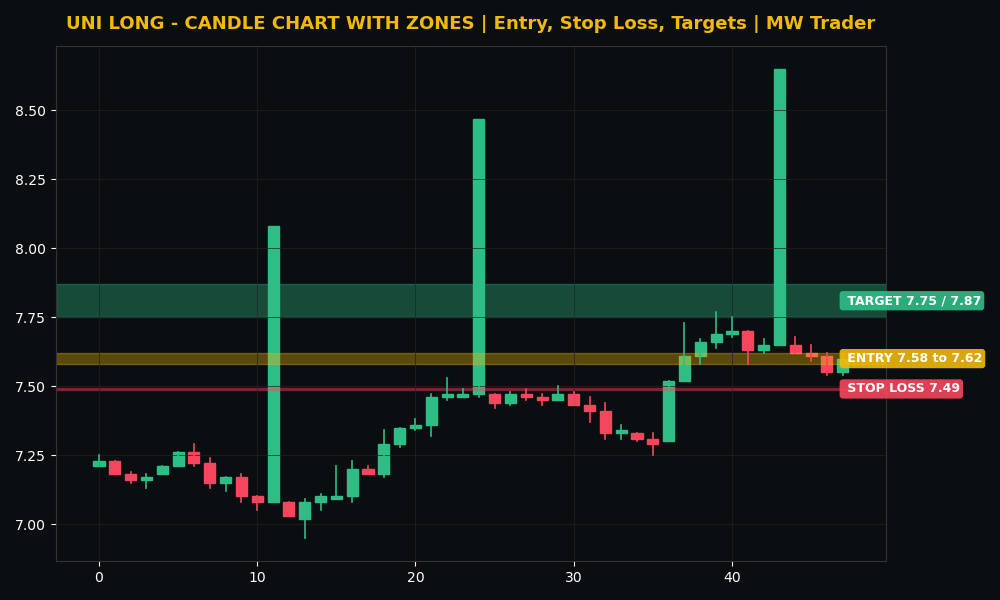
$UNI #UNI 🚀
Direction: LONG
Entry zone: 7.58 to 7.62
Stop loss: 7.49
Target 1: 7.75
Target 2: 7.87
Uniswap is trading near 7.60 dollars, up 4.96 percent in 24 hours, inside a range of 6.95 to 7.77, and the recent closes show a push that held, 7.62, then 7.61, then 7.55, then 7.60. 📈 My reading is that UNI fits the DeFi led bounce, because it rose with the sector instead of alone, and it held near the middle of its range after the move. A long from the current zone, with a stop below 7.49, targets 7.75 first and then 7.87 if DeFi strength continues. A fall below 7.49 kills the idea without debate.
Futures trading is risky. Trade small, use a stop loss, and do your own research. This is my reading, not a guaranteed signal.
Does Uniswap rise to 7.75 first, or fall below 7.49? 🤔
Follow for more trades.
#UNI #Crypto #FuturesTrading #TradingSignals

·
--
$UNI looks ready to go higher from here
RSI is at 62 so buyers have room to run 🚀
Buy $UNI 7.5412 to 7.6297
SL 7.1960
Targets 8.2360 / 8.6520 / 9.2760
Up 5.2 percent today and holding strong near the top
Price is in the zone right now
Tap $UNI to buy
Last 7 days of my calls, 40 hit target and 59 hit stop
Taking it or watching it
#UNI #TradingSignals
3


·
--
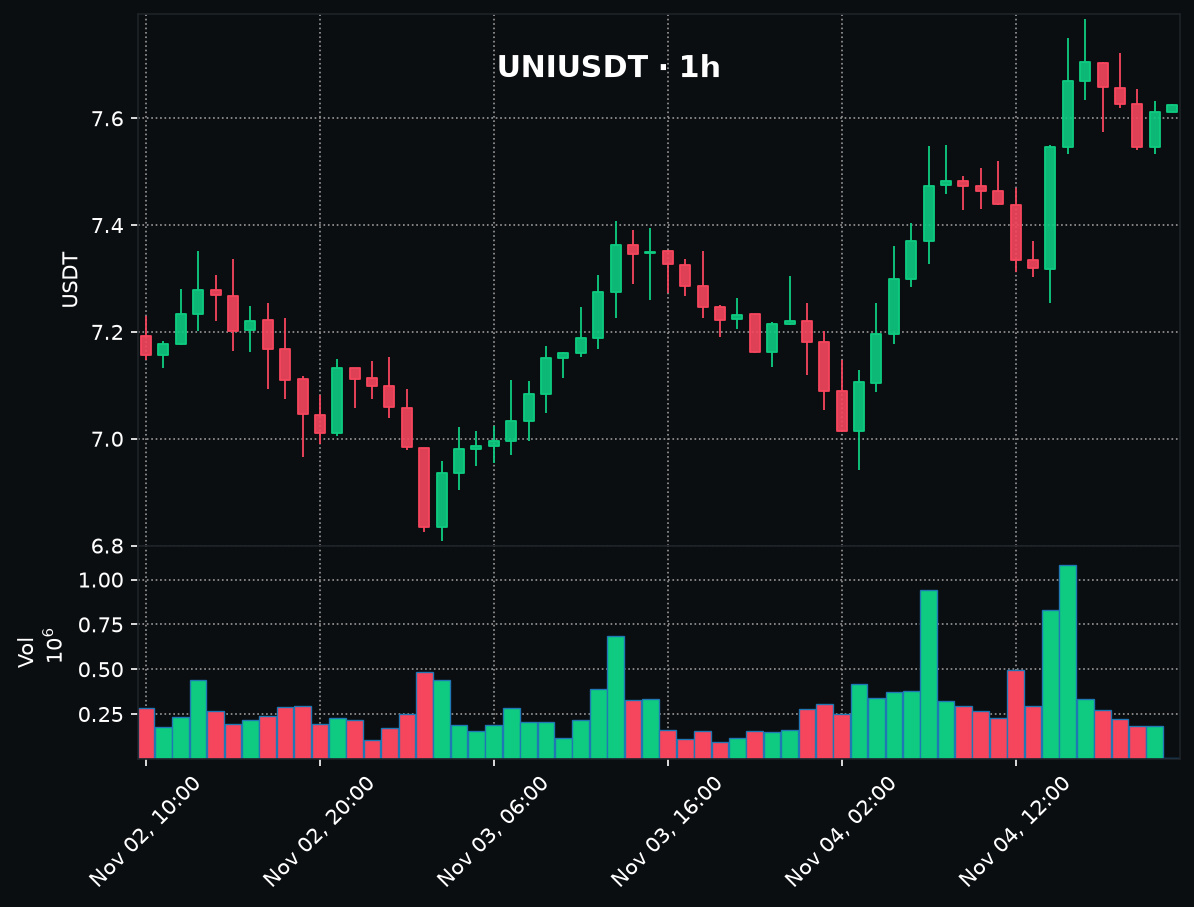
$UNI - 6% rally stalls at range top, RSI still has room but volume drying up
1h · RSI 59.1 · price 7.617 (+6.34%)
Support 7.255
Resistance 7.785
24h range 6.941-7.785
Invalidation: 1h close above 7.785
The bounce looks corrective not impulsive - BTC leading but UNI lagging on relative strength.
$BTC
#TechnicalAnalysis #UNI
1h · RSI 59.1 · price 7.617 (+6.34%)
Support 7.255
Resistance 7.785
24h range 6.941-7.785
Invalidation: 1h close above 7.785
The bounce looks corrective not impulsive - BTC leading but UNI lagging on relative strength.
$BTC
#TechnicalAnalysis #UNI
34

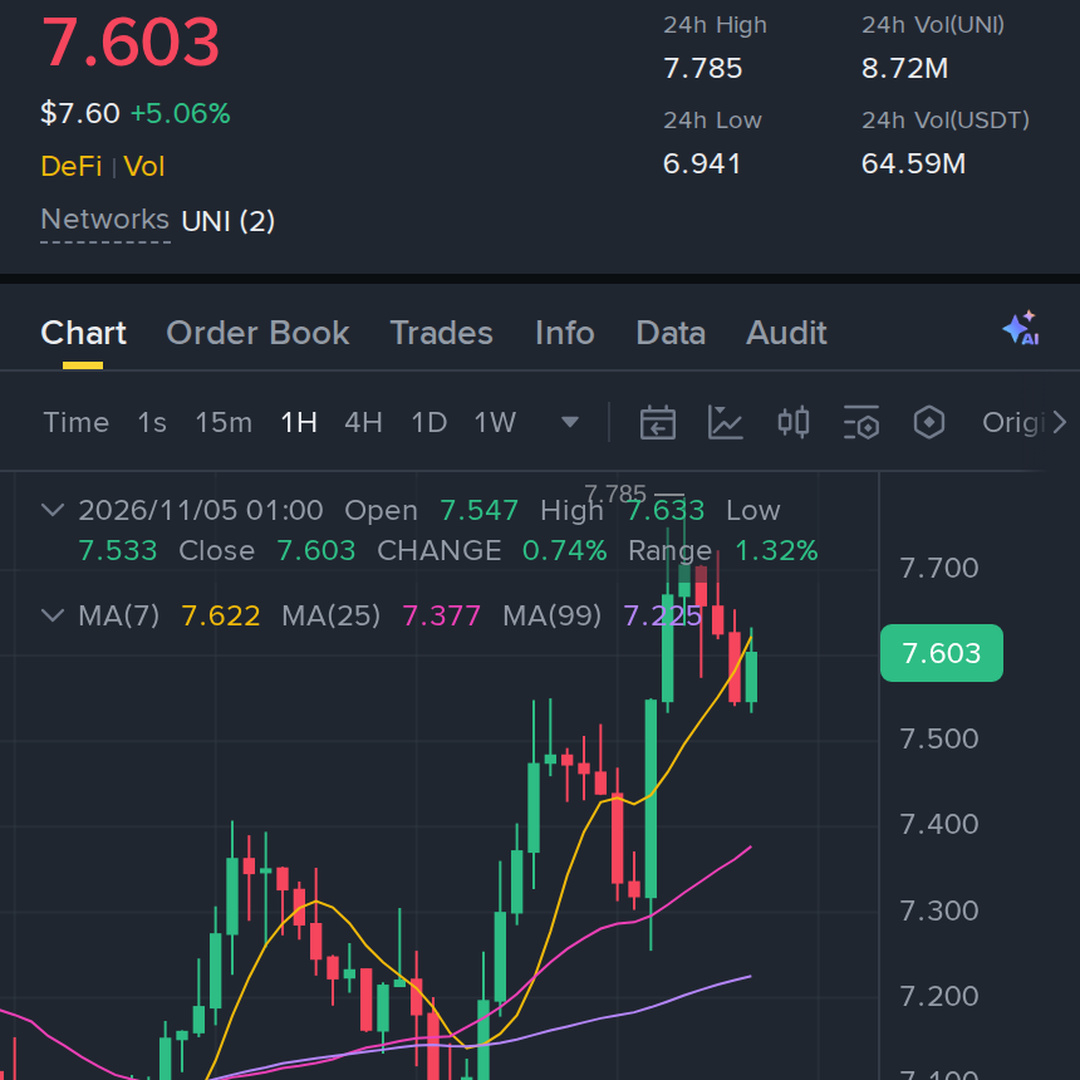
alright, $UNI gave a controlled pullback and the trend is trying to continue, keeping this one around 47x
Entry: 7.572–7.612
TP1: 7.858 / TP2: 8.085 / TP3: 8.351
Stop Loss: 7.226
#UNI #Crypto #Write2Earn #binance
alright, $UNI gave a controlled pullback and the trend is trying to continue, keeping this one around 47x
Entry: 7.572–7.612
TP1: 7.858 / TP2: 8.085 / TP3: 8.351
Stop Loss: 7.226
#UNI #Crypto #Write2Earn #binance
Entry: 7.572–7.612
TP1: 7.858 / TP2: 8.085 / TP3: 8.351
Stop Loss: 7.226
#UNI #Crypto #Write2Earn #binance
90

·
--
$UNI +5.03% | $SNDKB -7.55% | $SUI +2.81%
#UNI’s price nudged up to $7.58, pulling $64.6 M in volume as the Uniswap governance token enjoys a 5.03% gain.
#SNDKB slipped to $1,028.74, with volume at $62.0 M despite a 7.55% decline, suggesting traders are still active on the downside.
#SUI rose modestly to $0.9190, attracting $47.7 M of flow and a 2.81% uptick, reflecting steady interest in the Mysten Labs Layer 1.
👀 Watch the divergence between UNI’s strong volume boost and SNDKB’s pullback; the contrast may hint at shifting liquidity preferences among DEX‑related assets.
#Write2Earn #Binance
5
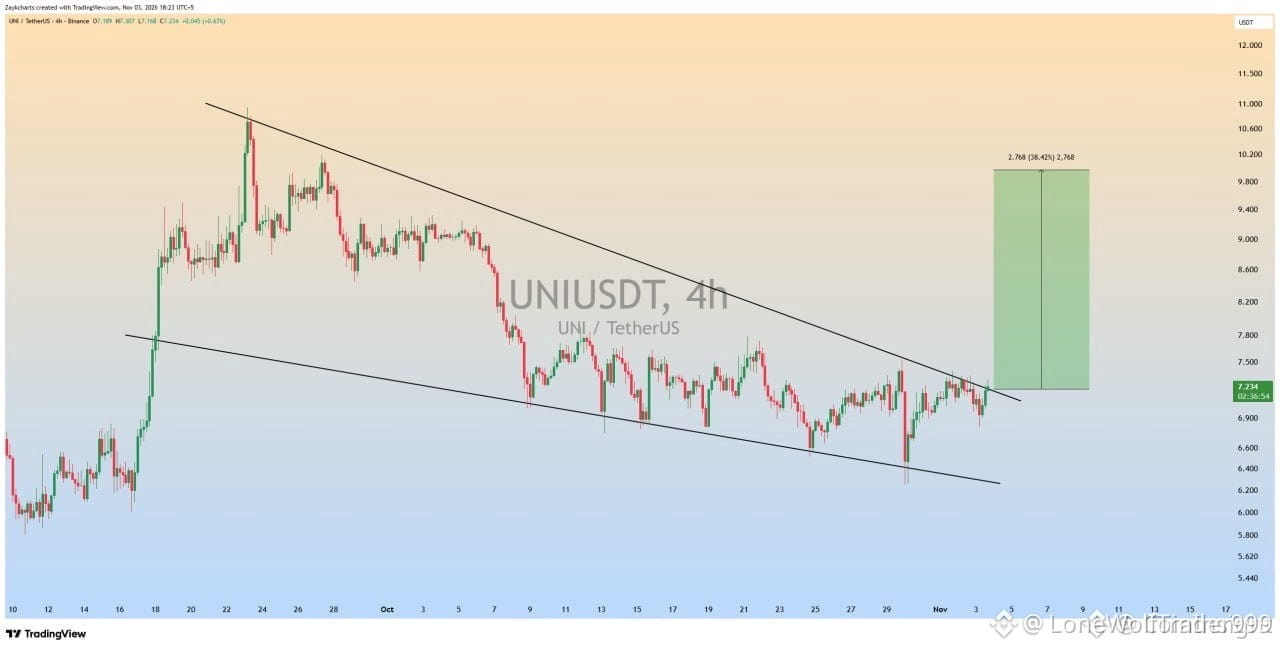
🚀 $UNI FALLING WEDGE READY TO BREAKOUT ON 4H! 📈
The 4H chart has sealed a clean falling wedge, and every volume spike 📊 is a whisper that smart‑money 🦈 is loading up for the next push.
With buyers already testing the upper trendline, a bullish wave could erupt ⚡, flipping the wedge into a steep ascent 📈. 💬 What’s your entry plan for $UNI ?
⚠️ Not financial advice. Always manage your risk. 🛡️
🏷️ #UNI #BullishSetup #FallingWedge #Crypto
🚀 ⚡

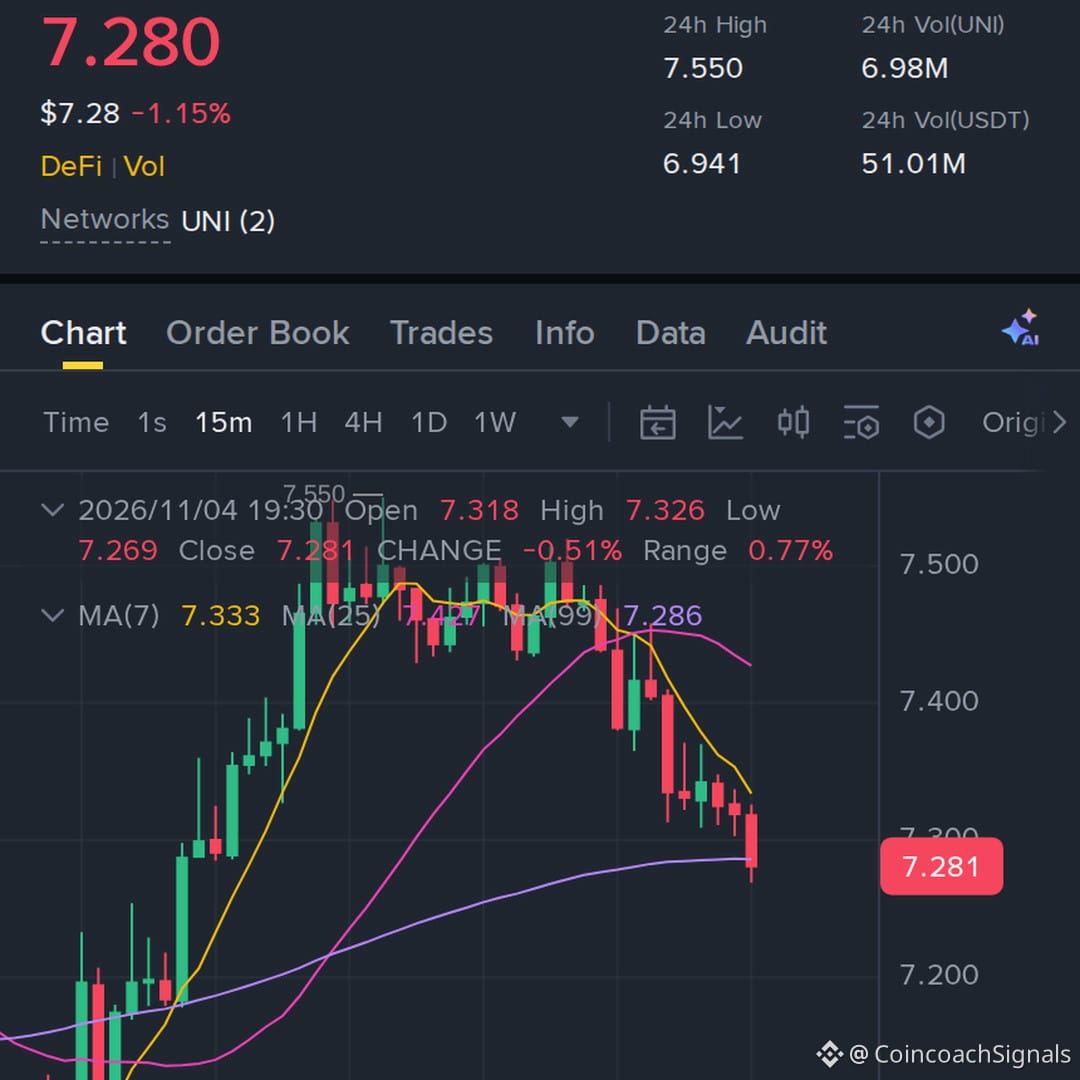
🚀 $UNI REBOUND AFTER security incident SINK, NEW BUY ZONE EMERGES! 🦈
Entry: $7 ⚡
📊 The $7 order block has absorbed the post‑security incident sell‑off, acting as a fresh liquidity bucket for smart money. 🦈 With the price now reclaiming pre‑event ranges, the market structure is flipping higher, hinting at a potential 42% upside on the next swing. 📈 If the current support holds, we could see a higher low forming on the 4H, tightening the bullish bias.
💬 Do you see $UNI cementing a new higher low, or is the next pullback looming? 👇
⚠️ Not financial advice. Always manage your risk. 🛡️
🏷️ #UNI #LongSetup #BuyTheDip #Crypto
🔥 💎

4

·
--
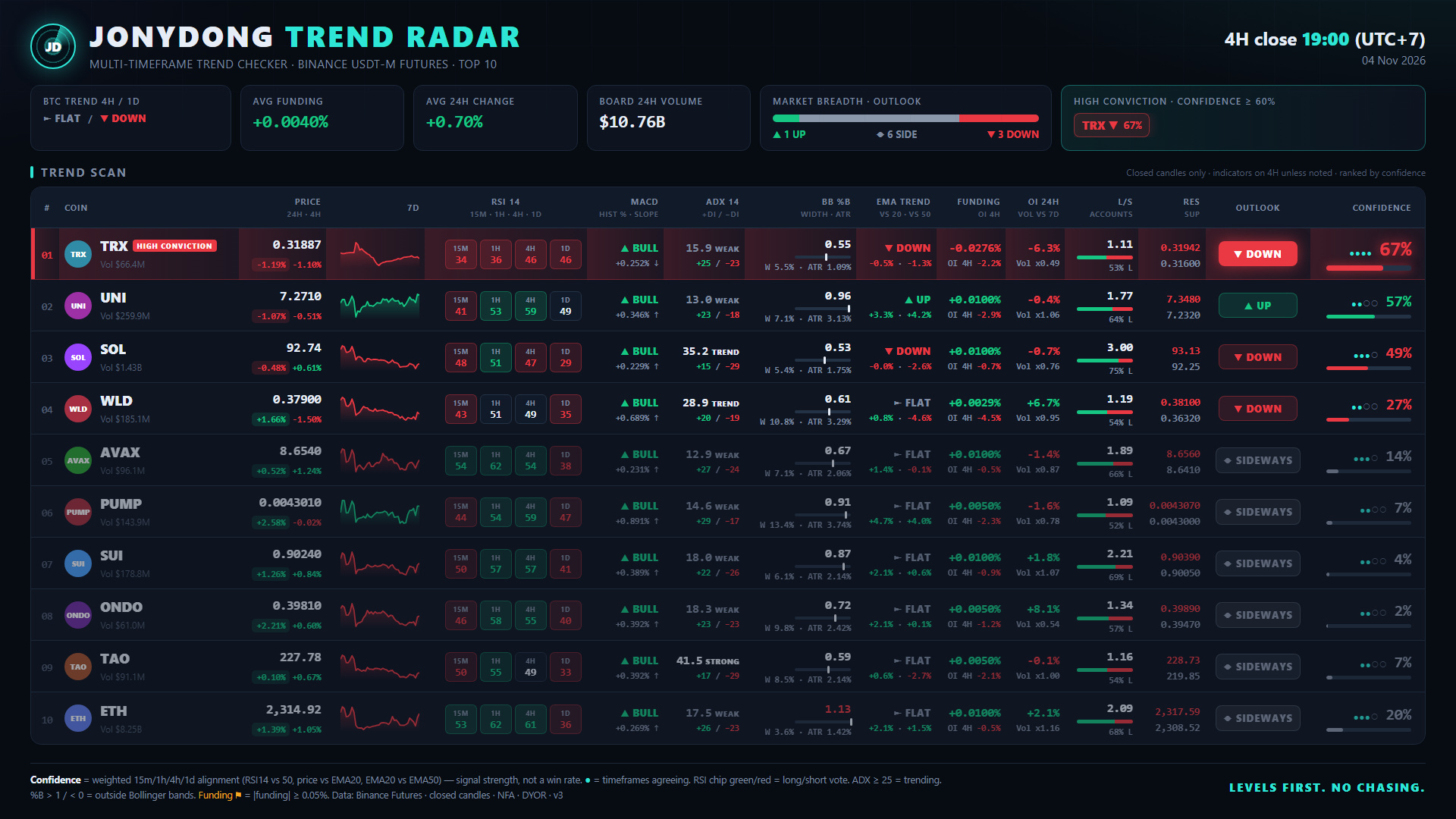
🚨 $UNI & $SUI ORDER MISHAP THAT LEFT MY ACCOUNT IN RED! ⚡
The morning buzz around $UNI was electric, volume spiking and the order book lighting up like a runway. I rode that surge without a second thought, letting adrenaline dictate the entry. 📊
Then I flipped the capital allocation, pouring cash into $SUI first. The whale‑level liquidity sweep hit hard, reversing the trade direction and draining my margin in seconds. 🦈⚡
Lesson learned: discipline beats hype. Align your capital flow with market hierarchy or watch your P&L bleed red. 💡
💬 Did you ever get caught in a similar order‑timing trap?
⚠️ Not financial advice. Always manage your risk. 🛡️
🏷️ #UNI #SUI #Discipline #TradeSetup #Crypto
🔥 💎
6

·
--
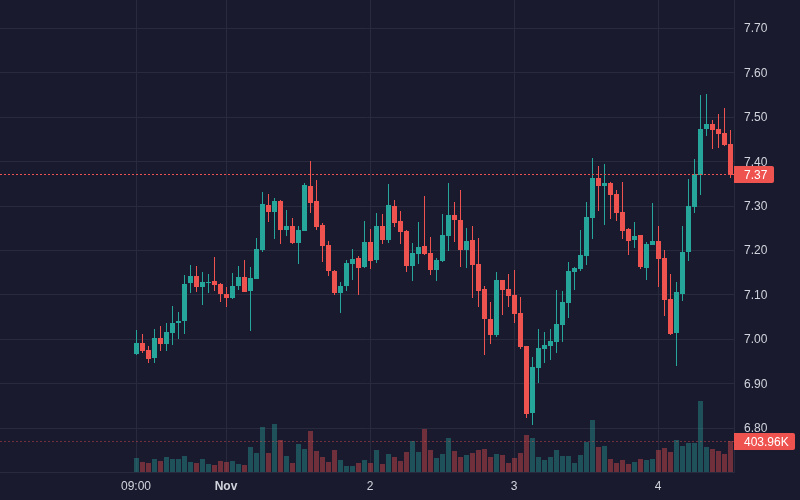
$UNI UNI is showing bullish movement: 1.04% (Crypto).
Volume: 53.37M | Last: $7.37
Key signals: high trader activity.
Bias Daily: BULLISH 🟢 | Weekly: BULLISH 🟢
UNI gained 6.0% from intraday lows to $7.44 in 24h, driven by massive whale inflows and ecosystem growth.
**Institutional and whale accumulation (High)**: A newly tracked wallet withdrew 521,501 UNI (~$3.69M) from an exchange → triggered a surge of +$6.2M net inflow and +$4.25M large orders.
- **Ecosystem volume expansion (High)**: Rising adoption in tokenized equity and StablePair Hook deployment on X Layer bolstered demand → volume expanded past $14.7M on the breakout.
- **Bullish momentum breakout (Medium)**: Price crossed above the 7/25/99 EMA stack, lifting UNI from $7.01 to $7.48.
#UNI #BinanceIncidentReport #TRUMP #USMidtermElections #Crypto
10
·
--
Volume slows as $UNI trades at $7.405, up 1.72% over 24 hours on $53.72M volume.
The hourly volume ratio sits at 0.77x the 23-hour average, signaling potential exhaustion after touching a $7.55 high.
A bullish continuation scenario requires reclaiming that $7.55 high on rising volume. Conversely, a drop below the $6.941 range low would invalidate this momentum and increase downside risk.
Will you wait for a confirmed break above $7.55, or does a pullback toward $6.941 look more likely?
Tap $UNI for the live chart. #UNI #BinanceSquare
4

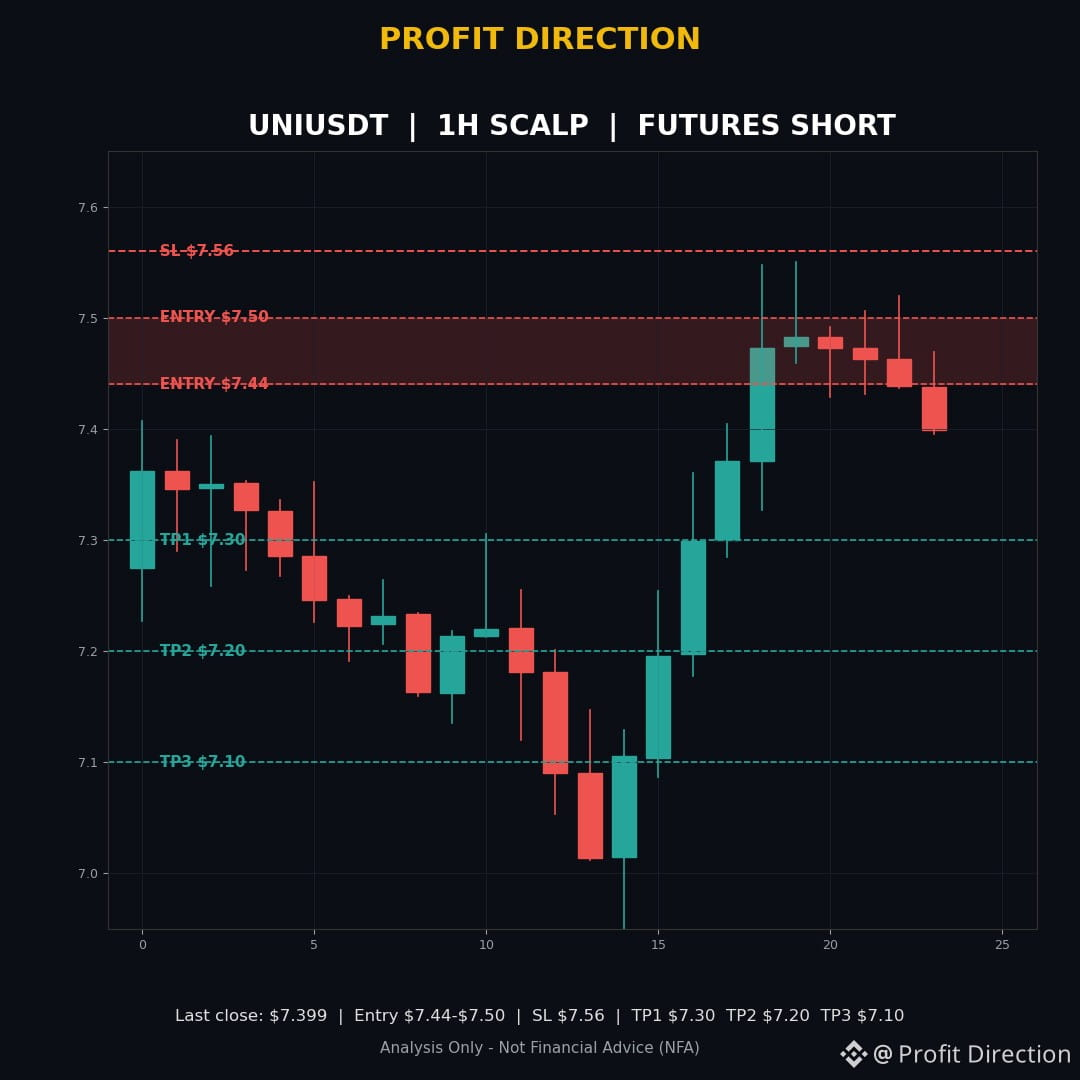
🔴 UNIUSDT — FUTURES SHORT
Entry Zone: $7.44 - $7.50
Stop Loss: $7.56
TP1: $7.30
TP2: $7.20
TP3: $7.10
R:R: 1:1.89 to TP1, 1:3.00 to TP2, 1:4.11 to TP3 (midpoint $7.47)
TF: 1H (SCALP)
$UNI
This is a conditional setup — UNI is trading around $7.40 right now, below the entry zone, so the idea only triggers on a retest into $7.44-$7.50. Do not short it here in the middle of the range, and do not chase it lower without that retest.
Why I like this one: UNI pushed up to the same ceiling three times today — $7.548, then $7.550, then $7.520 — and each push was rejected, with the 1H closes since then stepping lower ($7.483, $7.473, $7.463, $7.439) and the volume on each push up fading. That repeated rejection at one clear ceiling, with weaker buying on every retest, gives a clean short zone, with the first target back at $7.30, then $7.20 and $7.10 if sellers keep control.
Invalidation: a 1H close above $7.56 breaks the ceiling and voids this idea — do not hold the short past that.
Analysis Only — Not Financial Advice (NFA). Trading involves risk.
Follow Profit Direction for more signals, best signals and market updates. Share your opinion in the comments.
Do you think TP1 will hit first, or SL? Comment LONG or SHORT.
#UNI #UNIUSDT #CryptoTrading #FuturesTrading
2

·
--
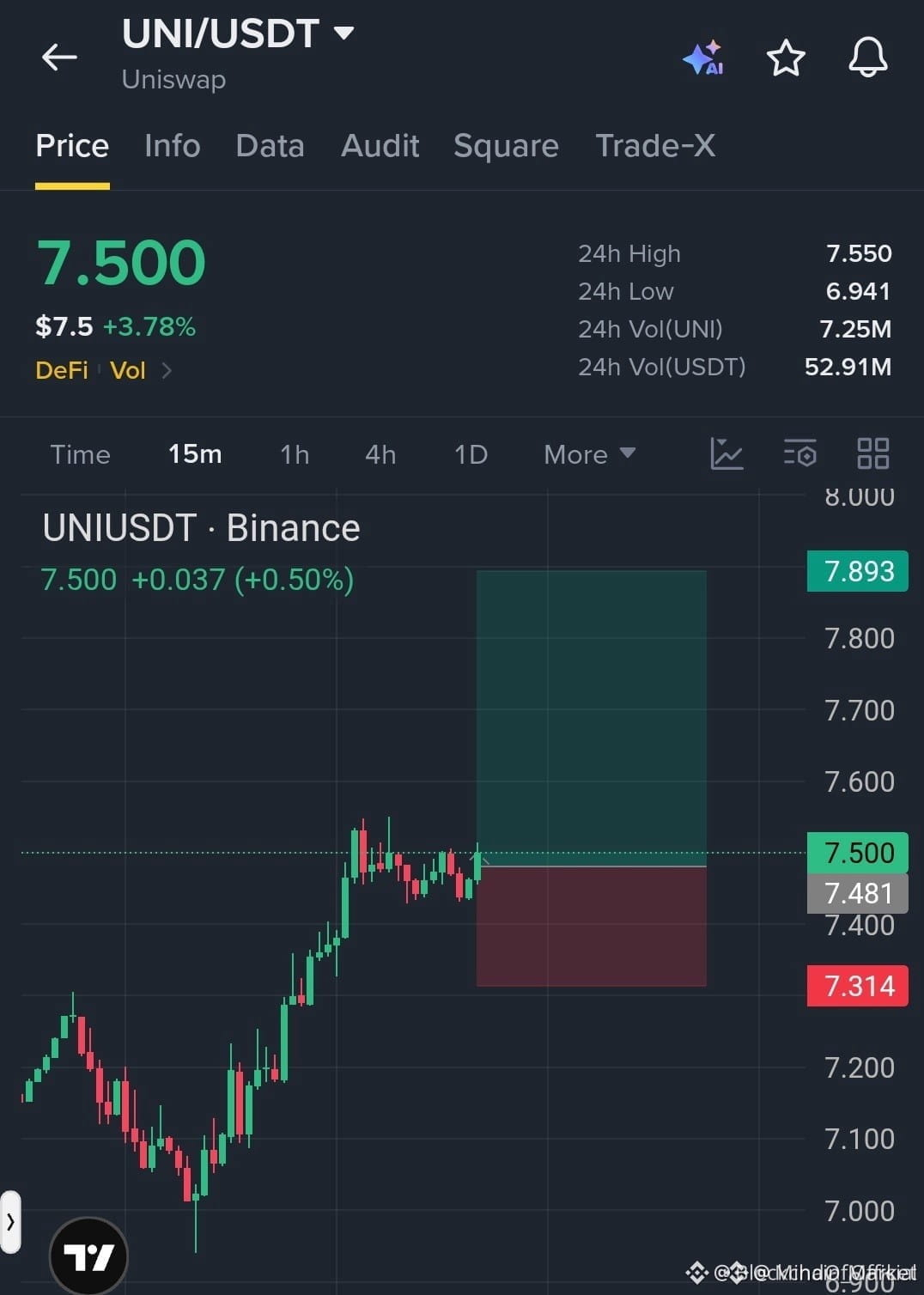
🚀 $UNI SET TO SURGE PAST $7.55 ON BULLISH MOMENTUM 💥
Entry: 7.48-7.52 ⚡
Target: 7.60 🚀
Target: 7.75 🚀
Target: 7.89 🚀
Stop Loss: 7.31 ⚠️
📊 $UNI has anchored firmly above the $7.40 support zone, with buyers dictating the tape and a tight demand block holding the price in check. 📌 The order block between $7.48‑$7.52 is now primed as a launchpad.
⚡ A clean break above $7.55 would trigger a liquidity sweep, unlocking the path toward $7.89 and delivering a crisp risk‑reward profile. 🌊 Smart money is likely stacking positions here—watch the volume surge as the breakout confirms. 💬 Are you ready to ride the next wave on $UNI ? 👇
⚠️ Not financial advice. Always manage your risk. 🛡️
🏷️ #UNI #LongSetup #Bullish #Crypto
🔥 💎
8

·
--
🚨 INSTITUTIONAL LIQUIDITY HUNT: $UNIUSDT
Quant metrics reveal a severe CVD divergence. While retail attempts a push, institutional order flow is aggressively absorbing bids. We are seeing a clear rejection at a high-timeframe Order Block, leaving a massive Fair Value Gap (FVG) that must be filled. Price is currently trapped in a low-volume node; the path of least resistance is DOWN as liquidity is grabbed from the upper wick.
EXECUTION:
ENTRY: 7.438 $UNI
SL: 7.905
TP1: 6.800
TP2: 6.200
RR: 1:2.5
Is $UNI facing a structural supply flip or just a temporary liquidity sweep?
#UNI #BinanceSquare #SlowSclap #TradingAnalysis
1
Log in to explore more content
Join global crypto users on Binance Square
⚡️ Get latest and useful information about crypto.
💬 Trusted by the world’s largest crypto exchange.
👍 Discover real insights from verified creators.
Email / Phone number
Trending Topics
1
#BTCRebounds80K
29,667 views
546 Discussing
2
#Binance98PercentReplenished
25,513 views
475 Discussing
3
#USMidterms-WhatAreMarketsExpecting?
299,744 views
1,966 Discussing
4
#USOctoberNFP-AreRateCutsStillPossible
374,131 views
2,770 Discussing
5
#AMDBeatsExpectations-AINarrativeContinues
85,611 views
751 Discussing
6
#CircleQ3Revenue865M
23,132 views
419 Discussing
7
#BinanceIncidentReport
501,922 views
2,087 Discussing
8
#USStocksOpenHigherAsDowGains1.9%
3,839 views
67 Discussing
9
#ADPUSPrivateEmployersAdd86000JobsInOctober
2,794 views
46 Discussing
10
#FrenchAssemblyPassesSelfCustodiedCryptoReportingAmendment
800 views
21 Discussing