




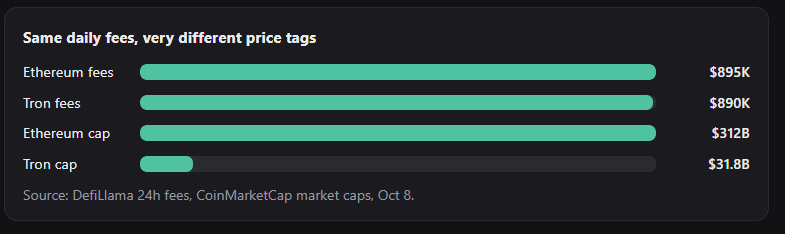
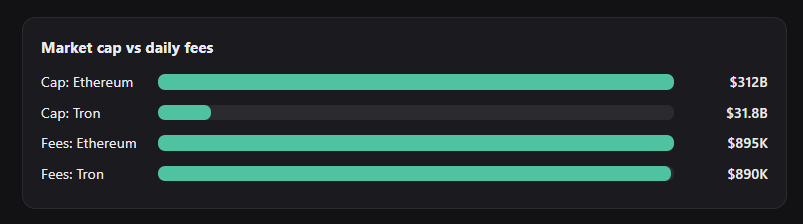
About $890K each, in a single 24-hour window. Ethereum is valued at $312B. Tron at $31.8B.
That doesn't mean Tron is cheap or Ethereum is expensive. Fees aren't everything. But it tells you something: market cap is what people believe. Fees are what people actually pay.
So I did something simple. I took the current top 10 and asked the same four questions of each: where does the money come from, who keeps it, who is really using it, and do the partnerships produce anything real?
Not a buy list. A map of where the story and the numbers agree, and where they don't.
1 · Bitcoin · $1.65TThe security bill is paid by price, not fees
Bitcoin isn't a business, so don't judge it like one. Its value is scarcity plus demand: ETF assets near $103B, 197 public companies holding it.
But look at what keeps the network secure. September fees were 87.53 BTC, about 0.63% of miner rewards. Roughly $7M for the month (my arithmetic).
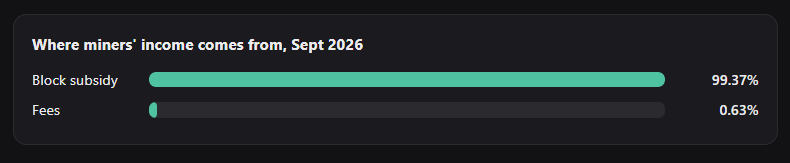
Long term, Bitcoin's security depends on its price holding up. That's the thing to watch.
2 · Ethereum · $312B
Real usage, thin base layer
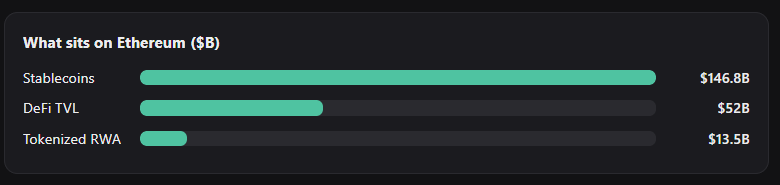
Ethereum hosts $146.8B in stablecoins, $52B in DeFi and $13.5B in tokenized real-world assets. The usage is real. But the mainnet itself earned about $376K in chain revenue over 24 hours, because most activity moved to layer-2s.
Institutions are interested too: BlackRock's staking ETF grew from a $107M seed to over $250M in its first week. Yet spot ETH ETFs also had a 17-day outflow streak (~$708M). Real, but uneven.
Ethereum is the venue. The question is how much of the rent it keeps.
3 · Tether · $184BThe most profitable project here. Holders get none of it.
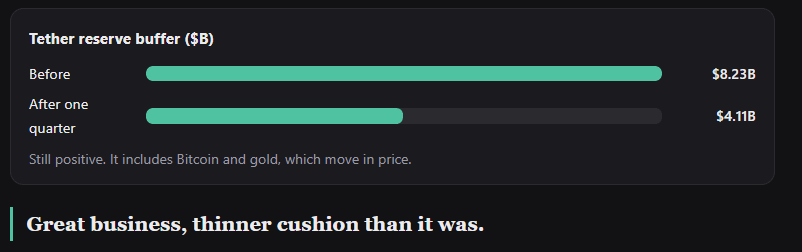
Tether made about $1.5B in operating profit in Q2, mostly from Treasury interest. It holds the reserves behind USDT and keeps the interest. USDT holders get nothing extra: they own a claim on $1, not a share of Tether.
The detail I'd watch: the reserve buffer halved in one quarter.
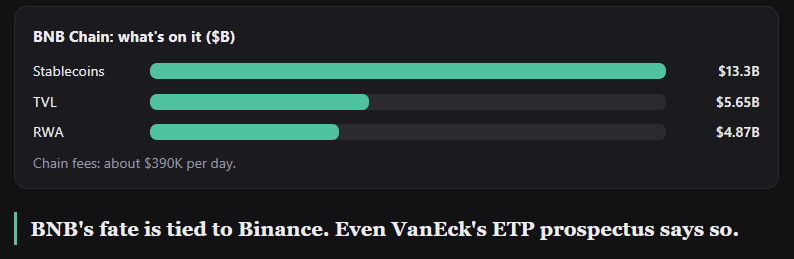
4 · BNB · $102BThe burn is real. The profit proof isn't.
The July burn removed 1,615,827 BNB (about $931.7M). Supply is now 133.17M, heading toward 100M. But the burn is formula-driven, not paid from a verified revenue stream. It's supply reduction, not proof of profit. Binance's own profits are private, so I can't verify them.
5 · XRP · $88B
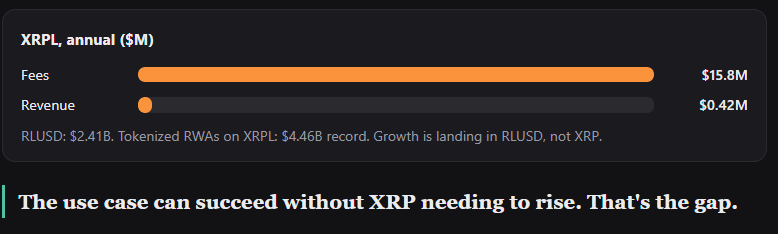
The story is growing. The ledger's income isn't.
The institutional headlines are real: Ondo, JPMorgan Kinexys and Mastercard settled tokenized Treasuries on XRPL in under five seconds. But settlement ran through RLUSD, with only fractions of XRP for fees. XRPL chain revenue was $1,027 over 24 hours.
6 · USDC · $73.7B
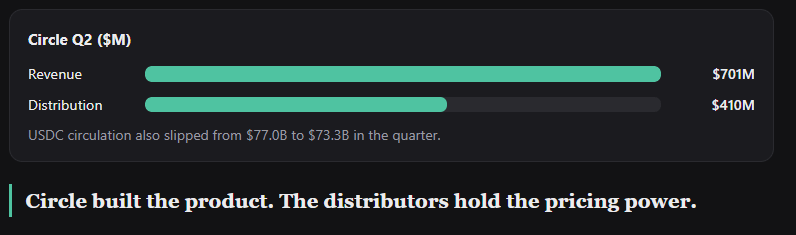
Who keeps the interest?
Circle's Q2 revenue was $701M, almost all from reserve interest. But $410M went to distribution partners, mainly Coinbase. About 61.5 cents of every reserve dollar leaves Circle.
7 · Solana · $67.7B
Apps earn more than the chain
Solana has 3.39M active addresses, $16.3B in stablecoins and $6.45B in TVL. Chain fees were $970K, but apps earned $5.4M in a day. Money is made on top of the chain, not by it.

Western Union's USDPT launched on Solana in May and added a Visa wallet in 37 markets in August. A real distribution channel. I found no volume data yet.
The pipes are working. The proof is volume, and it isn't public.
8 · TRON · $31.8B
The dollar highway
People in emerging markets use Tron to move USDT. That is why fees are real: someone pays them to send dollars. USDT is 97.77% of Tron's $94.8B stablecoin supply.
Caveats: TRON DAO reports $604M Q1 revenue, far above DefiLlama's run rate. Definitions differ, so I used the conservative number. Q1 was also net inflationary (+70.5M TRX), and it depends heavily on USDT and its founder.
A research lead, not a recommendation.
9 · Hyperliquid · $22.2B
The one place revenue visibly reaches the token
$429M in revenue through mid-September, the most on CoinGecko's ranking. About 99% of eligible perp fees go to the Assistance Fund, which buys back HYPE. A June vote also sends about 90% of net USDC reserve yield there. The first payment was about $14.58M.
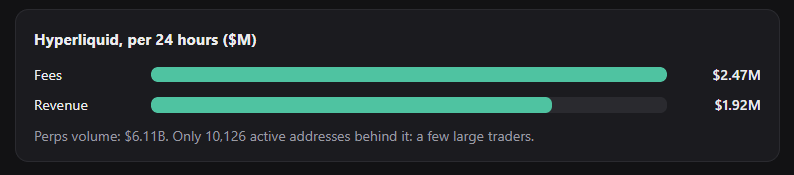
The risks are volume swings (weekly volume down 16%) and team unlocks. Supply counts also differ: 254.29M (CMC) vs 298.68M (Hyperliquid, late August).
The clearest value capture in the top 10. Also the most volume-sensitive.
10 · Zcash · $21B
Strong privacy usage, messy year
About 4.4M ZEC, roughly 26% of supply, is shielded. That's the project's best data point. Fee unavailable, and fees go to miners anyway.

This year: the Electric Coin Company team left in January, a critical Orchard flaw was disclosed in June (price bottomed near $410), then the Ironwood fix. ZEC has since risen roughly threefold to $1,241. Grayscale's ETF began trading August 25.
A fast price move after a consensus-level scare. Keep both facts in view.
The partnership test
New partnerships matter. Live ones matter more.
It's tempting to count: more new partners, more promising. I'd count a different way. A partnership announced is a promise. A partnership live is a fact. And a partnership with measurable volume is evidence.
Here is where the top 10 stands on new (2025–26) partnerships, split by stage. Green is live. Orange is pilot or sandbox.
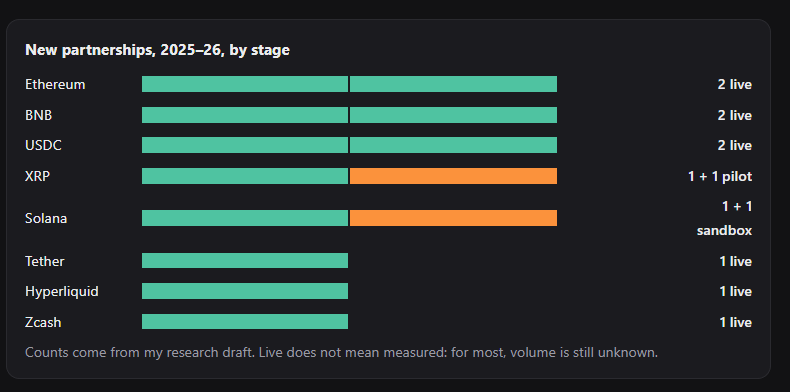
Now the part that matters more: how fast does an announcement become something real? Two I could verify.
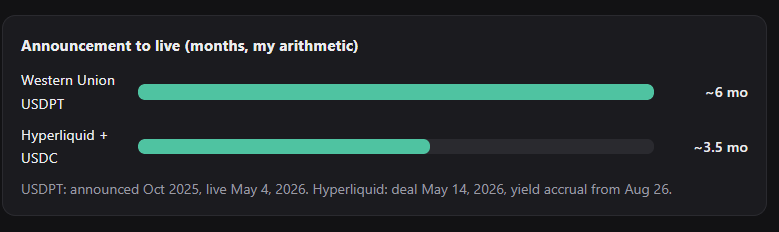
So what I'm watching isn't the number of announcements. It's the gap between "announced" and "live," and then between "live" and "volume."
What I'm taking from this
Three patterns stood out. Profit and holder value are different things (Tether, USDC). Great partnerships can flow around a token instead of through it (XRP, USDC). And the clearest links between money and token are rare (Hyperliquid, Tron).
Tron and Hyperliquid are my research leads. XRP is where the story runs ahead of the ledger. None of this is a price call.
Here's what I can't answer yet: if your favorite coin stopped trending tomorrow, would its network still make money?
#CryptoResearch #CryptoFundamentals #onchaindata #Stablecoins #Hyperliquid