
When will Bitcoin mining end, and what will happen to the price afterward?
The question of when Bitcoin mining will end is one of the most frequently asked in the cryptocurrency market, and the answer lies at the heart of Bitcoin’s own programming.
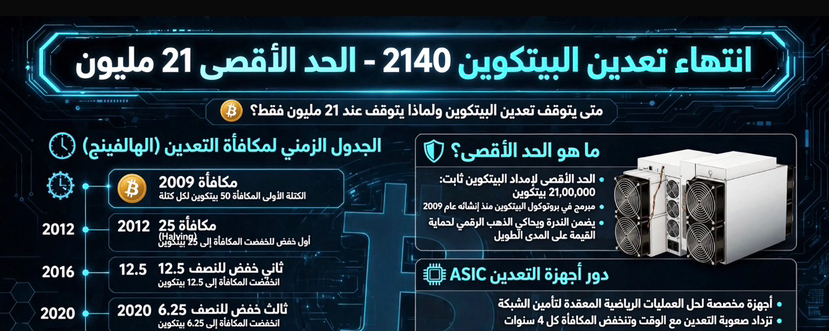
The Bitcoin protocol was designed to have a limited supply of no more than 21 million coins. This supply is not issued all at once, but according to a fixed schedule known as the halving mechanism. Every 210,000 blocks, or approximately every four years, the mining reward received by miners is cut in half.
The reward began in 2009 at 50 Bitcoin per block, then fell to 25 Bitcoin in 2012, to 12.5 Bitcoin in 2016, and then to 6.25 Bitcoin in 2020. The most recent halving took place in April 2024, and the current reward became 3.125 Bitcoin.
The next halving is expected in 2028 at block number 1,050,000, where the block reward will drop to 1.5625 Bitcoin, then to 0.78125 Bitcoin in 2032. With this ongoing geometric decline, mathematical estimates indicate that the last mineable portion of Bitcoin will be extracted in 2140.
Up to today, more than 19.9 million Bitcoins have already been mined, and only less than 1.1 million coins remain to be released gradually over the next 114 years.
What will happen to the price of Bitcoin after mining ends?
When the supply reaches 21 million, there will be no new Bitcoin entering the market. Here, economic analysis splits into two opposite paths.
The first path is the supply-shock path and absolute scarcity. Bitcoin will become a fully deflationary asset. And considering that millions of coins are already lost due to lost private keys and old wallets, the actual circulating supply will begin to decrease over time. If demand continues or grows, the law of supply and demand will push the price up over a very long term. History supports this theory: after every previous halving, new supply fell and was followed by a significant price increase after several months.
The second path is the network security path and the miners’ income shift. Today, miners earn income from two sources: the block reward and transaction fees. After 2140, the first source will disappear completely, and they will rely 100% on transaction fees alone. This raises a fundamental question about the network’s sustainability. If the Bitcoin network usage volume is not large enough to generate lucrative fees, a large number of miners may leave, leading to a drop in the Hashrate, and a decrease in the network’s security and decentralization. Weakened security could negatively affect investor confidence and thus the price.
The bet that developers and investors are making in the long run is that before 2140, Bitcoin will evolve into a global financial settlement layer. In this scenario, millions of transactions would happen every day, and the fee for each transaction would be sufficient to incentivize miners to keep securing the network—so the price would be supported by real usage and demand for transfers, not just speculation on scarcity.