



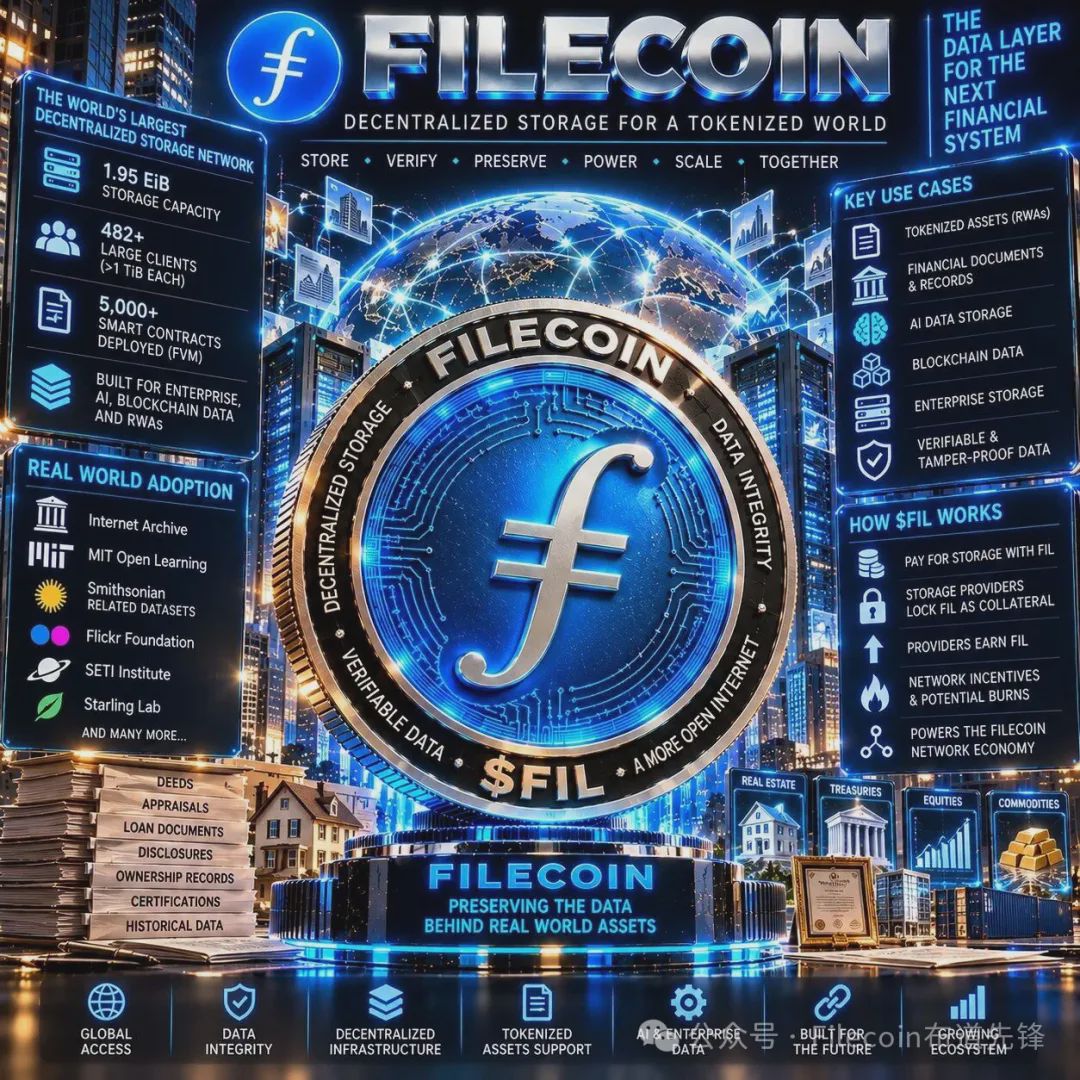
The Filecoin ecosystem has been especially active recently. Since entering 2026, the network has clearly shifted from “piling up capacity” toward meeting “real paying demand.” Here’s a roundup of the latest developments and technical breakthroughs to help everyone get up to speed. 1. Latest product launch: IPFS and Filecoin are finally connected for real. Filecoin Pin is now officially live. October 15, 2025: Filecoin Pin was officially released in Alpha (alongside the fifth anniversary of the Filecoin mainnet). The official blog and tweet explicitly said it “launches today in alpha.” After nearly a year of development and iteration, it entered a more mature phase in August–September 2026. GitHub saw releases including v2.0.0 in early September, and the official documentation (updated around September 2) clearly labeled it “Production-ready on Filecoin Mainnet,” adding that it is “live on Filecoin Mainnet and ready for use.” September 30, 2026: The official blog published a post titled “New IPFS Tools Launch on Filecoin,” highlighting Filecoin Pin and migration tools, and showcasing real user stories. This was an important milestone for product promotion and tool releases, but no official announcement designated this date as the “official launch date” or a version cutoff.
This may be one of the most developer- and creator-friendly updates yet:
Existing IPFS CIDs can be migrated directly without re-sharding, and the CIDs remain unchanged
Two replicas of storage by default
Costs about $2.50/TiB/month per replica, considerably less than mainstream pinning services
Supports CLI, JS libraries, and GitHub Actions
If a storage proof fails, payments are automatically paused
Put simply, data you previously pinned using services such as Pinata can now be stored on Filecoin at low cost and with verifiable proofs, while remaining accessible through your existing IPFS gateway. NFT platforms and institutional datasets have already begun migrating. Two: A major strategic shift—the three core goals for 2026. In 2026, the official strategy explicitly sets out a transformation of the network:
Drive paid onchain transactions
Strengthen network revenue and tokenomics
Expand flagship paying customers
The focus over the past few years has been on scaling. Now the focus is shifting to “who is actually willing to pay to use it.” The aim is to target high-value use cases such as AI datasets, AI agents, DePIN, and RWA. Meanwhile, the six-year vesting period for Protocol Labs and the Filecoin Foundation is due to end around October 15, and daily issuance (gross issuance) is expected to drop by about 75%. This is one of the biggest supply changes since mainnet launched. Three: A review of major technical breakthroughs—these developments are highly significant. 1. Fast Finality (F3) is live. Finality has been reduced from about 7.5 hours to tens of seconds or a few minutes, an improvement of roughly 100x. This is a qualitative change for applications, cross-chain use, and user experience. 2. Proof of Data Possession (PDP) supports hot and warm storage use cases. Storage providers can prove cryptographically, through random challenges, that they still hold the data without having to upload it again. Payments are automatically paused if a proof fails, enabling truly “verifiable hot storage.” 3. Filecoin Onchain Cloud is a programmable cloud that brings storage, proofs, and payments onchain. It supports automatic execution by smart contracts, two replicas by default, and streaming payments. Designed for AI agents and automation use cases, it already has early real-world paid usage. 4. Network upgrades continue to roll out.
NV28 Fire Horse (May 2026): Smart contracts can query sector health in real time, passkey login is supported, and the gas mechanism is optimized.
NV29 Solstice: The Calibration testnet has been upgraded, and the mainnet launch is drawing near. The key changes involve adjusting the reward structure and removing some Fil+ mechanisms so that rewards are more closely tied to real paid demand.
Storage batching has also been optimized, significantly reducing gas costs for large-scale operations. Four: Summary and outlook. Filecoin is undergoing a pivotal transformation:
From “the world’s largest decentralized cold-storage network”
to a “verifiable, programmable decentralized cloud platform that supports hot data”
F3 + PDP + Onchain Cloud + Filecoin Pin form the core of today’s technical foundation. Combined with major tokenomics changes, the second half of 2026 is certainly worth keeping an eye on. Of course, paid demand is still in its early growth stage, and the pace of real-world adoption remains to be seen. But the direction is clear.
If you're working on an IPFS-related project or following decentralized storage and AI data infrastructure, I recommend taking a close look at the real-world user experience of Filecoin Pin and Onchain Cloud. If there are any major developments, I'll share an update as soon as possible.
Source materials: official media and online news
Disclaimer: The content published on this account is for learning and discussion purposes only. The materials in this article come from publicly available online sources. If you believe any copyright has been infringed, please leave us a message, and we will correct or remove the material as soon as possible. This article is intended to share more market information and does not constitute investment advice.