


In October 2026, the crypto market is in a delicate balance: Bitcoin is staging a modest rebound near $86,000, institutional capital continues to flow back in, and the Fear and Greed Index is hovering in “Greed” territory—but remains far from euphoric highs. Yet the picture for three major coins—BNB, ETH, and SOL—is far more complex than the index suggests. Their core narratives have long since been priced in. Ethereum’s technical upgrades are still advancing, but pressure on the supply side is beginning to emerge. SOL has found a new anchor in the institutional settlement space, while BNB is seeking growth at the intersection of AI and RWA. Now that old stories are no longer scarce, will the next leg up come from a fundamental re-rating or sentiment-driven multiple expansion? Using a framework that distinguishes “narrative returns” from “sentiment returns,” and drawing on the latest on-chain data and market developments, this article explores a key question: when the bull market reaches its peak, are the major coins in your portfolio telling a new story—or simply running on old sentiment?
I. When the Market No Longer Lacks “Old Stories”
The biggest difference between the 2026 crypto market and the previous bull market is that the narratives around major public blockchains have become highly “standardized.”
BNB’s core story is the trading platform ecosystem and a low-cost public blockchain. Its value-capture pathways are clear: Binance trading fees, BNB Chain gas consumption, and expectations around new Launchpool listings. ETH’s core story is on-chain application infrastructure; from DeFi to L2s to RWAs, nearly every hot sector has a connection to Ethereum. SOL’s core story is a high-throughput public blockchain and a fast token-launch ecosystem. With extremely low transaction costs and an efficient execution environment, it has established a foothold in meme coins and consumer applications.
The problem is that everyone who needed to hear it has already heard it.
These three stories were fully priced in by the market as early as 2021, then repeatedly retold during the 2024–2025 rally. When a narrative shifts from “an expectation believed by a few” to “a consensus accepted by most,” pricing becomes much more efficient—in other words, the market is unlikely to award an additional valuation premium simply for “discovering the value of BNB/ETH/SOL.”
This is not to say that these public blockchains have no value. On the contrary, their infrastructure is more mature than ever. But excess investment returns have always come from “expectations diverging from reality,” not from “consensus being confirmed.” When a story no longer creates disagreement, it no longer generates excess returns.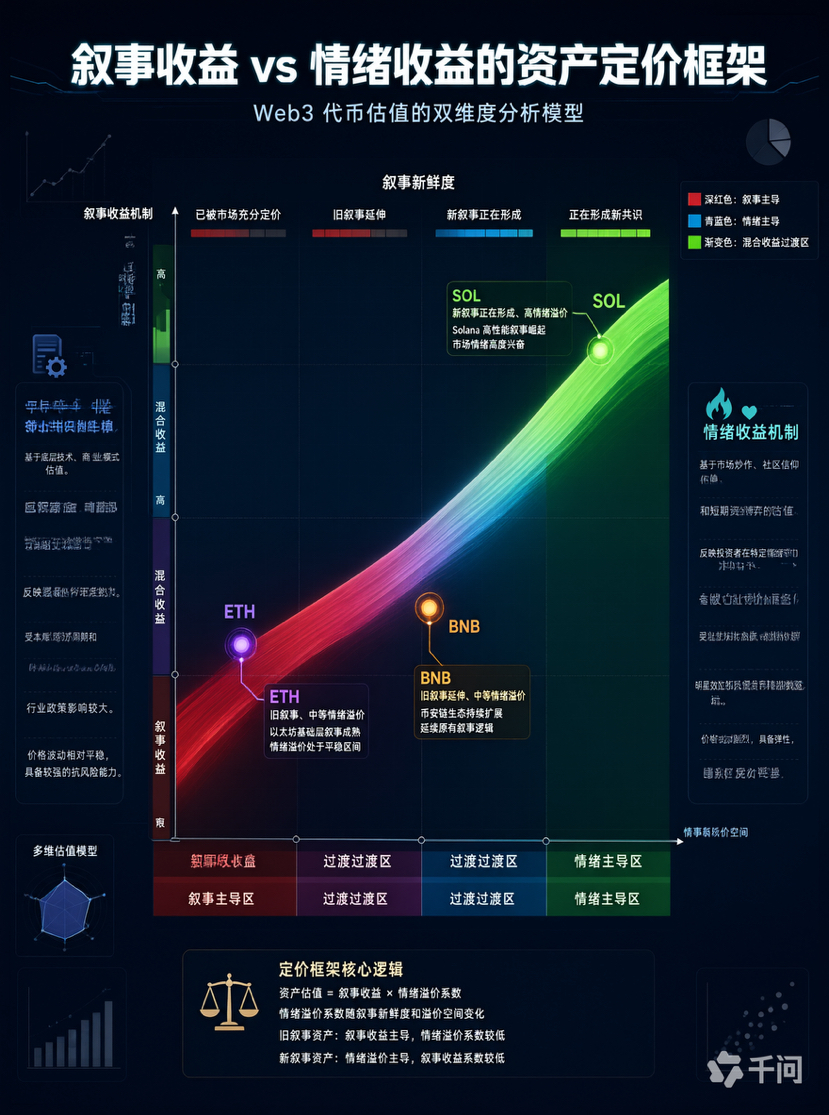
II. Ethereum: The Technology Narrative Remains, but the “Scarcity Premium” Is Fading
Ethereum is currently in a contradictory position: technologically, it is closer than ever to realizing its scaling ambitions, but its token economics are losing the “deflationary asset” halo.
On October 7, 2026, Ethereum’s next major upgrade, Glamsterdam, was activated on the Sepolia testnet. The upgrade raises the mainnet gas limit from 60 million to 200 million and introduces a parallel execution architecture, significantly increasing L1 processing capacity. Looking further ahead, Vitalik Buterin’s “Lean Ethereum” roadmap plans to rebuild the protocol’s core modules in stages over the next three to four years, positioning it as the third major evolution after the Merge.
These technological advances are real and important. But they face an awkward reality: the growth of L2s is “draining” value capture from the main chain. L2 fees have fallen below one cent, mainnet gas revenue continues to shrink, and Ethereum’s supply has shifted to modest net inflation in 2026.
In other words, Ethereum’s technology narrative is upgrading, while the token’s economic narrative is downgrading. When ETH is no longer a naturally deflationary asset, the “scarcity premium” investors are willing to pay for it needs to be reassessed.
ETF data also reflects this divergence. Year to date in 2026, spot Ethereum ETFs have seen cumulative net inflows of approximately $1.5 billion, surpassing the roughly $985 million recorded by Bitcoin ETFs. But recent flows have reversed: over the past week, Ethereum ETFs saw $138 million in net outflows, while Bitcoin ETFs recorded net inflows for a third consecutive week. This short-term divergence in flows shows that institutional investors, too, are reassessing whether Ethereum’s technological upgrades can translate into sustainable token value.
III. Solana: From a “Fast-Chain Narrative” to an “Institutional Settlement Narrative”
If the narratives for BNB and ETH in 2026 are more about “continuation,” SOL’s narrative is undergoing a substantial “upgrade.”
On October 6, 2026, the Solana Foundation released “Solana DvP,” an open-source settlement solution for financial institutions. It supports on-chain delivery-versus-payment settlement and aims to shorten traditional securities settlement cycles from one to two days to just seconds. JPMorgan participated in advising on the solution’s design.
This is a signal worth taking seriously. DvP (Delivery versus Payment) is a core mechanism in securities settlement, which has long been dominated by centralized clearinghouses. The Solana Foundation’s move to bring it on-chain, with JPMorgan’s involvement, means SOL’s narrative is expanding beyond a “high-performance public blockchain” toward an “institutional-grade financial settlement layer.”
More importantly, revenue from Solana’s on-chain applications continues to validate the commercial value of this narrative. Application revenue reached $365 million in the third quarter, leading all public blockchains for the tenth consecutive quarter. Monthly application revenue hit $180 million in September, a nine-month high, accounting for 32% of cross-chain revenue. Fiserv’s digital asset platform has also connected to Solana, reaching more than 90 banks and credit unions.
Going from “fast” to “used by institutions for settlement” is a qualitative leap. If Solana can continue attracting traditional financial institutions to use it as settlement infrastructure, SOL’s valuation logic will shift from a “public-chain narrative” to a “financial-infrastructure narrative”—the latter offers far greater valuation potential and certainty than the former.
Of course, risks remain. SOL is currently trading around $119. Several Solana ecosystem projects face token unlocks in October, including a staggered unlock of approximately 1.66 billion tokens on October 2. Supply-side pressure remains an important short-term price variable.
IV. BNB: Finding a “Second Growth Curve” at the Intersection of AI and RWA
BNB’s narrative predicament is the most typical: its core value is tightly bound to Binance’s trading ecosystem, and the growth ceiling for trading platforms is already clearly in sight.
But BNB Chain is making meaningful progress in two areas.
The first area is RWA (real-world assets). BNB Chain has become the first blockchain where the market capitalization of tokenized stocks and ETFs has exceeded $1 billion. 1inch’s RWA trading volume on BNB Chain grew by 85% over the past six months. As of October 5, bStocks covered 87 RWAs and ETFs, with a total value of approximately $855 million.
The second area is AI agent infrastructure. BNB Agent SDK is now live on mainnet, giving developers a standardized framework for building, deploying, and monetizing AI agents. The “Set and Earn” campaign, launched on October 1, invited nine AI agent marketplaces to participate, encouraging users to hire agents and build their own.
These two areas have one thing in common: both seek to create incremental value for BNB Chain “beyond trading.” If BNB Chain can become one of the main settlement layers for RWAs and AI agents, then BNB’s token value will no longer depend solely on Binance’s trading volume, but will also receive independent support from on-chain activity.
But frankly, both sectors are still at an early stage. The $1 billion RWA market capitalization represents only a tiny share of the total crypto market cap, and on-chain economic activity from AI agents is still far from reaching scale. The “second growth curve” narrative for BNB is real, but it still carries very little weight in its valuation.
V. The Limits of Sentiment-Driven Gains: What the Greed Index Is Telling Us
The Fear and Greed Index provides a window into market sentiment. As of October 6, it stood at 74, in the “greed” range; its 7-day average was 70 and its 30-day average was 67. It reached 72 on October 2, then briefly fell back to 65 on October 4.
These figures tell us that the market is bullish, but far from euphoric.
For comparison, during the peak of the 2021 bull market, the Fear and Greed Index stayed above 80 for an extended period. During the rally after Bitcoin ETF approval in early 2024, it also repeatedly topped 85. The current reading of 74 suggests market sentiment is “optimistic but cautious.”
But this very “mild greed” is precisely where the danger lies. When market sentiment has yet to reach an extreme, investors can easily fall into the illusion that there is still room to rise and that this is not the top. This mindset can make people less critical of the “quality of the narrative”—after all, sentiment is still strong, so if the price goes up, it must be right.
In its October 7 report, Wintermute noted that Bitcoin and major tokens are still in the early stages of a bull market, and that it is not too late to enter now. Citi also raised its 12-month Bitcoin price target to $113,000 and its Ethereum target to $3,028, citing “renewed concerns about currency debasement” and “the accelerated development of regulatory rules.”
Institutions are bullish, sentiment is greedy, but narrative quality is diverging. This is exactly the kind of environment where people can be “rich for a few minutes”—prices are rising and discussion is intensifying, but the logic supporting the rally increasingly depends on “the next buyer being willing to pay more,” rather than “the asset’s intrinsic value growing.”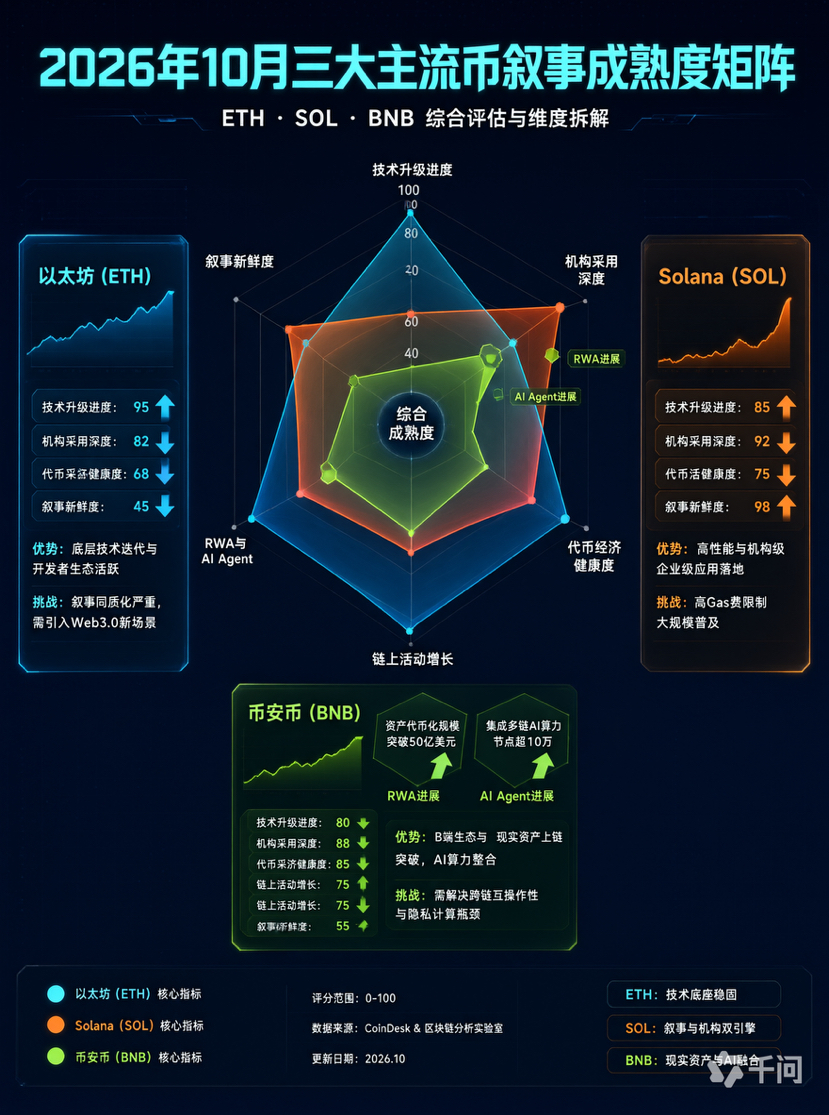
VI. A Framework for Assessing the Two Questions
Returning to the most practical level: the next time you open a market app, just ask yourself two questions.
Question 1: Is there a genuinely new narrative?
For ETH, the answer depends on whether the Glamsterdam upgrade can strike a new balance between the growth of L2s and L1 value capture. If a higher gas limit merely makes L2s cheaper while mainnet revenue continues to shrink, the “narrative gains” from technological upgrades will not translate into “value gains” for the token.
For SOL, the implementation of the DvP solution and JPMorgan’s involvement are positive signals, but we need to see whether actual institutional settlement volume moves on-chain. Continued growth in application revenue is a more reliable validation metric.
For BNB, RWA and AI agents are the right areas to pursue, but they are not yet large enough to support an independent valuation re-rating.
Question 2: Is the rally becoming driven by sentiment?
The current Fear and Greed Index is 74, in the “greedy but not euphoric” range. This means the sentiment premium has not yet been excessively stretched, but it also means the market is becoming more sensitive to “good news.” Watch for signs such as SOL rising more than 10% in a single day without a clear catalyst, ETH showing a “sell the news” reaction after the Glamsterdam mainnet launch, or BNB rallying sharply on RWA-related news without a corresponding increase in on-chain activity. These would be reasons to be wary of sentiment-driven gains fading.
BNB, ETH, and SOL remain among the crypto market’s most fundamentally supported assets. But “having fundamentals” and “having a narrative that generates returns” are two different things. The former helps you survive a bear market; the latter helps you earn excess returns in a bull market.
When old stories are no longer scarce, the projects truly worth watching are those turning “technological upgrades” or “institutional adoption” into sustainable economic activity. Solana’s DvP solution and BNB’s RWA push are two of the most noteworthy cases of “narrative upgrades” in 2026. Ethereum’s Glamsterdam upgrade, meanwhile, needs to be assessed using mainnet revenue data.
The next time you open a market app, first decide whether it’s a “new story or old sentiment,” then decide whether to participate. Don’t wait for a long upper wick to appear before remembering the risks—by then, your unrealized gains will already be a memory.#币安推出BinanceIntelligence #以太坊质押退出队列创2026年新高 #Winklevoss向美国SEC提交现货ZcashETF申请 #韩国AI加密交易推升Worldcoin至74.1亿美元 #Strategy预估41亿美元所得税收益 $BNB



