

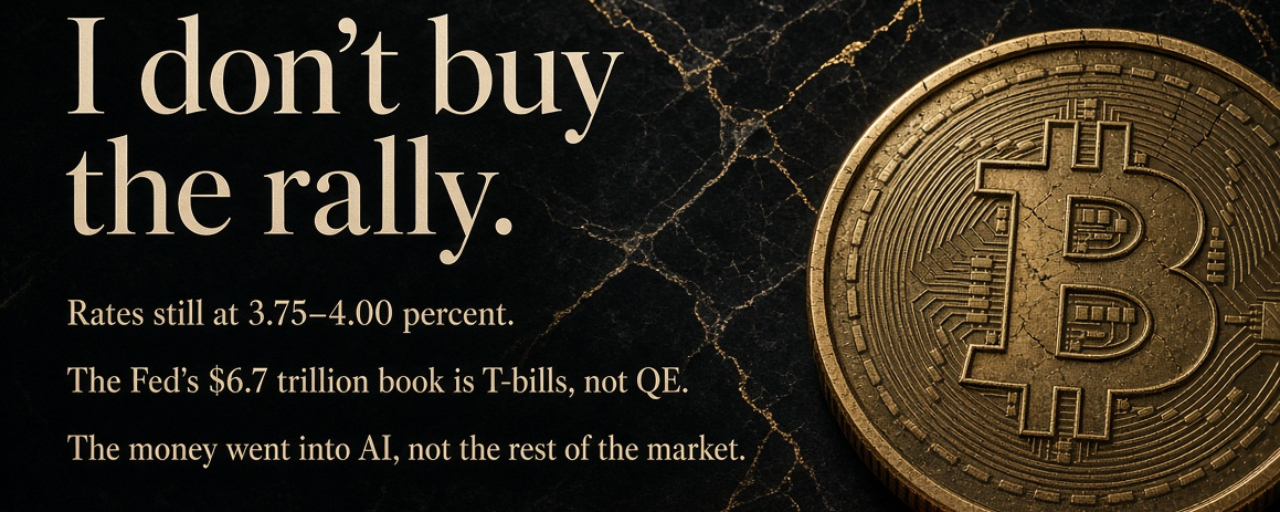

I don't think this rally will go much higher. I'm not predicting a crash; there's simply no reason it has to rise. The fact that rate hikes didn't knock it down only means the bad news has been priced in, not that there's still room to go higher.
Rates are still tightening. In September, the Fed raised the federal funds rate to 3.75%–4.00%, with all 12 votes in favor—the first rate hike in three years. The dot plot put the median rate at around 4.1% by year-end, with 12 of 18 officials expecting another hike this year. The statement removed the phrase “high inflation is driven by energy shocks” and instead called for a more timely return to 2%. This is a move the Fed is making itself, not a decision based on watching oil prices fall. The odds of no hike in October later fell; that simply meant one fewer surprise for the short end. Another hike in December remains the mainstream baseline. Japan is raising rates too. Neither side has shifted to easing.
The balance sheet tells an even clearer story. As of September 30, the Fed’s total assets stood at $6.743 trillion, down from a peak of about $8.97 trillion in April 2022. Balance-sheet runoff stopped in December 2025. Since then, the Fed has been buying short-term Treasury bills to keep bank reserves at an ample level of about $3 trillion—not to pursue quantitative easing. The overnight reverse repo facility is nearly drained. The Fed stopped runoff out of concern that reserves might fall too low, not to pump money into markets. For the balance sheet to drive risk assets higher, we’d need to see long-term bond purchases, sustained growth in reserves, and falling real interest rates. None of those is happening.
Long-term rates are still a drag. The 10-year Treasury yield is around 5.25%, with one early-morning quote as high as 5.29%—a multiyear high. The dollar index is about 102.5. Bitcoin pays no interest, so its carrying cost is this real interest rate. Until that cost falls, valuation multiples can’t expand. The Nasdaq can hit new highs without Bitcoin following. Bitcoin has been rejected three times at $87,000 and is now stuck between $85,000 and $86,000, still 32% below last October’s high of about $126,000. The $87,000–$87,500 range is a wall, and the 2026 opening price of about $87,570 is right around there too.
Money is going into AI, not elsewhere. Microsoft, Google, Amazon, and Meta are expected to spend about $730 billion on capital expenditures this year, up from about $410 billion last year. Direct AI revenue is around $25 billion—just 4% of that spending. More than 90% of operating cash flow is being reinvested, and there are another roughly $1.65 trillion in off-balance-sheet commitments. Building data centers ties up capital, electricity, and chips, pushing housing, factories, cars, and computers to the back of the line. Anyone competing with them for money will pay more in interest. That marginal dollar is no longer earned by the company itself; it comes from debt, private credit, and pensions.
Wealth creation is concentrated, so indices are up while the broader market is struggling. Since ChatGPT launched, about three-quarters of the S&P 500’s gains have come from 20 companies, with Nvidia alone accounting for about 16%. Depending on how you measure AI-related stocks, they make up nearly half of the S&P 500’s market cap—more concentrated than at the peak of the dot-com bubble. The equal-weighted index has fallen for seven straight weeks; the last time that happened was in 2022, and before that, in 2002. Fewer than a quarter of constituents are still above their 50-day moving averages. Consumer discretionary stocks are lagging, and some apparel stocks have roughly halved over the past year. Anyone who doesn’t own those few dozen companies hasn’t shared in this wealth.
The crypto market tells the same story. Spot Bitcoin ETFs just saw net outflows of about $90 million. There were inflows before that, but the price is still stuck in a range. Inflows are turnover, not multiple expansion. The Fear and Greed Index is at 73, still in greed territory. Those calling for an October rally point to the stats from the past 13 years: 10 up months and 3 down, with an average monthly return of about 17%. Statistics aren’t this month’s buy orders. When there are more bulls than buyers, it’s easiest to get caught near the top of the range.
That’s why I’m not bullish. Liquidity isn’t absent; it just isn’t leaving AI or long-term interest rates. I’d change my view only if one of two things happens: the 10-year yield drops significantly, or Bitcoin closes above $87,000 on the daily chart while ETFs see net inflows for several consecutive weeks. Without both, October’s history is just history. If support at $84,000–$85,000 fails, the little confidence built up during the rate-hike cycle will evaporate.#币安推出BinanceIntelligence #比特币三度受阻8.7万美元 #sol #ETH