#美联储10月维持利率概率升至82.3%
116 The bond market’s fear gauge has quietly climbed to a 1.5-year high, while Bitcoin and U.S. stocks are still sitting near their calmest levels of the year 🦖
🕐 最新解读群里更新
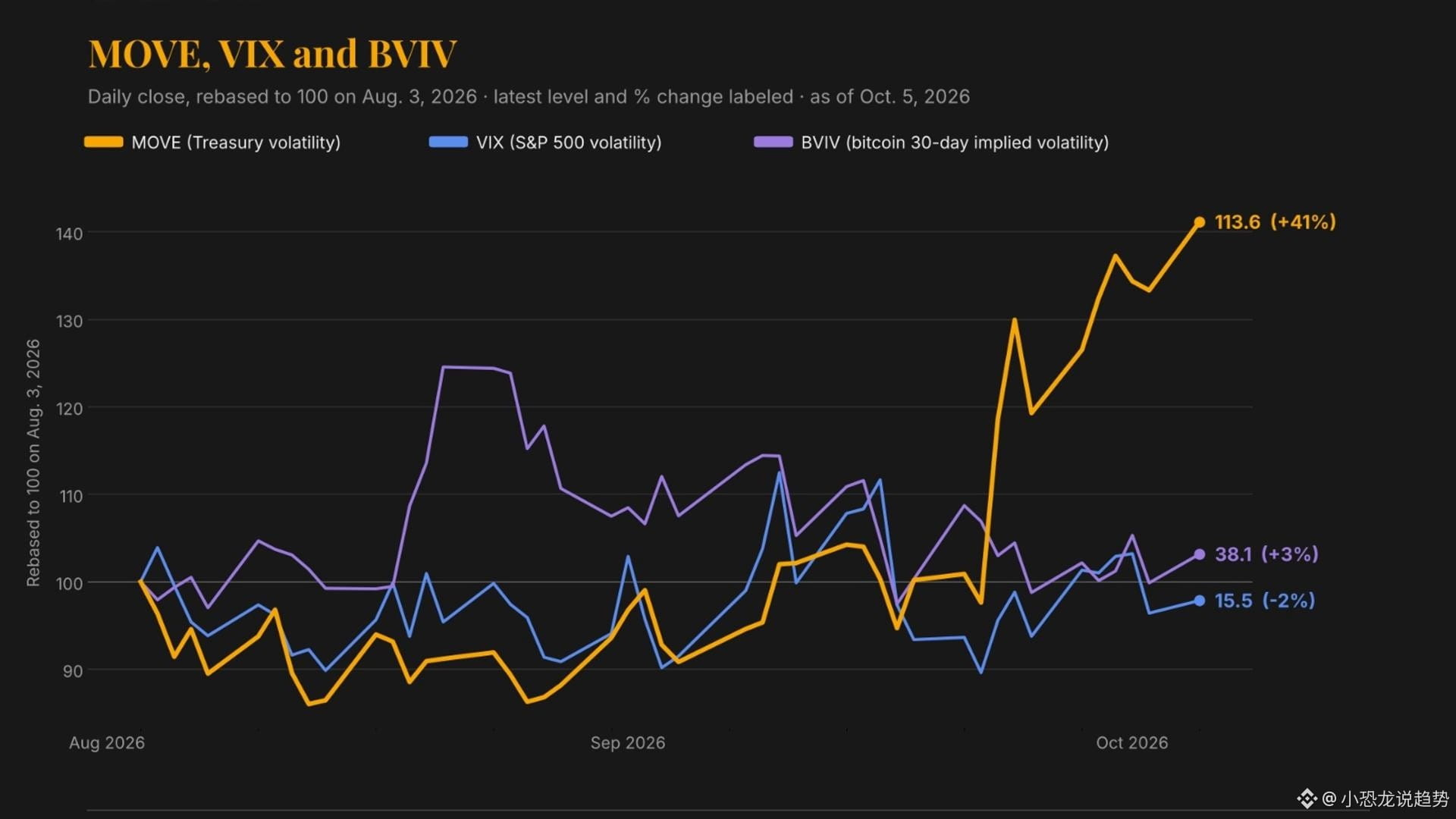
On October 6, CoinDesk spotted an unusual pattern: MOVE, the bond market’s version of the fear gauge, has surged to around 116, just shy of its March peak. That’s its highest level since April 2025. It jumped 46% in June alone, while Bitcoin’s 30-day implied volatility, BVIV, and the S&P 500’s VIX are both hovering near their lowest levels of the year.
MOVE stands for the ICE BofA U.S. Bond Market Option Volatility Estimate. It tracks options on 2-, 5-, 10- and 30-year U.S. Treasuries, with the 10-year options carrying the most weight. Put simply, it measures how much traders think Treasury yields will swing over the next month—not which way they’ll move, just how far.
Why pay more attention to it than to the VIX? Because Treasuries are the hardest collateral in the global financial system. When yields swing sharply, global financing costs rise and risk premiums climb, prompting money to instinctively retreat to safer places ⚠️ Kurt S. Altrichter, author of the wealth management firm RiskSIGNAL Report, put it plainly: when geopolitical conflicts erupted in 2022, 2023 and this year, MOVE was the first to move. Stocks are often the last to get the message.
Corporate bonds have already started to catch up. The Chicago Board Options Exchange (Cboe) says volatility in investment-grade and high-yield corporate bonds was still near historic lows two weeks ago—at the 6th and 11th percentiles, respectively. Now it has surged to the 79th and 84th percentiles.
But readings elsewhere tell a completely different story. Interest rate futures have priced in an 82.3% chance that the Fed will hold rates steady in October. Treasury yields have pulled back from their highest levels since 2002, oil has fallen below $100 a barrel again, and Bitcoin is moving sideways around $86,000, barely budging in 24 hours 📉 Last week, it was knocked back for the third time at $87,000.
My interpretation is simple: the bond market is the plumbing of the whole building, and leaks often show up there first. Bitcoin and U.S. stocks look stable right now, but that’s more likely because volatility is being suppressed—not because the risks have disappeared. If MOVE really breaks above its March high, volatility in crypto and stocks will probably catch up. FxPro has also laid out some key levels: if Bitcoin falls below $84,000, control shifts to the bears. If it then loses the lows around $83,000, $80,000 could come into range quickly.
Bitcoin is still 32% below its all-time high of $126,080 on October 6 last year. Whether that cushion is enough depends on what this week’s minutes from the Fed’s last meeting say.
Do you think this calm is the quiet before the storm, or have markets really stabilized? Share your thoughts in the comments.
Tap the profile picture to watch the livestream.
Every day, we bring you the latest on Bitcoin and the Fed—not just what’s happening, but the logic and opportunities behind the headlines 👀🚀
116 The bond market’s fear gauge has quietly climbed to a 1.5-year high, while Bitcoin and U.S. stocks are still sitting near their calmest levels of the year 🦖
🕐 最新解读群里更新
On October 6, CoinDesk spotted an unusual pattern: MOVE, the bond market’s version of the fear gauge, has surged to around 116, just shy of its March peak. That’s its highest level since April 2025. It jumped 46% in June alone, while Bitcoin’s 30-day implied volatility, BVIV, and the S&P 500’s VIX are both hovering near their lowest levels of the year.
MOVE stands for the ICE BofA U.S. Bond Market Option Volatility Estimate. It tracks options on 2-, 5-, 10- and 30-year U.S. Treasuries, with the 10-year options carrying the most weight. Put simply, it measures how much traders think Treasury yields will swing over the next month—not which way they’ll move, just how far.
Why pay more attention to it than to the VIX? Because Treasuries are the hardest collateral in the global financial system. When yields swing sharply, global financing costs rise and risk premiums climb, prompting money to instinctively retreat to safer places ⚠️ Kurt S. Altrichter, author of the wealth management firm RiskSIGNAL Report, put it plainly: when geopolitical conflicts erupted in 2022, 2023 and this year, MOVE was the first to move. Stocks are often the last to get the message.
Corporate bonds have already started to catch up. The Chicago Board Options Exchange (Cboe) says volatility in investment-grade and high-yield corporate bonds was still near historic lows two weeks ago—at the 6th and 11th percentiles, respectively. Now it has surged to the 79th and 84th percentiles.
But readings elsewhere tell a completely different story. Interest rate futures have priced in an 82.3% chance that the Fed will hold rates steady in October. Treasury yields have pulled back from their highest levels since 2002, oil has fallen below $100 a barrel again, and Bitcoin is moving sideways around $86,000, barely budging in 24 hours 📉 Last week, it was knocked back for the third time at $87,000.
My interpretation is simple: the bond market is the plumbing of the whole building, and leaks often show up there first. Bitcoin and U.S. stocks look stable right now, but that’s more likely because volatility is being suppressed—not because the risks have disappeared. If MOVE really breaks above its March high, volatility in crypto and stocks will probably catch up. FxPro has also laid out some key levels: if Bitcoin falls below $84,000, control shifts to the bears. If it then loses the lows around $83,000, $80,000 could come into range quickly.
Bitcoin is still 32% below its all-time high of $126,080 on October 6 last year. Whether that cushion is enough depends on what this week’s minutes from the Fed’s last meeting say.
Do you think this calm is the quiet before the storm, or have markets really stabilized? Share your thoughts in the comments.
Tap the profile picture to watch the livestream.
Every day, we bring you the latest on Bitcoin and the Fed—not just what’s happening, but the logic and opportunities behind the headlines 👀🚀