Binance Square
乘风Sunshine
561 Posts

乘风Sunshine

Square Verified+
返佣码:CFCF888 |X推特@KeShiqing57753|专注研究大饼BTC |星河社区联合创始人
Frequent Trader
1.8 Years
421 Following
30.2K+ Followers
13.0K+ Liked
Posts
PINNED
·
--
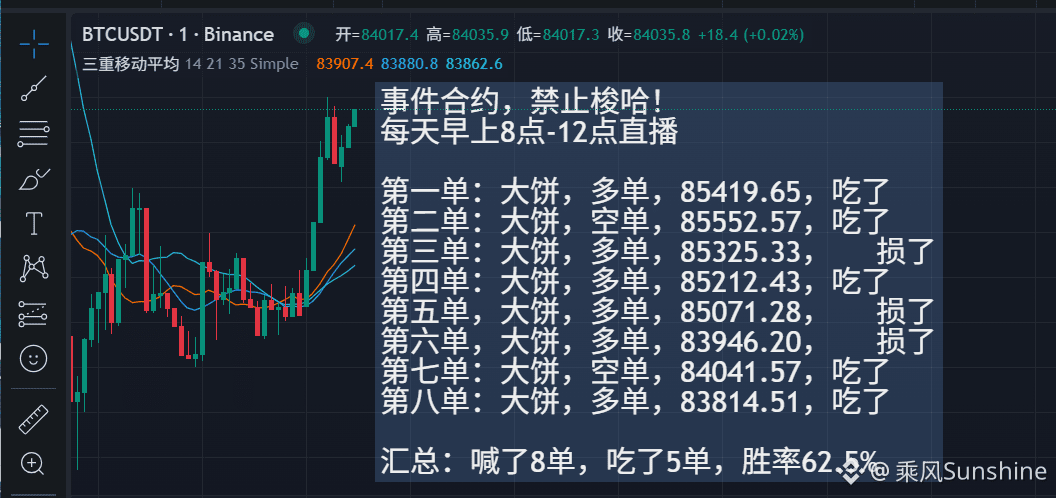
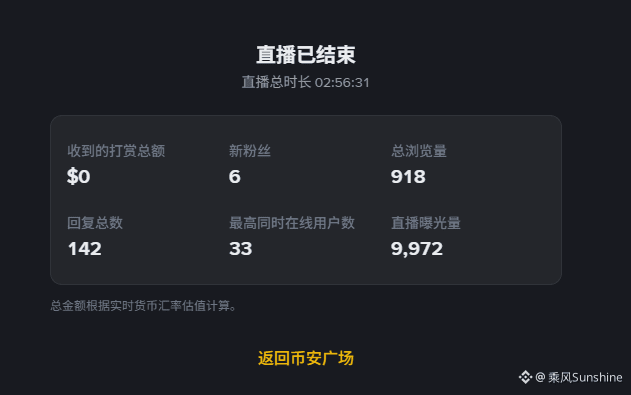
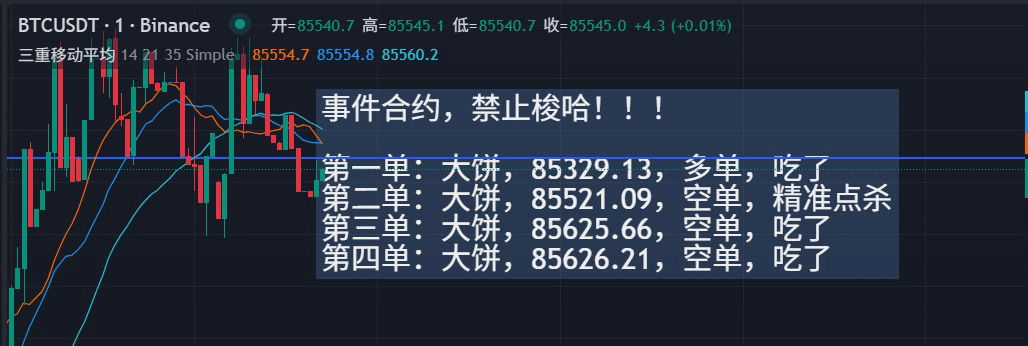
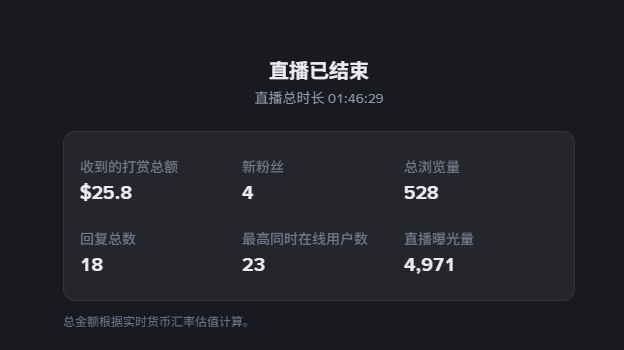
Got up early today and went live around 8 a.m., streaming until 11. I called 8 trades and hit 5. (I’ve adjusted to the new schedule pretty quickly. I’ll go live around 8 again tomorrow morning. See you tomorrow, guys.)
Boost your followers—join now!
avatar
@晚风Vesper_1688
is speaking
[LIVE] 🎙️ Stay committed 💪🏻 to dollar-cost averaging into BTC, ETH, BNB, and SOL—the leading cryptocurrencies 🚀🚀🚀
863 listens

666
666
橙子Joyce
·
--
Bullish
SpaceX plans to raise $40 billion to pour into Nvidia! The AI computing arms race is heating up again 🚀💥

Following its $25 billion bond issuance in June this year, Elon Musk’s SpaceX is making another aggressive push to raise capital. The company plans to raise $40 billion—including $30 billion in investment-grade bonds and $10 billion in bank loans—specifically to make large-scale purchases of Nvidia chips and accelerate its plans for space and AI data centers!

📌 Key points at a glance:

1️⃣ Fully embracing Nvidia’s Vera Rubin architecture
Musk stated unequivocally during an earnings call that SpaceX has decided to build its computing infrastructure entirely on the Nvidia platform. He also said that Vera Rubin is currently the world’s leading AI computing platform, and that the two companies will work closely together on multiple fronts.

2️⃣ Wall Street giant Apollo to lead $40 billion debt financing
The financing will be led by private equity giant Apollo Global Management and distributed to institutional investors. Bond giant Pimco is also among the lenders in discussions, and the deal is expected to close in 2027.

3️⃣ Hidden concerns in the credit market
Although SpaceX has a BBB investment-grade rating, its long-term bonds maturing in 2056 have fallen to around 85 cents on the dollar, with yields approaching junk-bond levels, due to the company’s limited financial disclosures to date. Bringing in Apollo is intended to boost confidence among institutional buyers by leveraging its extensive network and reputation.

4️⃣ AI data centers are “devouring” global capital
From Nvidia’s partnership with Apollo, BlackRock, and others to build a $500 billion financing platform, to the surge in traditional non-institutional private credit, the massive funding needs of AI computing infrastructure are rapidly draining market liquidity.
————————————————————————
💬 With Starlink in space on one hand and enormous computing power on the other, Musk has taken the AI arms race from the ground into space! We remain optimistic about the long-term capital gains from this wave of AI infrastructure investment, and continue investing in SpaceX and Nvidia (NVDA) stocks on Binance Exchange.

#加密货币 #币安推出BinanceIntelligence We’re building BNB for the long term

#币安交易所美股投资
#SpaceX AI Infrastructure
#NVDA
$NVDA.US


$SPCX.US

$AMZN.US

666
666
易琳Ten
·
--
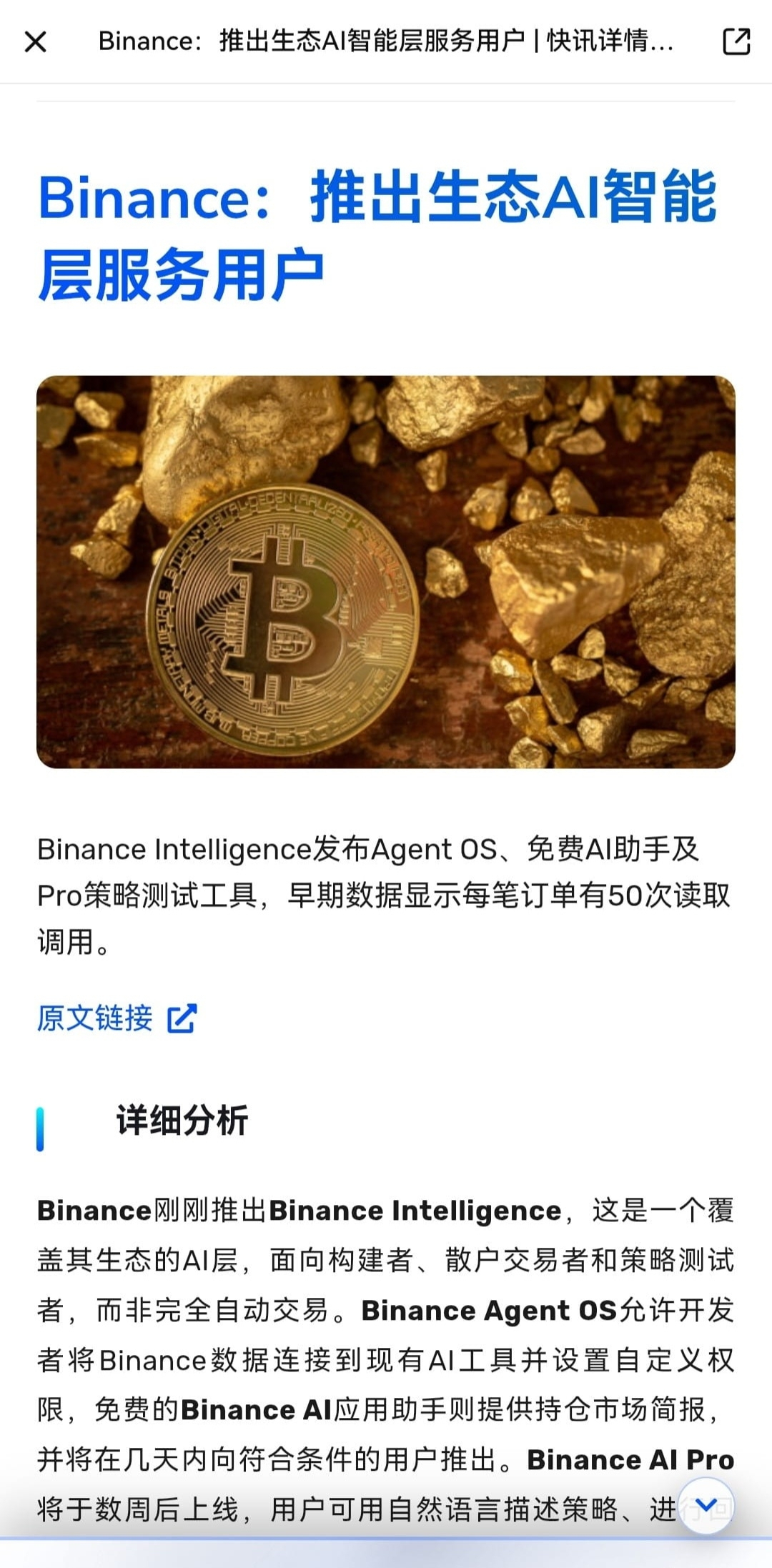
🤖 Binance Intelligence: An “AI Nanny” for Retail Traders

Folks, Binance Intelligence is basically Binance giving everyday retail traders an “AI nanny” 😂

Lots of people have been trading crypto for years and still place orders based on gut feeling:
Buy when it goes up, sell when it goes down. Ask them what their strategy is—
“Buy low, sell high.”
So when is it low? When is it high? No idea 😂

Now AI can bring together loads of market information, data, and analysis, then tailor the content to your experience level: beginners get the simplified version, while seasoned traders get the more technical one.

Even more interestingly, He Yi mentioned that in the future, AI Pro might be able to tell whether you’re a Holder or a Trader, whether you prefer dollar-cost averaging or grid trading, and then match you with structured strategies based on your habits.

In a nutshell:
You used to research strategies yourself; in the future, AI might help you organize them.

But I think it’s important to remember:

AI is a tool, not gospel.

Its greatest value may not be making you smarter, but helping you filter information and cut through the noise so you make fewer dumb mistakes.

As for whether it’ll eventually be able to “create a strategy from one sentence and execute it right away,” we’ll have to wait and see.

After all, no matter how good the tool is, if you can’t keep your hands off the buttons, that’s still on you 😂

What do you think of this AI tool? Would you be willing to use it as a trading assistant?
666
666
灼见Cryptosighted
·
--
With Binance’s move into AI, I think many people only see it as “AI helping you analyze the market.”

But what’s really worth paying attention to is the next step: moving from “telling you what happened” to “helping you turn your ideas into strategies.” 🤖

Binance Intelligence is now divided into three layers:

🔹 Binance AI: Tracks market movements, news, changes in positions, and market signals
🔹 AI Pro: Describe your ideas in natural language to generate trading workflows, which you can simulate and test first
🔹 Agent OS: Lets developers connect AI agents to market data, trading, wallets, and other capabilities

Here’s a simple example:

Before, you might have had to keep an eye on BTC price movements, funding rates, news, and on-chain data yourself.

In the future, you could simply tell AI:

“Alert me when BTC price movements diverge from funding rates, and generate a strategy based on my conditions.”

That’s what I think is most valuable.

AI may not be better than you at predicting whether prices will rise or fall,

but it can organize information faster, follow rules more strictly, and be less affected by emotions.

If this technology truly matures, the most important skill for traders in the future may no longer be “watching the charts.”

It’ll be—

knowing how to explain your trading logic to AI accurately.

Would you let AI execute your trading strategy?

🟢 Yes, I’d start with simulated trading
🔴 No, AI should only be an assistant

#BTC #ETH #BNB

Yesterday’s Crypto Market News Brief 1. BTC’s push toward $87,000 was rejected again, bringing the market into a critical battleground. Bitcoin briefly broke above $86,600 before retreating to around $85,600. Since September 23, $87,000 has now acted as a key resistance level, turning back bullish momentum for the third time; 2. The U.S. FinCEN withdrew two proposed crypto regulations, easing pressure on self-custody wallets. The Treasury Department’s Financial Crimes Enforcement Network withdrew a proposed reporting requirement for transfers exceeding $10,000 from self-custody wallets, as well as an additional regulatory proposal targeting crypto mixers, signaling a further easing of digital asset regulation. 3. Solana launched an institutional-grade on-chain settlement tool, with input from JPMorgan. The Solana Foundation released Solana DvP as open-source software, enabling institutions to atomically settle assets and funds on-chain. The goal is to cut settlement cycles from days in traditional markets to seconds. 4. Ondo is expanding into tokenized private markets, with an AI company as its first offering. Ondo launched Private Markets, offering eligible non-U.S. investors tokenized notes linked to the economic performance of private companies, and plans to support 24/7 secondary-market trading. This further expands RWA beyond U.S. Treasuries and stocks into the primary private markets. 5. The tokenized cash sector continues to attract investment, with Spiko raising $90 million. Spiko, a tokenized cash fund platform, raised $90 million in a Series B led by NEA. Its tokenized cash products have reached approximately $2.7 billion in assets, showing that institutional capital continues to back RWA and on-chain financial infrastructure.
Yesterday’s Crypto Market News Brief

1. BTC’s push toward $87,000 was rejected again, bringing the market into a critical battleground. Bitcoin briefly broke above $86,600 before retreating to around $85,600. Since September 23, $87,000 has now acted as a key resistance level, turning back bullish momentum for the third time;
2. The U.S. FinCEN withdrew two proposed crypto regulations, easing pressure on self-custody wallets. The Treasury Department’s Financial Crimes Enforcement Network withdrew a proposed reporting requirement for transfers exceeding $10,000 from self-custody wallets, as well as an additional regulatory proposal targeting crypto mixers, signaling a further easing of digital asset regulation.
3. Solana launched an institutional-grade on-chain settlement tool, with input from JPMorgan. The Solana Foundation released Solana DvP as open-source software, enabling institutions to atomically settle assets and funds on-chain. The goal is to cut settlement cycles from days in traditional markets to seconds.
4. Ondo is expanding into tokenized private markets, with an AI company as its first offering. Ondo launched Private Markets, offering eligible non-U.S. investors tokenized notes linked to the economic performance of private companies, and plans to support 24/7 secondary-market trading. This further expands RWA beyond U.S. Treasuries and stocks into the primary private markets.
5. The tokenized cash sector continues to attract investment, with Spiko raising $90 million. Spiko, a tokenized cash fund platform, raised $90 million in a Series B led by NEA. Its tokenized cash products have reached approximately $2.7 billion in assets, showing that institutional capital continues to back RWA and on-chain financial infrastructure.
Article
After AI enters crypto, what truly changes isn’t trading—it’s the rulesIf there’s just one question about AI you’ve been thinking seriously about lately, I suggest you don’t start by researching which model is more powerful, or rush to debate whether AI will replace traders. Start by understanding one thing: Once AI enters crypto, what it may truly change isn’t trading at all, but the rules of the entire crypto world. In the past, we treated AI as a tool. We had it write research reports, summarize news, find narratives, analyze candlestick charts, write code, and handle customer service. But the truly dangerous—and truly valuable—part is that the next phase of AI won’t just “help you get things done”; it will start making decisions on its own.

After AI enters crypto, what truly changes isn’t trading—it’s the rules

If there’s just one question about AI you’ve been thinking seriously about lately, I suggest you don’t start by researching which model is more powerful, or rush to debate whether AI will replace traders.
Start by understanding one thing:
Once AI enters crypto, what it may truly change isn’t trading at all, but the rules of the entire crypto world.
In the past, we treated AI as a tool.
We had it write research reports, summarize news, find narratives, analyze candlestick charts, write code, and handle customer service.
But the truly dangerous—and truly valuable—part is that the next phase of AI won’t just “help you get things done”; it will start making decisions on its own.
Yesterday’s Crypto Market News Roundup 1. BTC retreats after approaching $87,000: Bitcoin briefly touched around $86,970 yesterday, nearing its late-September high of about $87,400, before falling back below $86,000. Its 24-hour gain peaked at around 1.3%. 2. U.S. crypto regulation continues to advance: The CFTC unveiled a new crypto regulatory proposal, further aligning its framework with the SEC’s rules. It focuses on derivatives and trading platforms, though gaps remain in spot market regulation. 3. Metaplanet’s holdings rise to 44,000 BTC: The Japanese Bitcoin treasury company first sold 10,000 BTC in the third quarter, then bought back 11,000, for a net increase of 1,000. Its holdings reached 44,000 BTC, as it expanded its strategy for yield-generating assets. 4. Strategy buys another 334 BTC: Michael Saylor’s Strategy acquired 334 BTC for about $28.7 million, bringing its total holdings to more than 848,000 BTC. Competition among institutional “Bitcoin treasuries” continues to heat up. 5. Liquidity concerns emerge behind ETH’s gains: CoinGecko data shows ETH gained about 70% in the third quarter, substantially outperforming BTC. However, its market depth declined further relative to BTC, meaning the order book’s capacity to absorb trades thinned even as prices rose.
Yesterday’s Crypto Market News Roundup

1. BTC retreats after approaching $87,000: Bitcoin briefly touched around $86,970 yesterday, nearing its late-September high of about $87,400, before falling back below $86,000. Its 24-hour gain peaked at around 1.3%.
2. U.S. crypto regulation continues to advance: The CFTC unveiled a new crypto regulatory proposal, further aligning its framework with the SEC’s rules. It focuses on derivatives and trading platforms, though gaps remain in spot market regulation.
3. Metaplanet’s holdings rise to 44,000 BTC: The Japanese Bitcoin treasury company first sold 10,000 BTC in the third quarter, then bought back 11,000, for a net increase of 1,000. Its holdings reached 44,000 BTC, as it expanded its strategy for yield-generating assets.
4. Strategy buys another 334 BTC: Michael Saylor’s Strategy acquired 334 BTC for about $28.7 million, bringing its total holdings to more than 848,000 BTC. Competition among institutional “Bitcoin treasuries” continues to heat up.
5. Liquidity concerns emerge behind ETH’s gains: CoinGecko data shows ETH gained about 70% in the third quarter, substantially outperforming BTC. However, its market depth declined further relative to BTC, meaning the order book’s capacity to absorb trades thinned even as prices rose.
Article
After listening to Binance’s AI launch event, I think Binance is aiming to build more than just an AI trading toolIf we understand the insights shared by Binance’s leading lady at this Binance AI product launch as just another product announcement, we’re underestimating its significance. What’s truly worth paying attention to isn’t how many new AI features Binance has launched, but one very clear shift: Binance is evolving from an “exchange” into “AI-powered financial infrastructure.” In the past, we went to Binance to buy and sell crypto, trade futures, and earn returns. In the future, we may not need to actively seek out market opportunities. Instead, AI could help us understand the market, filter information, manage assets, and even execute strategies according to rules we authorize.

After listening to Binance’s AI launch event, I think Binance is aiming to build more than just an AI trading tool

If we understand the insights shared by Binance’s leading lady at this Binance AI product launch as just another product announcement, we’re underestimating its significance.
What’s truly worth paying attention to isn’t how many new AI features Binance has launched, but one very clear shift:
Binance is evolving from an “exchange” into “AI-powered financial infrastructure.”
In the past, we went to Binance to buy and sell crypto, trade futures, and earn returns.
In the future, we may not need to actively seek out market opportunities. Instead, AI could help us understand the market, filter information, manage assets, and even execute strategies according to rules we authorize.
Article
The people who really make money in crypto do things that go against the consensusSpend enough time in crypto, and you'll discover a very brutal truth: Most people's judgment isn't nearly as valuable as they think it is. When many people trade, they make decisions based on gut feeling first, then use all kinds of indicators, candlestick charts, news, and logic to come up with an explanation that makes their decision seem reasonable. When the price goes up, they say they called it right. When the price goes down, they say it's a shakeout. When they lose money, they say they're in it for the long term. The human brain is especially good at one thing: Not to discover the truth, but to prove they're right. So what really determines whether someone can make big money in crypto often isn't whether they can predict the future, but:

The people who really make money in crypto do things that go against the consensus

Spend enough time in crypto, and you'll discover a very brutal truth:
Most people's judgment isn't nearly as valuable as they think it is.
When many people trade, they make decisions based on gut feeling first, then use all kinds of indicators, candlestick charts, news, and logic to come up with an explanation that makes their decision seem reasonable.
When the price goes up, they say they called it right.
When the price goes down, they say it's a shakeout.
When they lose money, they say they're in it for the long term.
The human brain is especially good at one thing:
Not to discover the truth, but to prove they're right.
So what really determines whether someone can make big money in crypto often isn't whether they can predict the future, but:
Article
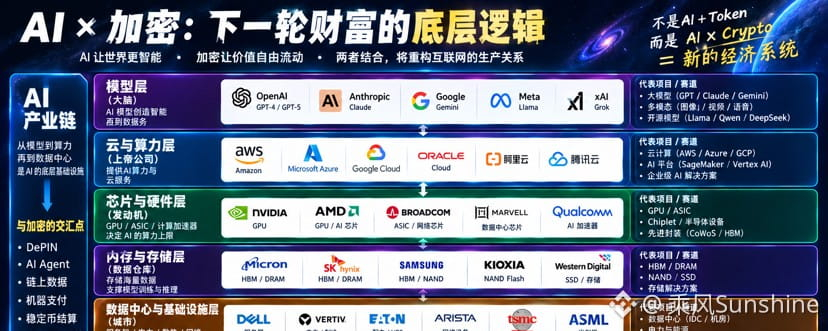
A look at the AI value chain to understand the opportunities in crypto that truly deserve attention in the next cycleThe real AI battle is no longer about “whose model is the strongest,” but who controls computing power, energy, data, and capital —A look at the AI value chain to understand the opportunities in crypto that truly deserve attention in the next cycle Many people are still discussing: Which is stronger: GPT, Claude, or Gemini? But if you zoom out, you’ll discover a more important fact: AI is no longer a “battle of models”—it’s a battle over the infrastructure powering everything. What you see is ChatGPT, Claude, and Gemini. But behind these products, what really powers AI is an enormous, far-reaching value chain:

A look at the AI value chain to understand the opportunities in crypto that truly deserve attention in the next cycle

The real AI battle is no longer about “whose model is the strongest,” but who controls computing power, energy, data, and capital
—A look at the AI value chain to understand the opportunities in crypto that truly deserve attention in the next cycle
Many people are still discussing:
Which is stronger: GPT, Claude, or Gemini?
But if you zoom out, you’ll discover a more important fact:
AI is no longer a “battle of models”—it’s a battle over the infrastructure powering everything.
What you see is ChatGPT, Claude, and Gemini.
But behind these products, what really powers AI is an enormous, far-reaching value chain:
October 6, 2026 results report: I called 4 bets and hit 3. As I adjust my schedule, I’ll gradually move my livestream to 8 a.m.–12 p.m. That’s the best time to place bets during the week, guys. Stay tuned. (My current livestream hours are 11 a.m.–2 p.m.)
Article
In the AI Era, How Can Ordinary People Make Money in Crypto?In the past, in crypto, whether someone could make money often came down to three things: Information asymmetry, knowledge gaps, and execution. If you see a narrative before others, spot a project early, understand a policy ahead of time, or get in one step sooner, your wealth could make a leap. That’s why so many people used to work relentlessly at studying K-lines and projects, scrolling through X, joining chat rooms, getting to know KOLs, and hunting for alpha. But since AI arrived, something is changing in a very dangerous way: These abilities are shifting from “scarce human skills” to “infrastructure you can buy.”

In the AI Era, How Can Ordinary People Make Money in Crypto?

In the past, in crypto, whether someone could make money often came down to three things:
Information asymmetry, knowledge gaps, and execution.
If you see a narrative before others, spot a project early, understand a policy ahead of time, or get in one step sooner, your wealth could make a leap.
That’s why so many people used to work relentlessly at studying K-lines and projects, scrolling through X, joining chat rooms, getting to know KOLs, and hunting for alpha.
But since AI arrived, something is changing in a very dangerous way:
These abilities are shifting from “scarce human skills” to “infrastructure you can buy.”
Binance Smart's Chinese AMA will start in about 19 hours. I'm so excited! Everyone, hurry and reserve your spot for the livestream! #币安智能 .
Article
The Xinghe Community isn’t hiring people—it’s developing talent who can stand on their ownTruly valuable talent has never been identified through a single interview. Truly exceptional people don’t suddenly grow just by joining a community, attending a few classes, memorizing a few concepts, and learning a few tricks. If I were to use Patriarch Subhuti from Journey to the West as an analogy, I think what a community should really learn isn’t “how to teach people,” but how Subhuti discovered someone, assessed them, nurtured them, and ultimately sent them out into the world. Because at its core, top-tier talent development isn’t about shaping someone into the person you want them to be.

The Xinghe Community isn’t hiring people—it’s developing talent who can stand on their own

Truly valuable talent has never been identified through a single interview.
Truly exceptional people don’t suddenly grow just by joining a community, attending a few classes, memorizing a few concepts, and learning a few tricks.
If I were to use Patriarch Subhuti from Journey to the West as an analogy, I think what a community should really learn isn’t “how to teach people,” but how Subhuti discovered someone, assessed them, nurtured them, and ultimately sent them out into the world.
Because at its core, top-tier talent development isn’t about shaping someone into the person you want them to be.
Article
The next bull market is coming. Are you ready?I'm not telling you to go all in, gamble, or stare at the markets all day. Quite the opposite. The worse the market gets, the more you need to lower your expectations, take fewer actions, and narrow your focus. Spend less time watching the markets and get more sleep. When you wake up, exercise. After your workout, study English and technology, research the market, create content, and build your own audience and knowledge assets. Don't launch all kinds of random projects, rent an expensive office, keep a team of people who produce nothing, or go out eating and drinking everywhere for so-called “connections.” Don't chase trends, insider tips, or get-rich-quick stories in chat rooms.

The next bull market is coming. Are you ready?

I'm not telling you to go all in, gamble, or stare at the markets all day.
Quite the opposite.
The worse the market gets, the more you need to lower your expectations, take fewer actions, and narrow your focus.
Spend less time watching the markets and get more sleep.
When you wake up, exercise. After your workout, study English and technology, research the market, create content, and build your own audience and knowledge assets.
Don't launch all kinds of random projects, rent an expensive office, keep a team of people who produce nothing, or go out eating and drinking everywhere for so-called “connections.”
Don't chase trends, insider tips, or get-rich-quick stories in chat rooms.
Last Week’s Crypto Market News Roundup 1. BTC surges above $87,000 then pulls back: On October 2, BTC briefly touched around $872,000, before retreating; weaker-than-expected U.S. employment data lowered U.S. Treasury yields, providing support for risk assets, but resistance near the $87,000 level remains evident. 2. Bitcoin ETF inflows continue: U.S. spot Bitcoin ETFs recorded roughly $2.7 billion in monthly net inflows at the end of September, signaling a clear rebound in institutional demand; the previous week also saw about $2.4 billion in net inflows. 3. SEC proposes easing institutional crypto custody limits: The SEC put forward a new framework for crypto asset custody that, under certain conditions, allows investment advisers and funds to self-custody, and permits state-level trust companies to act as custodians. This further clarifies a compliant path for institutions to directly hold assets such as BTC. 4. Tether brings USDT back to the Bitcoin network: Tether-supported Utexo enables USDT to re-enter the Bitcoin ecosystem via technologies such as RGB, supporting private transfers, exchanging BTC and USDT, and BTC-collateralized borrowing. 5. Blast announces shutdown of its Ethereum L2 network: Blast, which at one point held more than $2 billion in assets, announced it will stop operations and asked users to migrate their assets, reflecting that the current L2 space is entering a phase of elimination under pressure from users, revenue, and costs.
Last Week’s Crypto Market News Roundup

1. BTC surges above $87,000 then pulls back: On October 2, BTC briefly touched around $872,000, before retreating; weaker-than-expected U.S. employment data lowered U.S. Treasury yields, providing support for risk assets, but resistance near the $87,000 level remains evident.
2. Bitcoin ETF inflows continue: U.S. spot Bitcoin ETFs recorded roughly $2.7 billion in monthly net inflows at the end of September, signaling a clear rebound in institutional demand; the previous week also saw about $2.4 billion in net inflows.
3. SEC proposes easing institutional crypto custody limits: The SEC put forward a new framework for crypto asset custody that, under certain conditions, allows investment advisers and funds to self-custody, and permits state-level trust companies to act as custodians. This further clarifies a compliant path for institutions to directly hold assets such as BTC.
4. Tether brings USDT back to the Bitcoin network: Tether-supported Utexo enables USDT to re-enter the Bitcoin ecosystem via technologies such as RGB, supporting private transfers, exchanging BTC and USDT, and BTC-collateralized borrowing.
5. Blast announces shutdown of its Ethereum L2 network: Blast, which at one point held more than $2 billion in assets, announced it will stop operations and asked users to migrate their assets, reflecting that the current L2 space is entering a phase of elimination under pressure from users, revenue, and costs.
Article
What truly changes a person in the crypto world isn’t earning the first bucket of money—it’s winning six times in a row.Why six times? Because making money once might just be luck. Making money twice might be the market. Making money three times might mean you caught the right hot trend. But when you’re able to make six correct moves in a row—under the same logic and making the right decisions—what changes is not just your account balance, but your understanding of yourself. Then you start to truly believe: “I don’t make money by luck. I have the ability to consistently deliver results from the market.” This is the most terrifying kind of change. Imagine you just entered the crypto world. Your first Meme purchase goes up 50%. You feel your judgment is pretty good.

What truly changes a person in the crypto world isn’t earning the first bucket of money—it’s winning six times in a row.

Why six times?
Because making money once might just be luck.
Making money twice might be the market.
Making money three times might mean you caught the right hot trend.
But when you’re able to make six correct moves in a row—under the same logic and making the right decisions—what changes is not just your account balance, but your understanding of yourself.
Then you start to truly believe:
“I don’t make money by luck. I have the ability to consistently deliver results from the market.”
This is the most terrifying kind of change.
Imagine you just entered the crypto world.
Your first Meme purchase goes up 50%.
You feel your judgment is pretty good.
Premiered on April 3, 2026 at the Binance Square. As of today, October 4—exactly 6 months. I finally reached 30,000 followers and became a Binance Gold Badge streamer. Along the way, it has all been thanks to friends and great people. Thank you for your support, encouragement, and understanding throughout. I will keep working hard—and once again, I’m truly grateful!
Yesterday’s Crypto Market News Snapshot 1. BTC remained range-bound around $84,000, while ETH hovered at about $2,685. A CoinDesk Oct 3 New York time 4:00 p.m. benchmark showed BTC at $84,835.77, up about 0.64% on the day, and ETH at $2,685.23, up roughly 0.65%. Overall, the market held steady at high levels. 2. NEAR Intents has recovered all $3.8 million of stolen funds. The project team said the attacker returned the full amount before the final 48-hour deadline. The team then halted its investigation and urged the project to address security issues through the vulnerability bounty mechanism. 3. Blast announced the shutdown of its Ethereum Layer 2 network. Blast said operating costs have exceeded revenues and the network lacks a sustainable economic path. Users can withdraw assets via the official interface. The deadline is Oct 26; its DeFi TVL has fallen by more than 98% from its 2024 peak. 4. The EU’s crypto regulation continues to tighten stablecoin rules. ESMA proposed strengthening MiCA oversight, clarifying that it will consider banning regulated crypto service providers from offering users services related to stablecoins that do not meet MiCA requirements—further shrinking the space for non-compliant stablecoins to survive in the EU. 5. Market sentiment remains bullish, but BTC has not yet effectively broken above $90,000. According to CoinDesk data on Oct 3, BTC was around $84.8k and ETH about $2,685. BTC is still in a consolidation phase at elevated levels. Meanwhile, the market continues to watch institutional fund flows and whether Q4 trading can sustain the strong performance seen in Q3.
Yesterday’s Crypto Market News Snapshot

1. BTC remained range-bound around $84,000, while ETH hovered at about $2,685. A CoinDesk Oct 3 New York time 4:00 p.m. benchmark showed BTC at $84,835.77, up about 0.64% on the day, and ETH at $2,685.23, up roughly 0.65%. Overall, the market held steady at high levels.
2. NEAR Intents has recovered all $3.8 million of stolen funds. The project team said the attacker returned the full amount before the final 48-hour deadline. The team then halted its investigation and urged the project to address security issues through the vulnerability bounty mechanism.
3. Blast announced the shutdown of its Ethereum Layer 2 network. Blast said operating costs have exceeded revenues and the network lacks a sustainable economic path. Users can withdraw assets via the official interface. The deadline is Oct 26; its DeFi TVL has fallen by more than 98% from its 2024 peak.
4. The EU’s crypto regulation continues to tighten stablecoin rules. ESMA proposed strengthening MiCA oversight, clarifying that it will consider banning regulated crypto service providers from offering users services related to stablecoins that do not meet MiCA requirements—further shrinking the space for non-compliant stablecoins to survive in the EU.
5. Market sentiment remains bullish, but BTC has not yet effectively broken above $90,000. According to CoinDesk data on Oct 3, BTC was around $84.8k and ETH about $2,685. BTC is still in a consolidation phase at elevated levels. Meanwhile, the market continues to watch institutional fund flows and whether Q4 trading can sustain the strong performance seen in Q3.
Log in to explore more content
Join global crypto users on Binance Square
⚡️ Get latest and useful information about crypto.
💬 Trusted by the world’s largest crypto exchange.
👍 Discover real insights from verified creators.
Email / Phone number
Sitemap
Cookie Preferences
Platform T&Cs