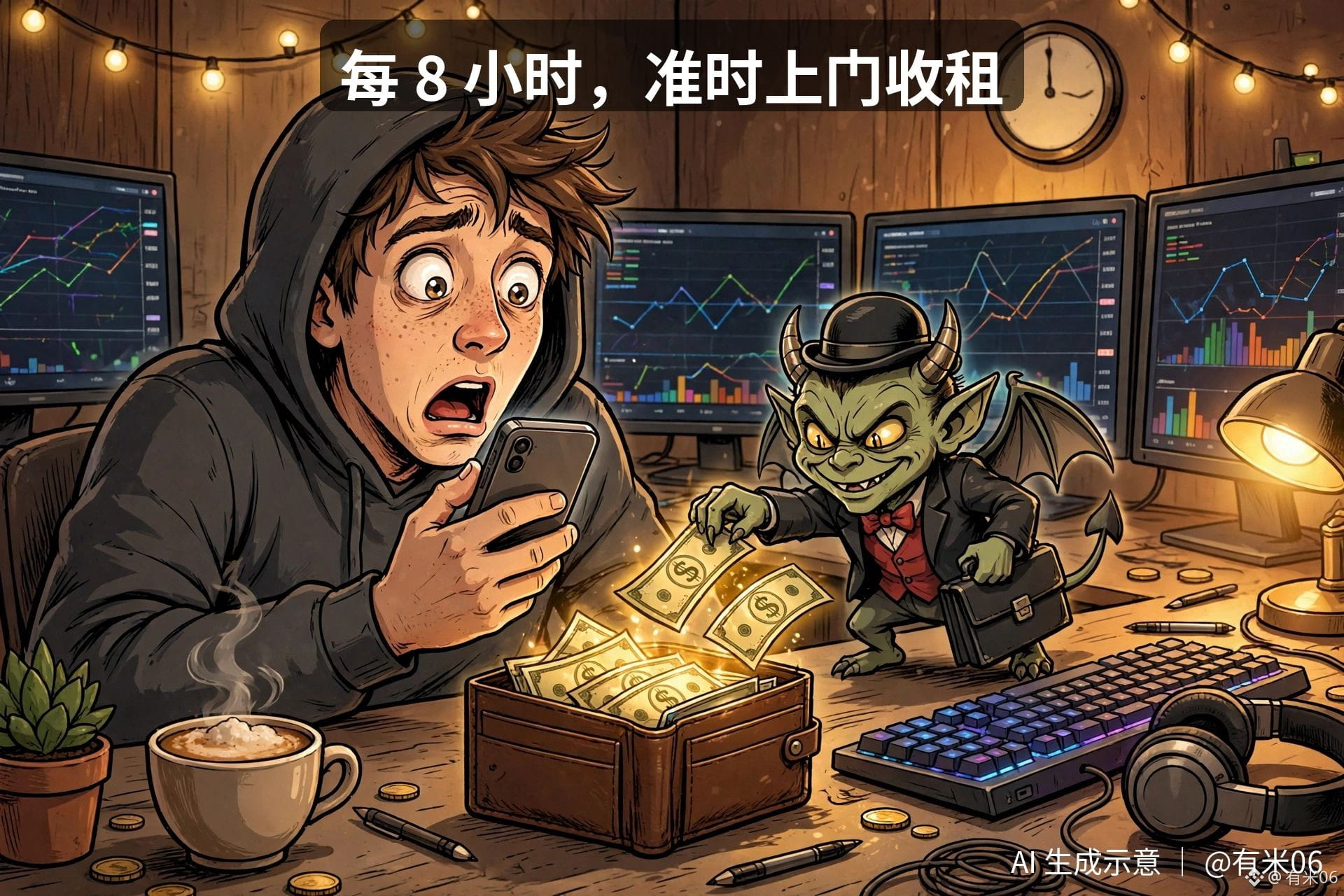
Losing money on a perpetual contract even when the market isn’t moving against you—but still getting quietly charged every day?
The likely culprit: funding rates.
A lot of beginners are confused the first time they trade perpetual contracts:
They haven’t even placed a trade, yet the USDT in their account keeps shrinking.
It’s not a system bug—you’re paying your counterparty “protection money.”
① What is a funding rate?
Perpetual contracts have no expiry date, so their prices can easily drift away from spot prices.
Exchanges introduced funding rates to pull contract prices toward spot prices—
essentially, it’s a balancing payment exchanged between longs and shorts. The exchange itself doesn’t take a cut.
② Who pays whom? It depends on whether the rate is positive or negative.
Positive rate (+): The market is overcrowded with bullish traders, so longs pay shorts.
Negative rate (-): The market is overcrowded with bearish traders, so shorts pay longs.
Remember: the money you pay goes straight into your counterparty’s pocket.
③ How often is it charged?
Binance settles every 8 hours by default:
UTC 00:00, 08:00, and 16:00—that is, 08:00, 16:00, and 00:00 Beijing time.
Binance reserves the right to adjust this based on market conditions. In January 2026, for example, some contracts such as XAUUSDT were switched from 4-hour to 8-hour settlement intervals.
④ How much is charged each time?
Funding fee = Notional value × Funding rate.
For example, if you open a $10,000 BTCUSDT perpetual long position and the rate is 0.01%, you’ll be charged $1 per settlement.
It may not seem like much, but in a raging bull market, rates can stay elevated for a long time, with three settlements a day.
The hidden cost of holding long positions for the long term can eat into a lot of your profits.
⑤ Where to check it, and how to save
You can see the current rate and countdown to the next settlement at the top of the futures trading interface.
You can also go to Futures Settings → Notification Settings and turn on funding fee alerts.
Don’t want to pay? Either avoid holding positions around settlement times,
or trade quarterly delivery contracts instead—they don’t have funding fees.
The same rules apply to USDT-margined ETH and BNB contracts.
My take:
Funding rates are actually the most honest sentiment indicator in the entire market.
If the rate stays positive and keeps rising, it means longs are getting dangerously crowded.
Chasing the rally at that point is like catching the falling knife while paying the shorts’ salary.
Conversely, a negative funding rate is often one sign that panic is nearing its end.
Trading contracts without understanding funding rates is like paying a toll blindfolded.
Contracts use leverage and carry extremely high risks. Trade within your means.
Source: Binance Academy, “Introduction to Funding Rates”; Wu Blockchain (via Sina Finance), report on Binance adjusting funding settlement intervals for certain contracts.
For informational purposes only; this is not investment advice.
$BTC $ETH $BNB
#FuturesTrading
When did you first realize you were being charged a funding fee? Share in the comments.
I’ll keep posting practical tips like this, so follow me and stay in the loop 👀
The likely culprit: funding rates.
A lot of beginners are confused the first time they trade perpetual contracts:
They haven’t even placed a trade, yet the USDT in their account keeps shrinking.
It’s not a system bug—you’re paying your counterparty “protection money.”
① What is a funding rate?
Perpetual contracts have no expiry date, so their prices can easily drift away from spot prices.
Exchanges introduced funding rates to pull contract prices toward spot prices—
essentially, it’s a balancing payment exchanged between longs and shorts. The exchange itself doesn’t take a cut.
② Who pays whom? It depends on whether the rate is positive or negative.
Positive rate (+): The market is overcrowded with bullish traders, so longs pay shorts.
Negative rate (-): The market is overcrowded with bearish traders, so shorts pay longs.
Remember: the money you pay goes straight into your counterparty’s pocket.
③ How often is it charged?
Binance settles every 8 hours by default:
UTC 00:00, 08:00, and 16:00—that is, 08:00, 16:00, and 00:00 Beijing time.
Binance reserves the right to adjust this based on market conditions. In January 2026, for example, some contracts such as XAUUSDT were switched from 4-hour to 8-hour settlement intervals.
④ How much is charged each time?
Funding fee = Notional value × Funding rate.
For example, if you open a $10,000 BTCUSDT perpetual long position and the rate is 0.01%, you’ll be charged $1 per settlement.
It may not seem like much, but in a raging bull market, rates can stay elevated for a long time, with three settlements a day.
The hidden cost of holding long positions for the long term can eat into a lot of your profits.
⑤ Where to check it, and how to save
You can see the current rate and countdown to the next settlement at the top of the futures trading interface.
You can also go to Futures Settings → Notification Settings and turn on funding fee alerts.
Don’t want to pay? Either avoid holding positions around settlement times,
or trade quarterly delivery contracts instead—they don’t have funding fees.
The same rules apply to USDT-margined ETH and BNB contracts.
My take:
Funding rates are actually the most honest sentiment indicator in the entire market.
If the rate stays positive and keeps rising, it means longs are getting dangerously crowded.
Chasing the rally at that point is like catching the falling knife while paying the shorts’ salary.
Conversely, a negative funding rate is often one sign that panic is nearing its end.
Trading contracts without understanding funding rates is like paying a toll blindfolded.
Contracts use leverage and carry extremely high risks. Trade within your means.
Source: Binance Academy, “Introduction to Funding Rates”; Wu Blockchain (via Sina Finance), report on Binance adjusting funding settlement intervals for certain contracts.
For informational purposes only; this is not investment advice.
$BTC $ETH $BNB
#FuturesTrading
When did you first realize you were being charged a funding fee? Share in the comments.
I’ll keep posting practical tips like this, so follow me and stay in the loop 👀