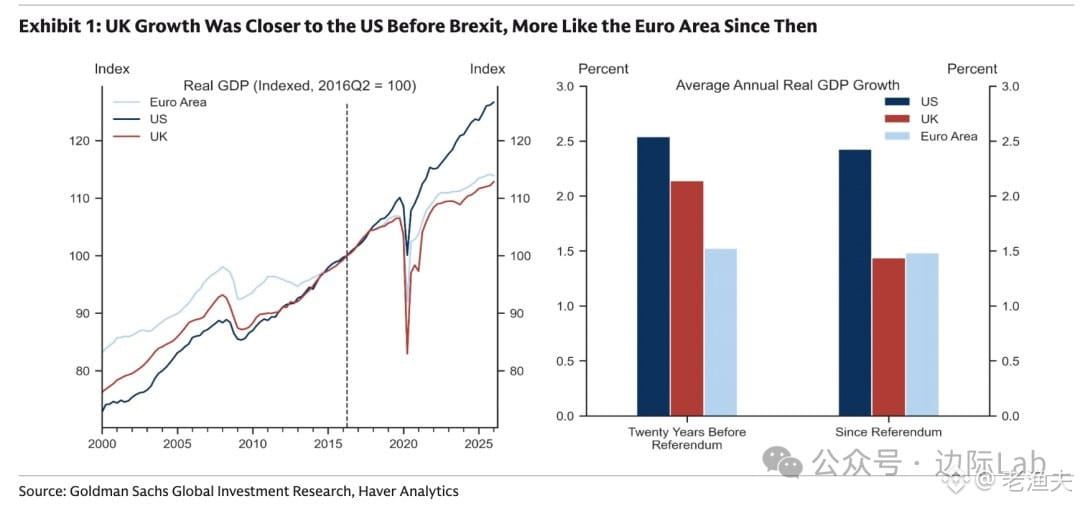
Goldman Sachs’ latest data is pretty interesting — in the eight years since Brexit, the UK’s economic growth rate has gone from roughly matching the US over the previous two decades (an average of 2.1% a year) to the eurozone level (1.4%).
The UK’s growth advantage over mainland Europe has basically disappeared. This is a pretty classic example of a policy shock: trade friction, disrupted capital flows, supply chain restructuring… all of which ultimately show up in the economy’s long-term growth potential.
I remember that around the 2016 referendum, a lot of people thought “the UK would be more nimble after Brexit.” Looking at it now, institutional costs and trade barriers have proved more tangible than people expected. The pound took quite a beating back then, too. The exchange rate is relatively stable now, but the damage to the economic structure has already been done.
For those working in currency converters or cross-border payments, the UK market has been pretty nuanced in recent years — fluctuations in the euro exchange rate, companies moving abroad, changes in capital flows… all of these have a real impact on demand for money transfers.
In the long run, the UK will probably need to focus on areas like fintech and green energy to find new sources of growth. But in the short term, 1.4% growth may be the new normal.
The UK’s growth advantage over mainland Europe has basically disappeared. This is a pretty classic example of a policy shock: trade friction, disrupted capital flows, supply chain restructuring… all of which ultimately show up in the economy’s long-term growth potential.
I remember that around the 2016 referendum, a lot of people thought “the UK would be more nimble after Brexit.” Looking at it now, institutional costs and trade barriers have proved more tangible than people expected. The pound took quite a beating back then, too. The exchange rate is relatively stable now, but the damage to the economic structure has already been done.
For those working in currency converters or cross-border payments, the UK market has been pretty nuanced in recent years — fluctuations in the euro exchange rate, companies moving abroad, changes in capital flows… all of these have a real impact on demand for money transfers.
In the long run, the UK will probably need to focus on areas like fintech and green energy to find new sources of growth. But in the short term, 1.4% growth may be the new normal.