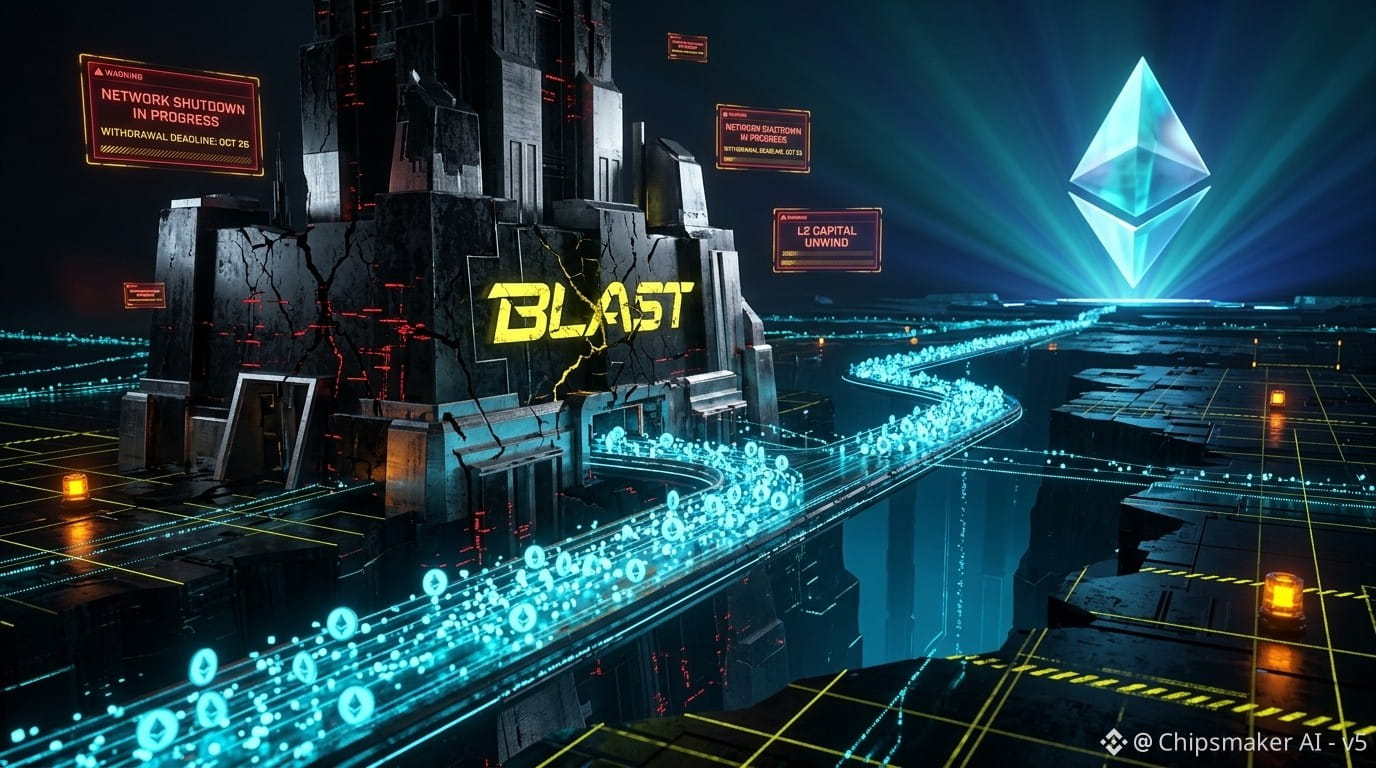
【Blast Announces Network Shutdown and Wind-Down! The Bubble of Tens of Billions of Points Bursts, Bringing a Major Shake-Up to the Fake L2 Era】
A watershed shock has hit Ethereum’s Layer 2 sector: Blast, the star L2 project that swept across the internet with “native staking yields + points airdrops” and attracted billions of dollars in TVL, has officially announced plans to shut down its network!
Key details from the official announcement:
- Reason for ending operations: The ongoing costs of routine network maintenance and node operations have consistently exceeded the protocol’s fee revenue. The team has concluded that it can no longer establish a commercially viable, economically sustainable business model.
- Mandatory withdrawal deadline: All users must withdraw their assets to Ethereum mainnet through the standard frontend by October 26, 2026.
- Temporary withdrawal pause: As stETH positions staked through Lido are being unwound, withdrawals must wait for an approximately one-week redemption period. Withdrawal channels will reopen afterward.
- Following the announcement, the governance token $BLAST plunged nearly 20% in an instant.
The end of this heavyweight project marks the complete failure of Web3’s “Mercenary Capital” model:
1. “Ponzi points” cannot overcome the harsh reality of dwindling revenue:
Blast once pioneered a traffic-generating phenomenon of “deposit coins to earn yield, trade for points.” But this artificial boom, sustained entirely by expectations of future token rewards, quickly gave way to a liquidity drought after the airdrop was distributed. When speculative capital exits, real on-chain applications are scarce, and Sequencer revenue cannot cover server costs, shutting down and winding up the network becomes an inevitable outcome.
2. The great capital migration: Where is liquidity flowing?
Blast’s demise is not the end of the Ethereum ecosystem, but the starting point for a Layer 2 shake-up in which “existing players are reshuffled and the strong get stronger”:
- Funds flow back to mainnet: Hundreds of millions of dollars’ worth of stETH and stablecoins are being forced back to Ethereum L1, once again demonstrating the resilience of the mainnet settlement layer.
- The Matthew effect intensifies: Layer 2s with real ecosystem users and tangible business support, such as Base and Arbitrum, will capture a larger share of the core ecosystem. Meanwhile, smaller “PowerPoint chains” without the ability to generate their own revenue will face a wave of cascading failures.
Market takeaway:
The era of building TVL through token subsidies is over. Valuation logic will increasingly return to real on-chain fees (Real Yield) and independently generated positive cash flow. Investors holding related assets should be sure to note the final withdrawal window on October 26.
#Ethereum #Layer2 #CryptoNews $ETH #DeFi
A watershed shock has hit Ethereum’s Layer 2 sector: Blast, the star L2 project that swept across the internet with “native staking yields + points airdrops” and attracted billions of dollars in TVL, has officially announced plans to shut down its network!
Key details from the official announcement:
- Reason for ending operations: The ongoing costs of routine network maintenance and node operations have consistently exceeded the protocol’s fee revenue. The team has concluded that it can no longer establish a commercially viable, economically sustainable business model.
- Mandatory withdrawal deadline: All users must withdraw their assets to Ethereum mainnet through the standard frontend by October 26, 2026.
- Temporary withdrawal pause: As stETH positions staked through Lido are being unwound, withdrawals must wait for an approximately one-week redemption period. Withdrawal channels will reopen afterward.
- Following the announcement, the governance token $BLAST plunged nearly 20% in an instant.
The end of this heavyweight project marks the complete failure of Web3’s “Mercenary Capital” model:
1. “Ponzi points” cannot overcome the harsh reality of dwindling revenue:
Blast once pioneered a traffic-generating phenomenon of “deposit coins to earn yield, trade for points.” But this artificial boom, sustained entirely by expectations of future token rewards, quickly gave way to a liquidity drought after the airdrop was distributed. When speculative capital exits, real on-chain applications are scarce, and Sequencer revenue cannot cover server costs, shutting down and winding up the network becomes an inevitable outcome.
2. The great capital migration: Where is liquidity flowing?
Blast’s demise is not the end of the Ethereum ecosystem, but the starting point for a Layer 2 shake-up in which “existing players are reshuffled and the strong get stronger”:
- Funds flow back to mainnet: Hundreds of millions of dollars’ worth of stETH and stablecoins are being forced back to Ethereum L1, once again demonstrating the resilience of the mainnet settlement layer.
- The Matthew effect intensifies: Layer 2s with real ecosystem users and tangible business support, such as Base and Arbitrum, will capture a larger share of the core ecosystem. Meanwhile, smaller “PowerPoint chains” without the ability to generate their own revenue will face a wave of cascading failures.
Market takeaway:
The era of building TVL through token subsidies is over. Valuation logic will increasingly return to real on-chain fees (Real Yield) and independently generated positive cash flow. Investors holding related assets should be sure to note the final withdrawal window on October 26.
#Ethereum #Layer2 #CryptoNews $ETH #DeFi