

Only 3 of the 50 largest stablecoins meet the European standard. Circle is asking for equivalence with the U.S. before the gap becomes irreversible.
The boundary MiCA drew, with three coins inside and the rest of the market waiting outside.
The stablecoin supply gap under MiCA’s clampdown is around USD 238 billion.
Circle is asking for equivalence so that MiCA can expand the stablecoin market.
The Regulation on Crypto-Asset Markets (MiCA) establishes a restrictive standard in the European Union that limits access to capital compared with the global sector.
Of the 50 largest stablecoins by market capitalization, only three are authorized to operate under MiCA: USD Coin (USDC), EUR Coin (EURC), and Global Dollar (USDG), backed by the infrastructure of Circle and Paxos.
The regulatory perimeter excludes 94% of the leading stablecoins by number of assets from the European market—that is, 47 of the sector’s 50 largest. These projects account for 75% of global capital, led by Tether (USDT), the giant that dominates global liquidity and whose absence confirms the bloc’s isolation.
This assessment is not theoretical. The figure appears in Circle’s official response to the European Commission’s public review consultation, published on October 1, 2026.
In its document, the company that issues USDC argues that MiCA risks turning the European Union into a financial ghetto, disconnected from major global payment and investment networks.
The core of the complaint is the lack of flexibility in recognizing rules from other key markets, such as the U.S. GENIUS Act, forcing companies to choose between complying with Brussels and maintaining international liquidity.
Circle’s warning
To break the bottleneck, Circle is proposing the urgent adoption of a transatlantic equivalence regime based on the model of traditional financial directives, such as the European Market Infrastructure Regulation (EMIR) or the Markets in Financial Instruments Regulation (MiFIR).
Under this framework, the European Commission would recognize the equivalence of the U.S. framework, while the European Banking Authority (EBA) would validate each issuer individually.
While Brussels considers whether to introduce this potential relaxation, market practice confirms the cost of compliance. The recent launch of the USDAU stablecoin, developed by Frankfurt-based AllUnity, illustrates this phenomenon.
To operate in the bloc, the company had to obtain a license from BaFin, Germany’s Federal Financial Supervisory Authority. The outcome reinforces the assessment, since the asset was launched with a limited scope, serving corporate treasuries and institutional clients without offering a mass-liquidity solution for the retail market.
The German example proves Circle right: tightening the rules will not eliminate demand for digital dollars. If the European Commission does not recognize U.S. rules by early 2027, it will not protect users; it will only push European capital toward offshore markets beyond any government oversight.
The mathematics of isolation and the $238 billion left out of play
This operational paralysis is not an abstract debate; it is reflected in a record amount of sidelined capital. At the end of June 2026, the global stablecoin supply reached $315.8 billion, according to DefiLlama data.
Just $77.73 billion operates within MiCA’s perimeter, concentrated almost entirely in USDC ($75.3 billion), EURC ($430.4 million), and USDG (estimated at $2 billion). The addition of recently launched corporate assets does not change this scale.
This supply gap represents more than a statistical discrepancy. In practice, it means that 75% of global dollar stablecoin liquidity is barred from entering European platforms.
Providers licensed in the European Union cannot list, custody, or offer trading pairs for major assets such as Tether or DAI. As a result, European exchanges lose volume to foreign competitors, and local users are cut off from the planet’s largest trading markets.
The paralysis affects authorized companies themselves. Of the 23 electronic money token (EMT) issuers registered in the European Union, only 9 hold a crypto-asset service provider (CASP) license under Article 60. 61% of approved entities are not authorized to custody or distribute their tokens, fragmenting operations from the outset.
Among comprehensive regulatory frameworks—those requiring prior authorization, audited reserves, and supervision with enforcement powers—MiCA captures the smallest share of the global supply relative to its regulatory ambition.
The world’s most ambitious regulation is building the smallest market among its peers. This does not refer to the volume of domestic transactions in the EU or the number of European users; it refers to the share of the global supply it captures.
A jurisdiction such as El Salvador can supervise Tether, which has more than $183.8 billion in supply, without that constituting a comprehensive regulated market. The comparison is between regulatory frameworks, not domestic market sizes.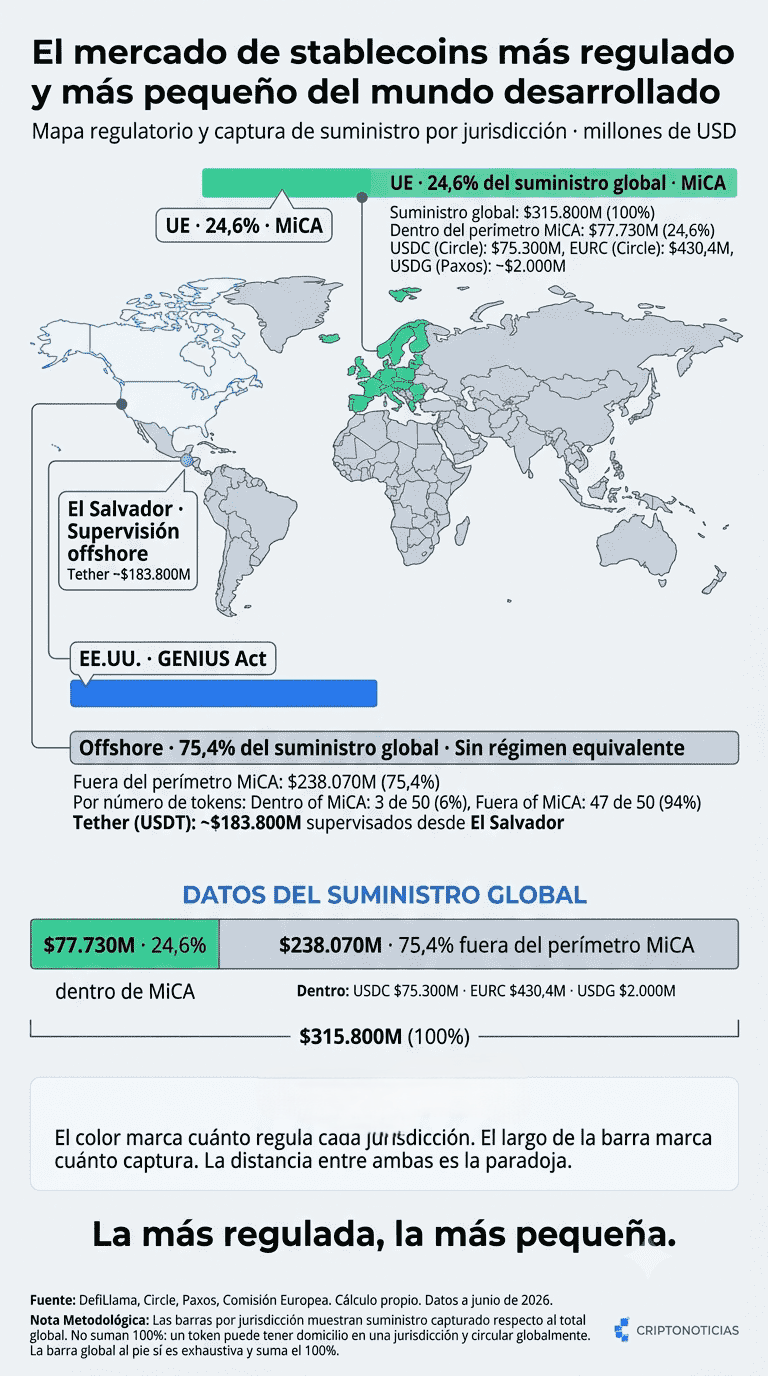
The more intense the color, the more comprehensive the regulation. The larger the bubble, the more market captured. MiCA has the first, but lacks the second
Protect investors—or drive them into the unregulated market?
The divergence stems from two irreconcilable regulatory models. On one side, the European approach imposes commercial reserves and requires significant issuers to hold 60% of their funds in accounts at EU banks. On the other, the U.S. approach favors direct government backing and requires collateral to be concentrated in Treasury bills with maturities of no more than 93 days.
Without a mutual recognition agreement, a U.S. issuer cannot deposit its cash in European banks without violating the laws of its home country.
Meeting these requirements involves building a costly network of partnerships. An issuer such as AllUnity cannot operate directly; instead, it must divide its business among BaFin banking licenses, external custodians such as Banking Circle, and additional intermediaries to manage liquidity and conversions into fiat currency. This overreliance on partners makes the service more expensive and explains why these assets are launched for large corporations only.
The result of this rollout is a two-speed market. European regulation succeeds in eliminating counterparty risk and safeguarding banking stability, but at the cost of choking liquidity and rendering retail investors invisible. While large corporations use dollar stablecoins under the protections of Article 49 of MiCA, the general public has no approved alternatives and is left underserved within the legal system.
The 2027 ultimatum and the urgency of transatlantic equivalence
Warnings from international issuers are part of the formal review that European authorities have just launched. After receiving industry feedback in the consultation that ended in September, the Commission is mandated to issue its technical assessment during the first three months of 2027, opening the only legal window to correct the market’s course.
In its 2020 impact studies, Commission officials warned that a ban on foreign stablecoins would push European users toward offshore platforms. If the 2027 report does not include a formal equivalence proposal, the $238 billion gap will cease to be a temporary discrepancy and become a permanent wall in Europe’s financial infrastructure.
#MiCA #Stablecoins #regulacion #LeyGENIUS #stablecoin $USDC $BTC $CRCL