During the National Day holiday, I took the time to read through in earnest the book *Binance Life* written by Big Cousin @CZ .
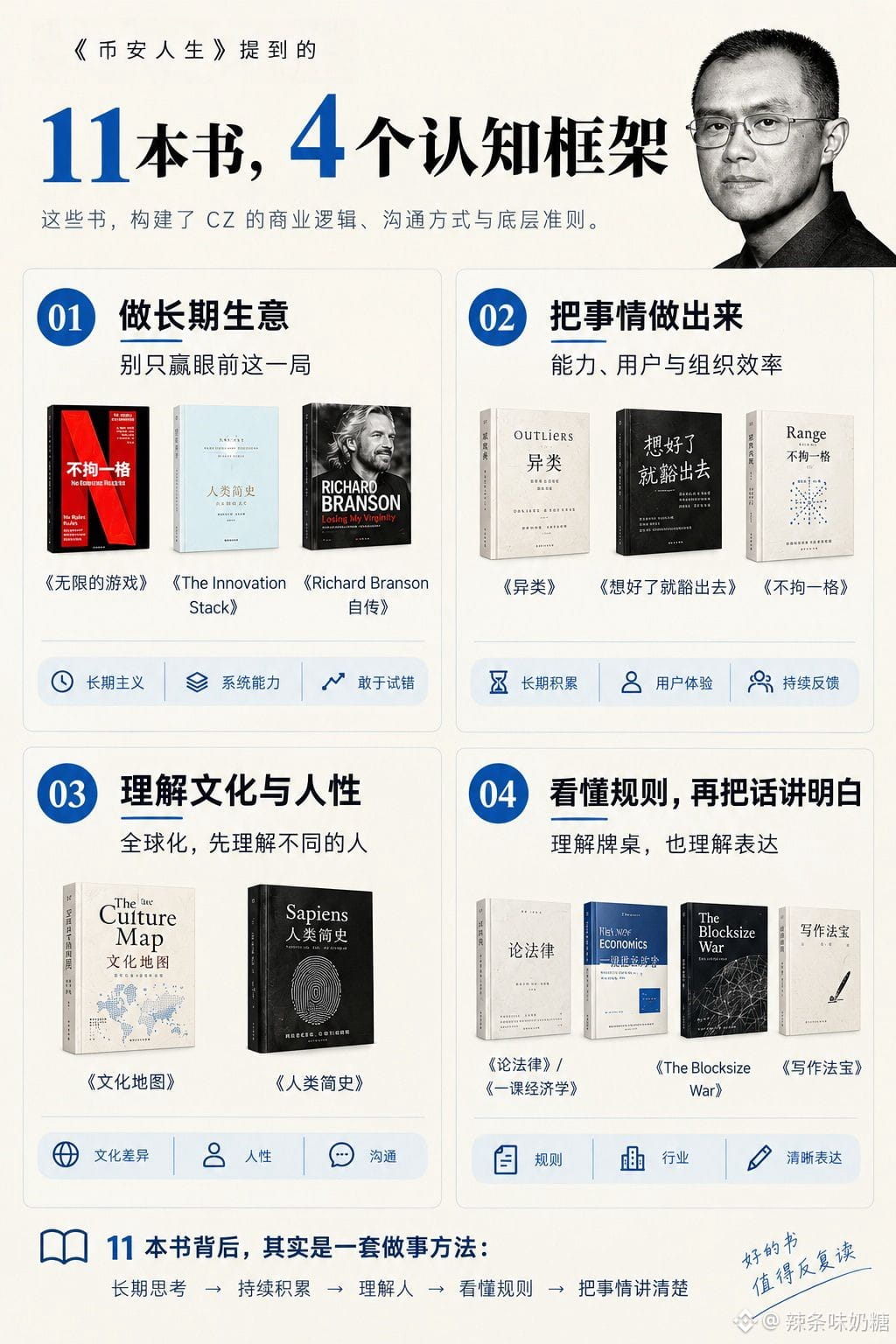
I compiled the reading list mentioned in the book, and I reorganized it by purpose (the drive link is shared in the comments).
1|For long-term business: don’t just win the current round
*The Infinite Game* ☑️
*The Innovation Stack*
*Richard Branson: A Memoir*
This set is about how to build a business that lasts. Long-term goals, system capabilities, and being willing to experiment—these are things you can see in Binance’s early expansion.
2|Get things done: ability, users, and organizational efficiency
*Outliers* ☑️
*Whatever It Takes* ☑️
*Good to Great* ☑️
Ten thousand hours, user experience, public feedback. They sound simple, but anyone who’s actually led a team knows these are the most time-consuming things—and they’re also what create the biggest gaps.
3|Dealing with different kinds of people: understanding culture and human nature
*The Culture Map*
*A Brief History of Humankind* ☑️
From the very beginning, Binance has been a global company. Many disputes on the surface are language issues; underneath, the real differences are culture, habits, and interest structures.
4|Rules, industries, and expression: understand the table, then say things clearly
*On Law* / *Microeconomics for Everyone*
*The Blocksize War* ☑️
*Writing Tools*
Now, back to *Binance Life*—this book feels more like a diary.
Big Cousin has said in multiple interviews that he’s very good at handling pressure. In his student days, even if things were noisy at home, he could still go to school as usual; later, when the company got pulled into legal proceedings, he could switch between meetings with lawyers and running the company operations.
That near “emotional isolation” ability may not be something to envy, but it truly helped him get through Binance’s hardest years.
A token offering dumping at launch, a downturn in the industry, regulatory entanglements—any one of these would be enough to derail many entrepreneurs. Reaching the world’s largest exchange in half a year depended, of course, on more than just being able to handle pressure. But being able to keep making decisions and keep pushing the business amid high pressure and chaos—this ability is hard to ignore.
There’s one line in the book that I really like: “Future opportunities will surely be more than the past.”
If you want to understand Binance’s history, this book may not add many new alpha. But if you want to see how someone sorts themselves out under immense pressure, it’s definitely worth reading carefully.