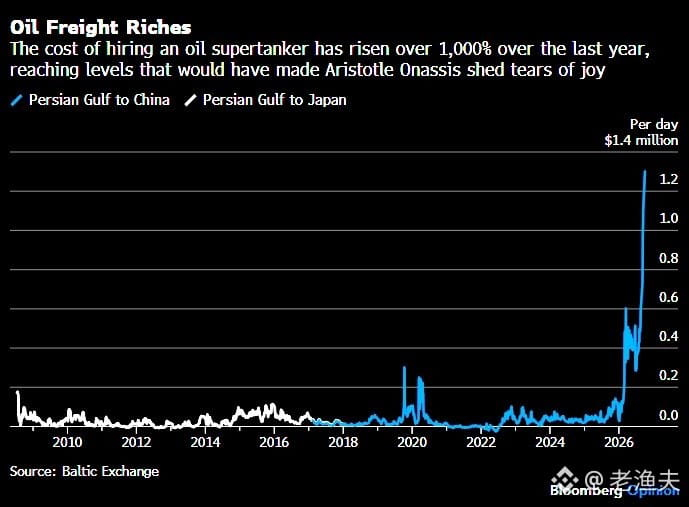
The crude oil export volume through the Strait of Hormuz has indeed returned to pre-war levels, but oil prices are still hovering above a hundred. Many people don’t understand why, even though supply has recovered, prices won’t come down.
The answer isn’t on the supply side—it’s in transportation costs. Now, tanker freight rates have surged to more than ten times their previous level, and they’re still climbing. This means that even if crude oil leaves the production regions, the cost of moving it to end markets increases substantially, and that higher cost ultimately shows up in oil prices.
This is a typical case of “supply-chain bottleneck pricing”—it’s not about whether it can be produced, but whether it can be moved, or whether it’s too expensive to move. Insurance premiums, rerouting costs, vessel shortages, and geopolitical risk premiums all stack into the freight charges.
Historically, this has happened often. After the Asian financial crisis in the late 1990s, oil prices also stayed high for a time due to tight capacity and skyrocketing insurance costs, even though OPEC production was sufficient. When oil prices surged to $147 in 2008, transportation costs and financial speculation also played a major role.
So when looking at oil prices, you can’t focus only on output and inventories—you also need to examine the cost structure of the entire logistics chain. As long as transportation costs don’t come down, it will be difficult for oil prices to truly fall.
The answer isn’t on the supply side—it’s in transportation costs. Now, tanker freight rates have surged to more than ten times their previous level, and they’re still climbing. This means that even if crude oil leaves the production regions, the cost of moving it to end markets increases substantially, and that higher cost ultimately shows up in oil prices.
This is a typical case of “supply-chain bottleneck pricing”—it’s not about whether it can be produced, but whether it can be moved, or whether it’s too expensive to move. Insurance premiums, rerouting costs, vessel shortages, and geopolitical risk premiums all stack into the freight charges.
Historically, this has happened often. After the Asian financial crisis in the late 1990s, oil prices also stayed high for a time due to tight capacity and skyrocketing insurance costs, even though OPEC production was sufficient. When oil prices surged to $147 in 2008, transportation costs and financial speculation also played a major role.
So when looking at oil prices, you can’t focus only on output and inventories—you also need to examine the cost structure of the entire logistics chain. As long as transportation costs don’t come down, it will be difficult for oil prices to truly fall.