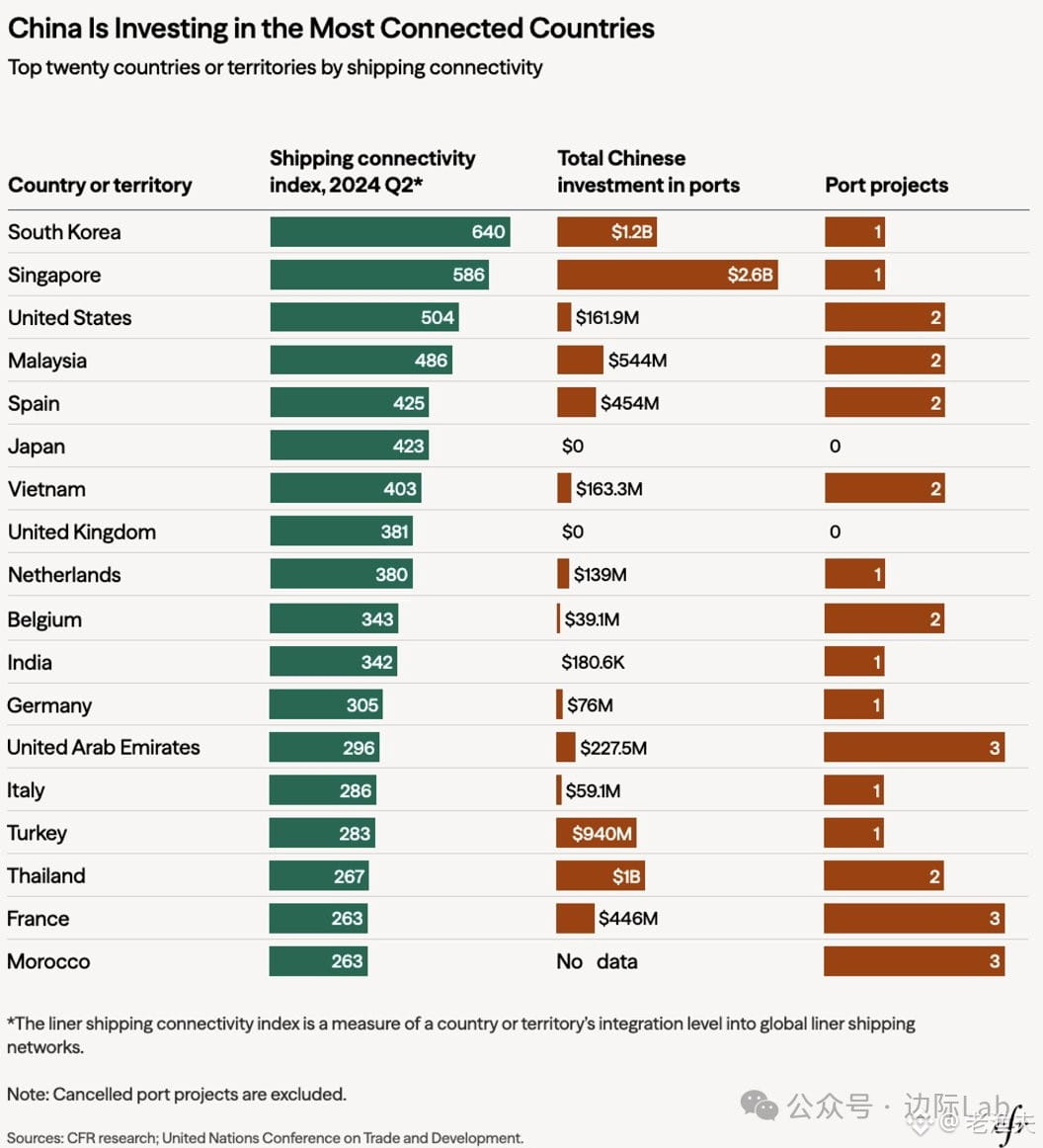
China’s port investment strategy is actually quite clear—target countries among the top 20 in the Global Shipping Connectivity Index, and according to CFR data, by Q2 2024, 15 of those 20 have already received investments.
This isn’t anything new; over the past decade or more, we’ve seen countless similar layouts: from Piraeus in Greece to Gwadar in Pakistan, from Hambantota in Sri Lanka to Trieste in Italy. On the surface it looks like business investment, but in reality it’s a flag planted on the global trade arteries.
Seasoned traders all understand one key truth: controlling liquidity nodes is more valuable than owning the cargo itself. Ports are liquidity nodes for global trade—whoever controls these choke points holds the leverage in geopolitical contests and supply-chain restructuring.
Now the US and Europe are starting to take notice, but the game is already on the board. In the coming years, competition for this kind of infrastructure will only intensify, not ease. commodity flows, currency flows, capital flows—none of them can bypass these ports.
This is the real-world map of great-power competition—no conspiracy theories here, just geopolitics that’s openly on the table, i.e., transparent economic geography.
This isn’t anything new; over the past decade or more, we’ve seen countless similar layouts: from Piraeus in Greece to Gwadar in Pakistan, from Hambantota in Sri Lanka to Trieste in Italy. On the surface it looks like business investment, but in reality it’s a flag planted on the global trade arteries.
Seasoned traders all understand one key truth: controlling liquidity nodes is more valuable than owning the cargo itself. Ports are liquidity nodes for global trade—whoever controls these choke points holds the leverage in geopolitical contests and supply-chain restructuring.
Now the US and Europe are starting to take notice, but the game is already on the board. In the coming years, competition for this kind of infrastructure will only intensify, not ease. commodity flows, currency flows, capital flows—none of them can bypass these ports.
This is the real-world map of great-power competition—no conspiracy theories here, just geopolitics that’s openly on the table, i.e., transparent economic geography.