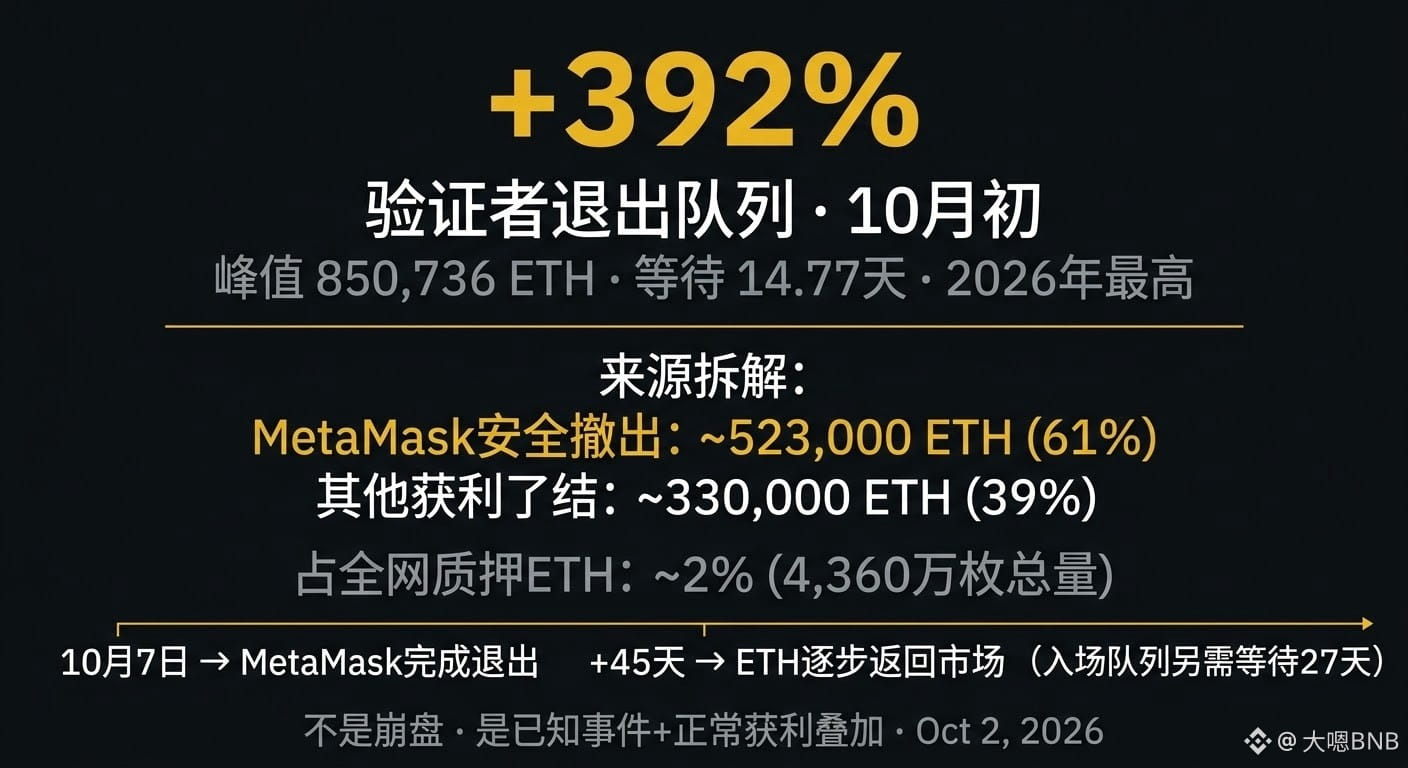

In early October, the Ethereum validator exit queue jumped 392%—a peak of 850,736 ETH, with a waiting time of 14.77 days, the longest this year.
First, put the numbers into perspective:
Total network staked ETH is about 43.6 million—850,000 of that is roughly 2%.
This isn’t a collapse; it’s localized pressure.
The drivers are clear:
About 523,000 ETH comes from a precautionary exit from MetaMask—last week MetaMask experienced an infrastructure security incident and proactively shut down about 17,000 validator nodes, which is the matter we mentioned earlier.
The remaining roughly 330,000 ETH comes from profit-taking by other stakers—ETH rose nearly 60% in Q3, and some capital at elevated levels chose to exit.
With both factors stacked, the queue piled up to the highest level of the year.
Timeline: MetaMask’s partial exits are expected to complete around October 7, but full withdrawals plus re-entry require another ~45 days, because the entry queue still has to wait about 27 days.
This batch of returning ETH to the market has a time lag, so it won’t dump all at once.
For ETH price: the real selling pressure will only show up once validators complete the exit process—not immediately today.
But with three things happening together—Ethereum ETF net outflows for three consecutive days totaling $118 million, the exit queue hitting an annual peak, and the BTC ETF continuing to see inflows during the same period—these jointly indicate that institutional capital currently has a clear directional divergence between ETH and BTC.
Is this a temporary divergence, or a trend-level rotation?
October’s data will tell.
$ETH
#以太坊验证者退出队列增392%
First, put the numbers into perspective:
Total network staked ETH is about 43.6 million—850,000 of that is roughly 2%.
This isn’t a collapse; it’s localized pressure.
The drivers are clear:
About 523,000 ETH comes from a precautionary exit from MetaMask—last week MetaMask experienced an infrastructure security incident and proactively shut down about 17,000 validator nodes, which is the matter we mentioned earlier.
The remaining roughly 330,000 ETH comes from profit-taking by other stakers—ETH rose nearly 60% in Q3, and some capital at elevated levels chose to exit.
With both factors stacked, the queue piled up to the highest level of the year.
Timeline: MetaMask’s partial exits are expected to complete around October 7, but full withdrawals plus re-entry require another ~45 days, because the entry queue still has to wait about 27 days.
This batch of returning ETH to the market has a time lag, so it won’t dump all at once.
For ETH price: the real selling pressure will only show up once validators complete the exit process—not immediately today.
But with three things happening together—Ethereum ETF net outflows for three consecutive days totaling $118 million, the exit queue hitting an annual peak, and the BTC ETF continuing to see inflows during the same period—these jointly indicate that institutional capital currently has a clear directional divergence between ETH and BTC.
Is this a temporary divergence, or a trend-level rotation?
October’s data will tell.
$ETH
#以太坊验证者退出队列增392%