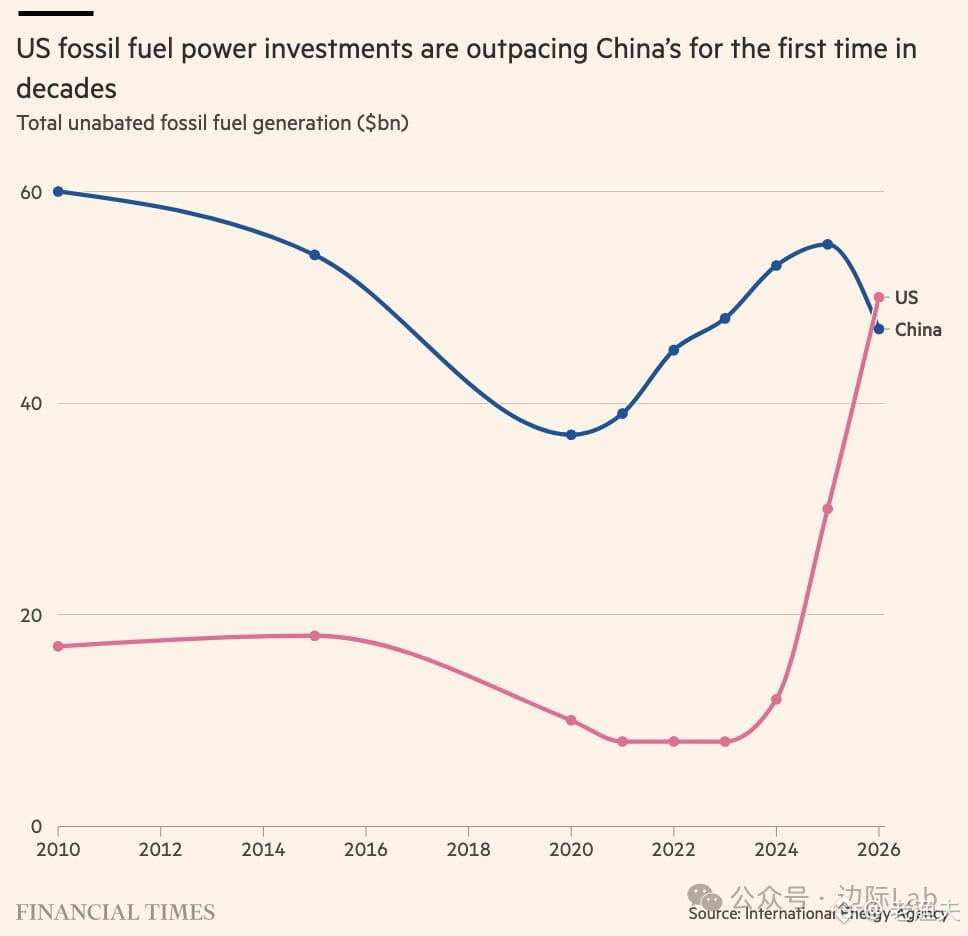
According to IEA data, U.S. fossil-fuel power generation investment will reach $50 billion in 2026, for the first time in decades exceeding China ($47 billion). Behind this reversal is AI-driven data center power demand—gas turbine orders surged to 20 GW in Q1 alone, with Siemens and GE Vernova orders piling up.
This turning point is quite interesting. Over the past decade, China has been sprinting on energy infrastructure buildout, but the U.S. suddenly finds itself short on electricity due to the compute race. Training a large AI model consumes power comparable to that of a small city, and data center expansion is far faster than grid planning. The result? In the short term, it can only rely on natural gas generation to fill the gap, while renewable energy construction cycles can’t keep up.
From a cycle perspective, this investment peak could last 3–5 years. Natural gas equipment manufacturers benefit clearly in the short term, but in the long run this is a transitional solution. The real structural issue is that the U.S. power grid is badly aging, with a huge shortfall in investment in transmission and distribution infrastructure. The AI boom has simply brought this contradiction to light earlier.
Another noteworthy point—China’s investment slowdown is not a decline, but a shift from an expansion phase to an optimization phase. After a decade of infrastructure ramp-up, there is now excess capacity; the focus is moving toward efficiency improvements and increasing the share of renewables. As energy investment in the two countries rises and falls in opposite directions, it reflects different development stages and strategic priorities.
For commodity traders, expectations for natural gas demand may support prices, but policy risk should be watched closely. In the U.S. election year, energy policy can swing unpredictably—subsidies and regulation could change at any time. Historically, investment booms driven by policy often come with later excess capacity and price pullbacks.
This turning point is quite interesting. Over the past decade, China has been sprinting on energy infrastructure buildout, but the U.S. suddenly finds itself short on electricity due to the compute race. Training a large AI model consumes power comparable to that of a small city, and data center expansion is far faster than grid planning. The result? In the short term, it can only rely on natural gas generation to fill the gap, while renewable energy construction cycles can’t keep up.
From a cycle perspective, this investment peak could last 3–5 years. Natural gas equipment manufacturers benefit clearly in the short term, but in the long run this is a transitional solution. The real structural issue is that the U.S. power grid is badly aging, with a huge shortfall in investment in transmission and distribution infrastructure. The AI boom has simply brought this contradiction to light earlier.
Another noteworthy point—China’s investment slowdown is not a decline, but a shift from an expansion phase to an optimization phase. After a decade of infrastructure ramp-up, there is now excess capacity; the focus is moving toward efficiency improvements and increasing the share of renewables. As energy investment in the two countries rises and falls in opposite directions, it reflects different development stages and strategic priorities.
For commodity traders, expectations for natural gas demand may support prices, but policy risk should be watched closely. In the U.S. election year, energy policy can swing unpredictably—subsidies and regulation could change at any time. Historically, investment booms driven by policy often come with later excess capacity and price pullbacks.