Taiwan Strait’s strategic dependency on Japan, South Korea, and the Philippines is actually higher than many people think.
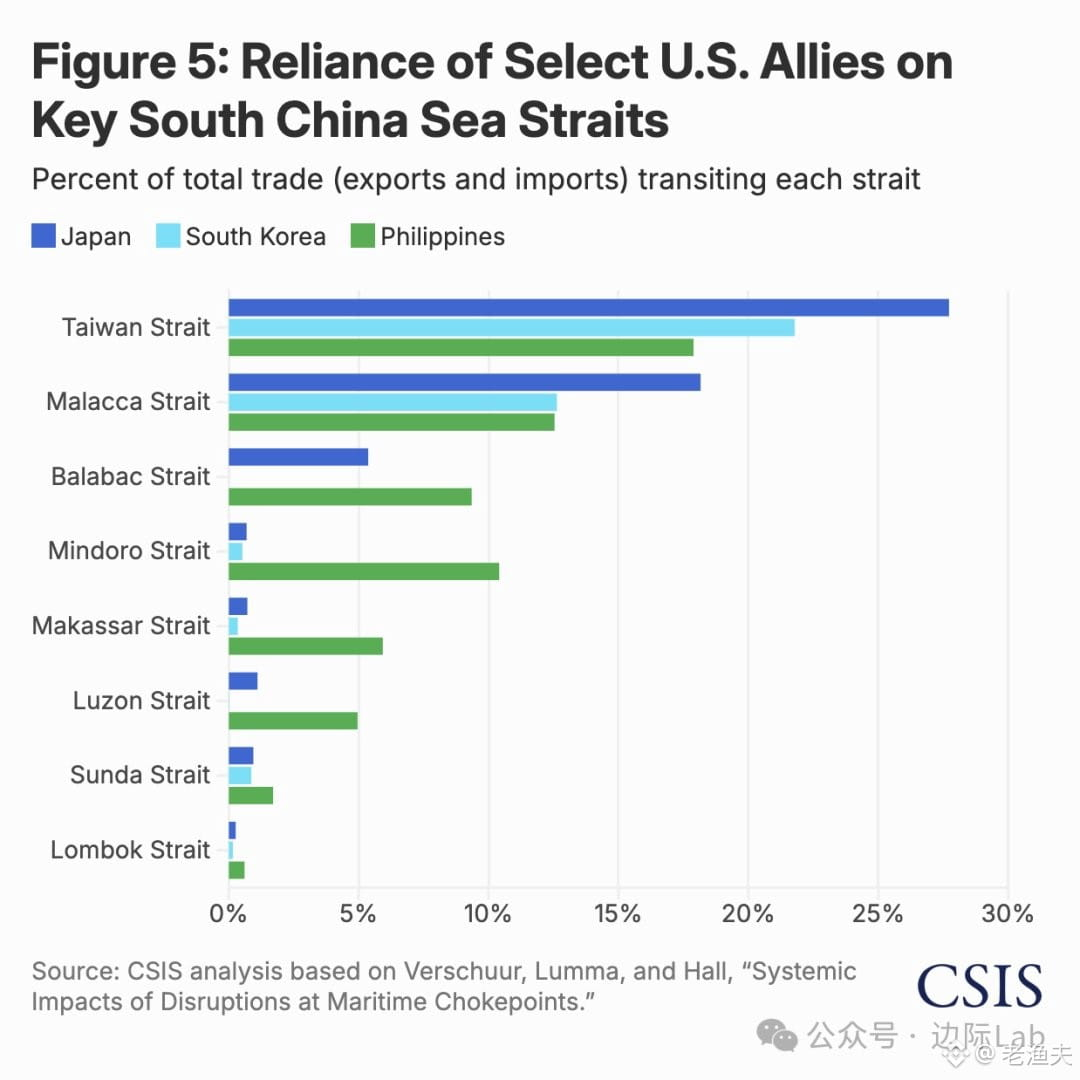
2024 data: Japan 28% of its foreign trade goes through the Taiwan Strait, South Korea 22%, and the Philippines 18%—all far exceeding their reliance on the Strait of Malacca (Japan 18%, South Korea 13%, Philippines 17%).
This is not just a matter of energy routes. For Japan and South Korea, what makes the Taiwan Strait more critical is the flow of high-value manufactured goods—semiconductors, precision machinery, and electronic components—deeply integrated with supply chains linking them to mainland China and Southeast Asia.
In other words, once something goes wrong in the Taiwan Strait, the hardest hit won’t be the U.S. and Europe, but rather these key American allies in East Asia. Geo-political risk is being priced in, but the market hasn’t fully digested it yet. That’s the real “chokepoint.”
As the old saying goes: maps are more honest than ideology.
2024 data: Japan 28% of its foreign trade goes through the Taiwan Strait, South Korea 22%, and the Philippines 18%—all far exceeding their reliance on the Strait of Malacca (Japan 18%, South Korea 13%, Philippines 17%).
This is not just a matter of energy routes. For Japan and South Korea, what makes the Taiwan Strait more critical is the flow of high-value manufactured goods—semiconductors, precision machinery, and electronic components—deeply integrated with supply chains linking them to mainland China and Southeast Asia.
In other words, once something goes wrong in the Taiwan Strait, the hardest hit won’t be the U.S. and Europe, but rather these key American allies in East Asia. Geo-political risk is being priced in, but the market hasn’t fully digested it yet. That’s the real “chokepoint.”
As the old saying goes: maps are more honest than ideology.