The Taiwan Strait has already surpassed the Strait of Malacca to become China’s most critical trade choke point—a shift many people still haven’t fully realized.
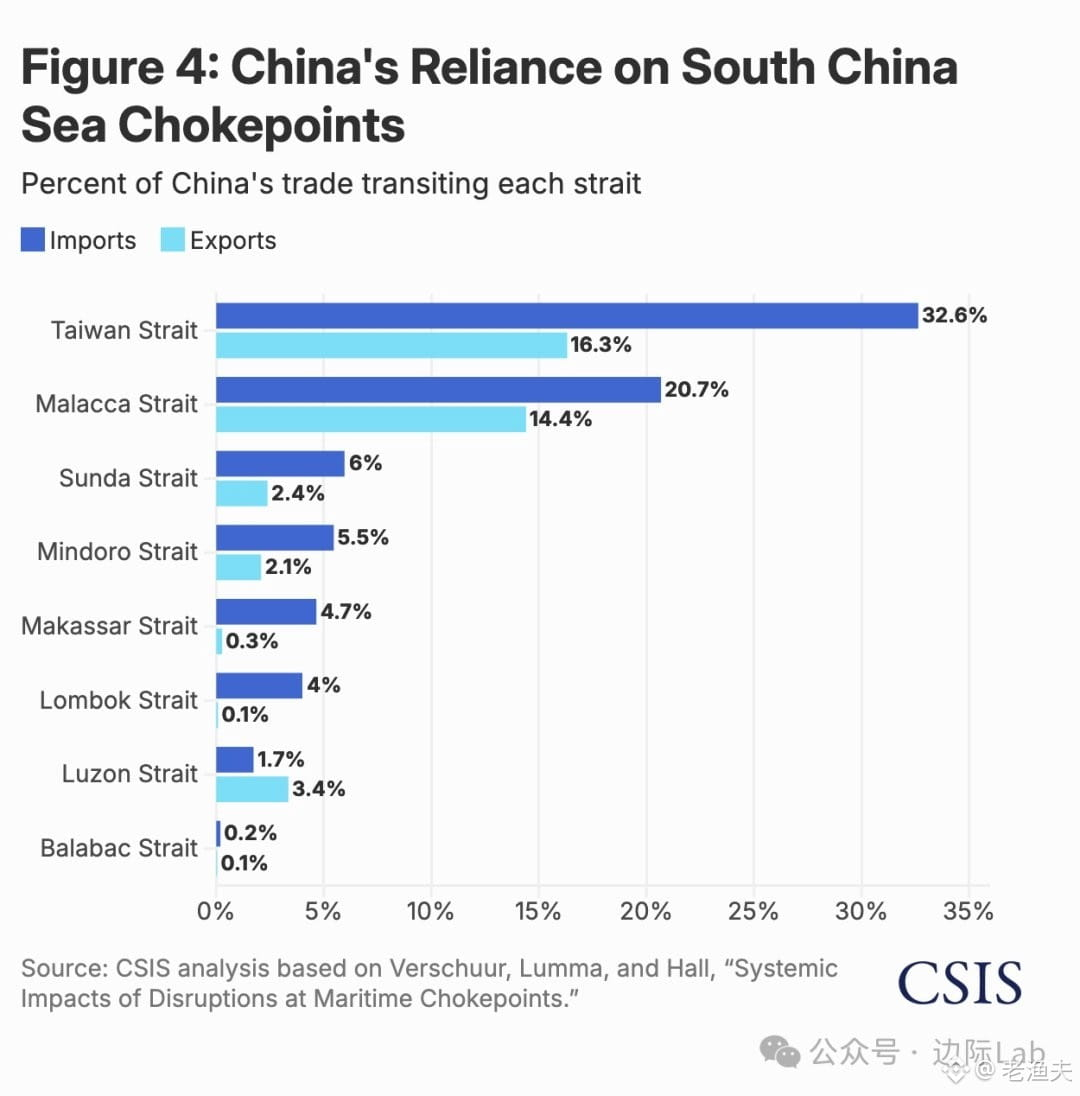
According to the latest CSIS data: in 2024, 32.6% of China’s imports (about US$1.3 trillion) and 16.3% of its exports need to pass through the Taiwan Strait, far exceeding Malacca’s 20.7% for imports and 14.4% for exports. It’s not only energy and raw materials—there is also a large amount of freight moving between domestic north-south ports.
This isn’t a geopolitical narrative; it’s a hard reality of trade logistics. Consider this: if this route is disrupted, the impact won’t stop at external trade—domestic supply chains would get stuck too.
Older generations used to talk about the “Malacca dilemma.” Now it’s time to re-examine the map. The Taiwan Strait is not only a military hotspot, but also a major artery of China’s economy. With this level of dependence, any disturbance will directly feed into commodity prices, shipping costs, and even the global supply chain.
Historically, whenever a key shipping lane has been threatened, markets have priced in a risk premium in advance. Will this time be an exception? We’ll see.
According to the latest CSIS data: in 2024, 32.6% of China’s imports (about US$1.3 trillion) and 16.3% of its exports need to pass through the Taiwan Strait, far exceeding Malacca’s 20.7% for imports and 14.4% for exports. It’s not only energy and raw materials—there is also a large amount of freight moving between domestic north-south ports.
This isn’t a geopolitical narrative; it’s a hard reality of trade logistics. Consider this: if this route is disrupted, the impact won’t stop at external trade—domestic supply chains would get stuck too.
Older generations used to talk about the “Malacca dilemma.” Now it’s time to re-examine the map. The Taiwan Strait is not only a military hotspot, but also a major artery of China’s economy. With this level of dependence, any disturbance will directly feed into commodity prices, shipping costs, and even the global supply chain.
Historically, whenever a key shipping lane has been threatened, markets have priced in a risk premium in advance. Will this time be an exception? We’ll see.