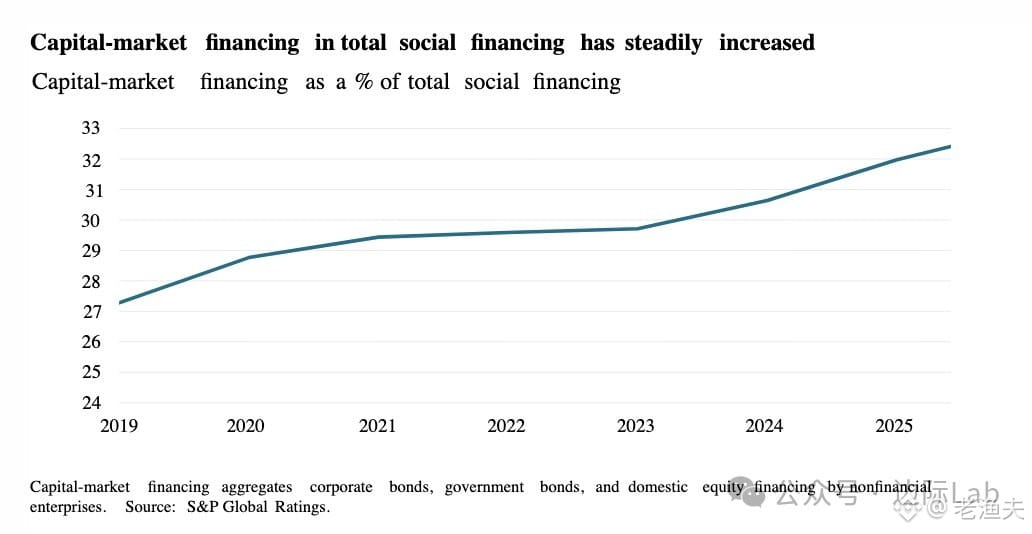
Recently, the PBoC has proposed setting up a liquidity support tool for non-bank financial institutions (such as securities firms). In essence, this is an admission of a reality: China’s financing structure has already changed. The share of financing from the capital markets in social financing (社融) has risen from 27% in 2019 to now over 32%. This means the systemic importance of non-bank institutions such as securities firms and funds is becoming increasingly critical, and they can no longer be treated as peripheral players.
The logic behind this tool is straightforward. In extreme circumstances, non-bank institutions can exchange bonds for cash to prevent liquidity stress from spreading throughout the entire financial system. This is not a new idea. The SFISF at the end of last year and the expansion of first-tier dealers in April this year are both continuations of the same playbook. Regulators are building a safety net for non-bank institutions because the era of bank-led indirect financing is already transitioning.
From a cyclical perspective, this kind of policy typically appears in two stages: either ahead of time to prepare for future risks, or after certain early signals have already been detected. Given the global tightening of liquidity and increased volatility in domestic assets, this tool looks more like a precautionary measure. However, it’s also important to be clear: having a tool does not mean things won’t go wrong. It only means there is a buffer if something happens. The fundamental issues still lie in non-bank institutions’ leverage and asset quality.
Looking back historically, whenever financial structures shift, new risk points and new regulatory tools tend to emerge. The U.S. S&L crisis in the 1980s and Japan’s securities firm failures in the 1990s are similar lessons. China is now moving down the path of expanding direct financing. The growth of non-bank institutions is inevitable—but whether risk management can keep pace is the key. This tool helps fill a shortcoming, but don’t expect it to solve all problems.
The logic behind this tool is straightforward. In extreme circumstances, non-bank institutions can exchange bonds for cash to prevent liquidity stress from spreading throughout the entire financial system. This is not a new idea. The SFISF at the end of last year and the expansion of first-tier dealers in April this year are both continuations of the same playbook. Regulators are building a safety net for non-bank institutions because the era of bank-led indirect financing is already transitioning.
From a cyclical perspective, this kind of policy typically appears in two stages: either ahead of time to prepare for future risks, or after certain early signals have already been detected. Given the global tightening of liquidity and increased volatility in domestic assets, this tool looks more like a precautionary measure. However, it’s also important to be clear: having a tool does not mean things won’t go wrong. It only means there is a buffer if something happens. The fundamental issues still lie in non-bank institutions’ leverage and asset quality.
Looking back historically, whenever financial structures shift, new risk points and new regulatory tools tend to emerge. The U.S. S&L crisis in the 1980s and Japan’s securities firm failures in the 1990s are similar lessons. China is now moving down the path of expanding direct financing. The growth of non-bank institutions is inevitable—but whether risk management can keep pace is the key. This tool helps fill a shortcoming, but don’t expect it to solve all problems.