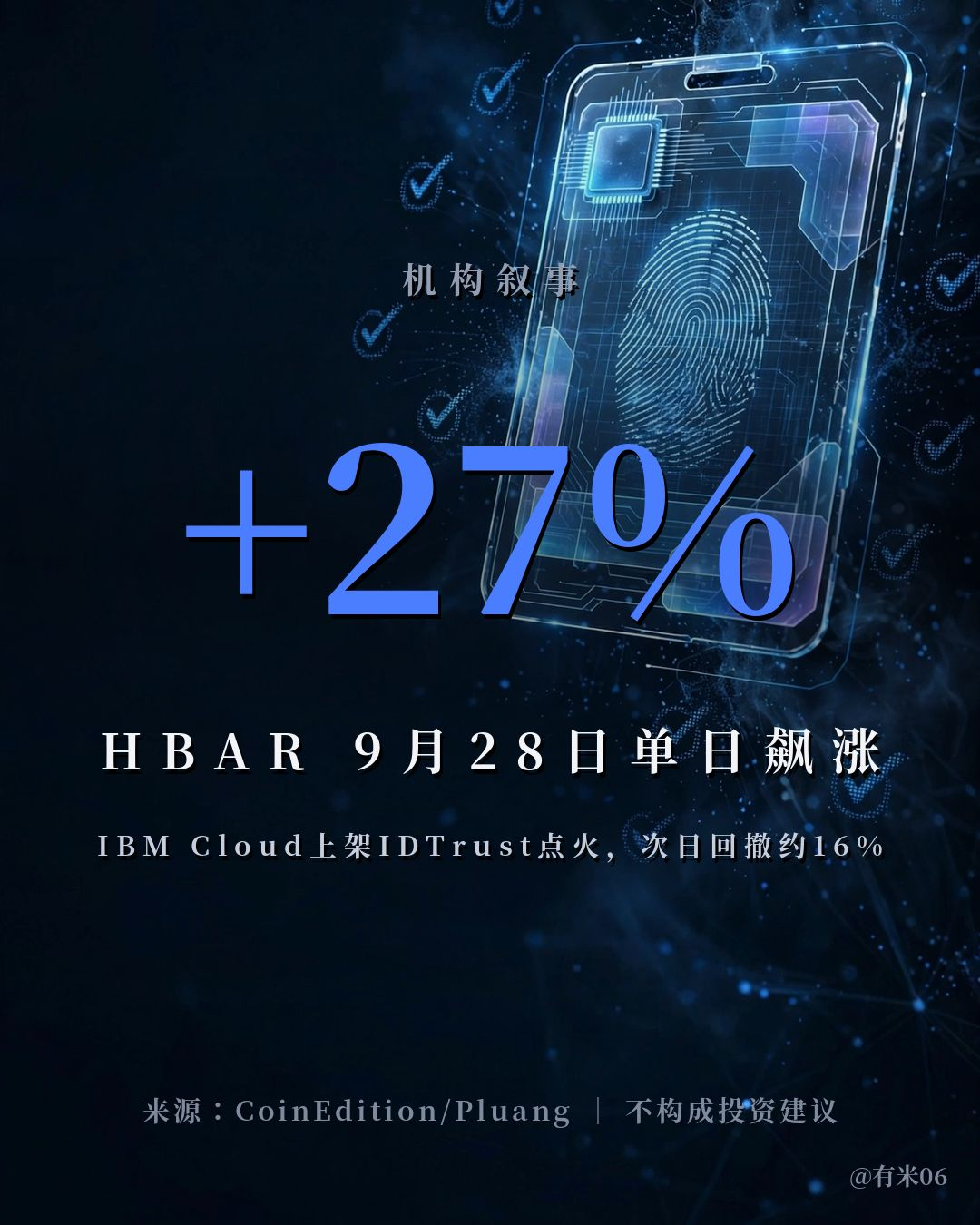
Google, IBM, Boeing, and Samsung are seated on the board—so why did HBAR jump nearly 40% in a week, only to be pulled back immediately?
What happened: On September 28, HBAR surged about 27% in a single day (from around 0.096 up to near 0.13). The weekly gain came to nearly 40%, and daily spot volume multiplied by more than 10x. The fuel behind the rally was mainly in the news: The Hashgraph Group’s AI identity platform IDTrust was listed in the IBM Cloud Catalog, meaning enterprise customers can access Hedera’s identity solution directly through IBM channels; on top of that, expectations of ongoing capital inflows into an HBAR spot ETF.
But then a bucket of cold water right away: the next day after the jump, it retreated about 16%, and it is now chopping around the $0.10 area. Santiment data shows that during the week the price surged, holdings measured in coin units skyrocketed 47% to nearly 1.2 billion HBAR—an annual high. This is typical of a spot squeeze plus leverage and FOMO, not genuine, real-world demand. Besides, while the listing is a listing: whether enterprise customers will use IDTrust, how much they will use, and how many HBAR they will burn are all still unknown. The so-called “NVIDIA partnership” that’s been floating online has never been confirmed by Hedera officially—don’t get swept up by reposted rumors.
How to look at it: This is a textbook “narrative rotation plus leverage ignition” type of market, not a fundamental-driven rally. Fairly speaking: institutional narrative is truly a positive for HBAR—the lineup at the governing council plus spot ETF exposure plus institutional partnerships like SWIFT gives it a “compliance plus institutions” label premium, which is rare among altcoins. But the chain must be clear: identity services bought by enterprises through the procurement chain doesn’t automatically mean someone is buying HBAR on the spot market. The transmission path of token value is still blurry. The only real verification lines are two: (1) enterprise customers generate actual on-chain transaction fee consumption, and (2) ETF inflows shift from a few million per week to consistently large inflows. As of now, neither has been proven—so this kind of setup is for watching, not for stepping in as the next rider. If you absolutely insist on tracking it, the key observation zone is around $0.10–$0.109. Holding above it counts as a valid breakout; if it falls back, you get another range-bound shakeout. Remember this: the more the “logic” behind a rally relies on a “story,” the less it makes sense when it drops.
Data as of: 2026-10-04 07:30 UTC
Sources: CoinEdition (Sep 29); Pluang (Oct 2)
For information sharing only and does not constitute investment advice.
Do you think enterprise-level narratives can really convert into real buy-side demand for the token?
#HBAR
$HBAR
What happened: On September 28, HBAR surged about 27% in a single day (from around 0.096 up to near 0.13). The weekly gain came to nearly 40%, and daily spot volume multiplied by more than 10x. The fuel behind the rally was mainly in the news: The Hashgraph Group’s AI identity platform IDTrust was listed in the IBM Cloud Catalog, meaning enterprise customers can access Hedera’s identity solution directly through IBM channels; on top of that, expectations of ongoing capital inflows into an HBAR spot ETF.
But then a bucket of cold water right away: the next day after the jump, it retreated about 16%, and it is now chopping around the $0.10 area. Santiment data shows that during the week the price surged, holdings measured in coin units skyrocketed 47% to nearly 1.2 billion HBAR—an annual high. This is typical of a spot squeeze plus leverage and FOMO, not genuine, real-world demand. Besides, while the listing is a listing: whether enterprise customers will use IDTrust, how much they will use, and how many HBAR they will burn are all still unknown. The so-called “NVIDIA partnership” that’s been floating online has never been confirmed by Hedera officially—don’t get swept up by reposted rumors.
How to look at it: This is a textbook “narrative rotation plus leverage ignition” type of market, not a fundamental-driven rally. Fairly speaking: institutional narrative is truly a positive for HBAR—the lineup at the governing council plus spot ETF exposure plus institutional partnerships like SWIFT gives it a “compliance plus institutions” label premium, which is rare among altcoins. But the chain must be clear: identity services bought by enterprises through the procurement chain doesn’t automatically mean someone is buying HBAR on the spot market. The transmission path of token value is still blurry. The only real verification lines are two: (1) enterprise customers generate actual on-chain transaction fee consumption, and (2) ETF inflows shift from a few million per week to consistently large inflows. As of now, neither has been proven—so this kind of setup is for watching, not for stepping in as the next rider. If you absolutely insist on tracking it, the key observation zone is around $0.10–$0.109. Holding above it counts as a valid breakout; if it falls back, you get another range-bound shakeout. Remember this: the more the “logic” behind a rally relies on a “story,” the less it makes sense when it drops.
Data as of: 2026-10-04 07:30 UTC
Sources: CoinEdition (Sep 29); Pluang (Oct 2)
For information sharing only and does not constitute investment advice.
Do you think enterprise-level narratives can really convert into real buy-side demand for the token?
#HBAR
$HBAR