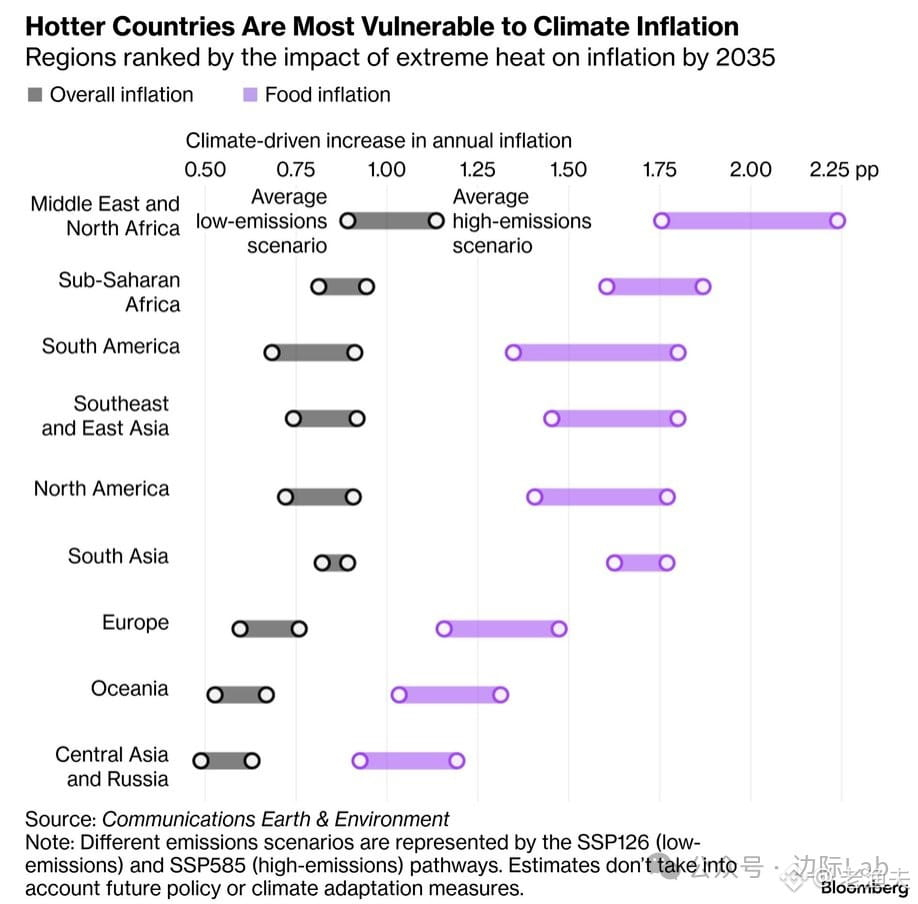
About climate-driven inflation: the issue had already been discussed in the 1990s among commodity circles, though back then nobody paid much attention. Now it looks like the impact of extreme weather on food prices has shifted from theory to a practical trading logic.
This Bloomberg study mentions projections for 2035, but what I care about more are the cases happening right now: a heatwave in India directly lifts the FY2027 inflation forecast; in Mexico, tomato prices double due to off-season rainfall and disease-related problems; and South Korea expects inflation to move up by 0.3–0.5 percentage points because of hot, heavy rainfall. These aren’t model scenarios—they’re real supply-chain shocks.
In climate-vulnerable regions such as the Middle East, North Africa, and sub-Saharan Africa, an annual rise of 1.75–2.25 percentage points in food prices may sound modest. But for these regions’ real purchasing power and social stability, the impact is structural. Remember the Arab Spring of 2010–2011? One of the driving forces behind it was a surge in wheat prices.
From a trading perspective, climate inflation is not linear. It can flare up suddenly in certain years (for example, during an El Niño year), then be forgotten by the market in calmer periods. But the long-term trend is clear: the frequency of extreme weather is increasing, and the volatility of agricultural supply chains will keep being amplified. That means the asset-allocation logic for hedging inflation may need to be reconsidered over the next decade.
This Bloomberg study mentions projections for 2035, but what I care about more are the cases happening right now: a heatwave in India directly lifts the FY2027 inflation forecast; in Mexico, tomato prices double due to off-season rainfall and disease-related problems; and South Korea expects inflation to move up by 0.3–0.5 percentage points because of hot, heavy rainfall. These aren’t model scenarios—they’re real supply-chain shocks.
In climate-vulnerable regions such as the Middle East, North Africa, and sub-Saharan Africa, an annual rise of 1.75–2.25 percentage points in food prices may sound modest. But for these regions’ real purchasing power and social stability, the impact is structural. Remember the Arab Spring of 2010–2011? One of the driving forces behind it was a surge in wheat prices.
From a trading perspective, climate inflation is not linear. It can flare up suddenly in certain years (for example, during an El Niño year), then be forgotten by the market in calmer periods. But the long-term trend is clear: the frequency of extreme weather is increasing, and the volatility of agricultural supply chains will keep being amplified. That means the asset-allocation logic for hedging inflation may need to be reconsidered over the next decade.