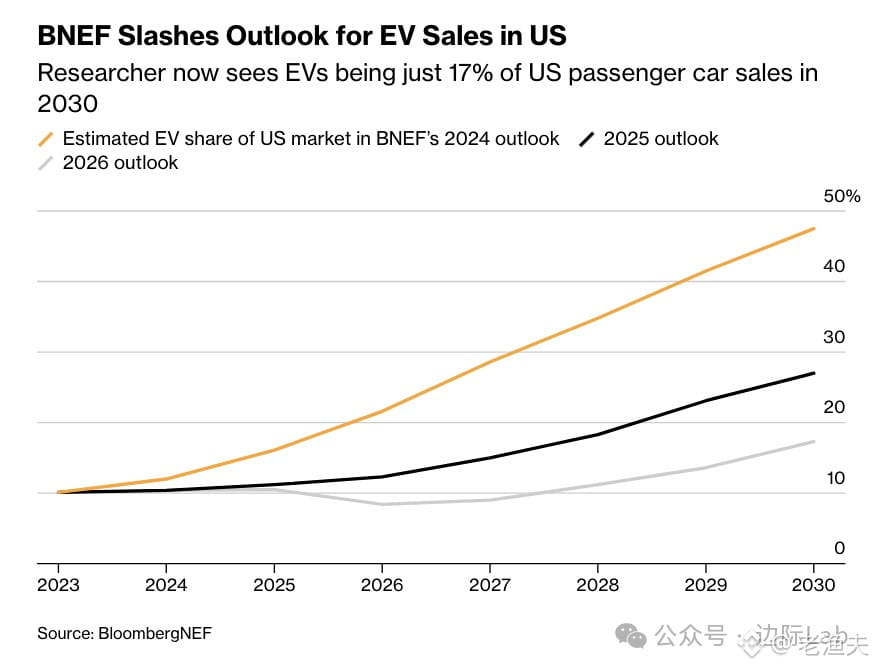
BloombergNEF has just cut its 2030 U.S. EV sales forecast from last year’s 48% to this year’s 17%. Behind this cliff-like downgrade is a textbook case of a policy-cycle shift— the Trump administration weakened fuel-efficiency standards, rolled back California’s sales order, and canceled the $7,500 federal subsidy.
This reminds me of the story of Japan’s solar industry in the 1990s. Once government subsidies were removed, the entire sector shrank immediately. For clean energy technologies like this, before the technology and costs truly reach real price parity, policy is the lifeline.
From a macro perspective, this is also a reshuffling of capital allocation. Without subsidies, automakers will recalculate ROI, the supply chain will adjust capacity, and demand expectations for lithium and copper ore will need to be reassessed. The market always adapts to policy reality— but the adjustment process is inevitably painful.
History shows us: growth driven by policy is fragile. Only when the cost curve genuinely comes down can the industry stand on its own. It appears that, for now, the U.S. EV market still needs more time to absorb this reality.
This reminds me of the story of Japan’s solar industry in the 1990s. Once government subsidies were removed, the entire sector shrank immediately. For clean energy technologies like this, before the technology and costs truly reach real price parity, policy is the lifeline.
From a macro perspective, this is also a reshuffling of capital allocation. Without subsidies, automakers will recalculate ROI, the supply chain will adjust capacity, and demand expectations for lithium and copper ore will need to be reassessed. The market always adapts to policy reality— but the adjustment process is inevitably painful.
History shows us: growth driven by policy is fragile. Only when the cost curve genuinely comes down can the industry stand on its own. It appears that, for now, the U.S. EV market still needs more time to absorb this reality.