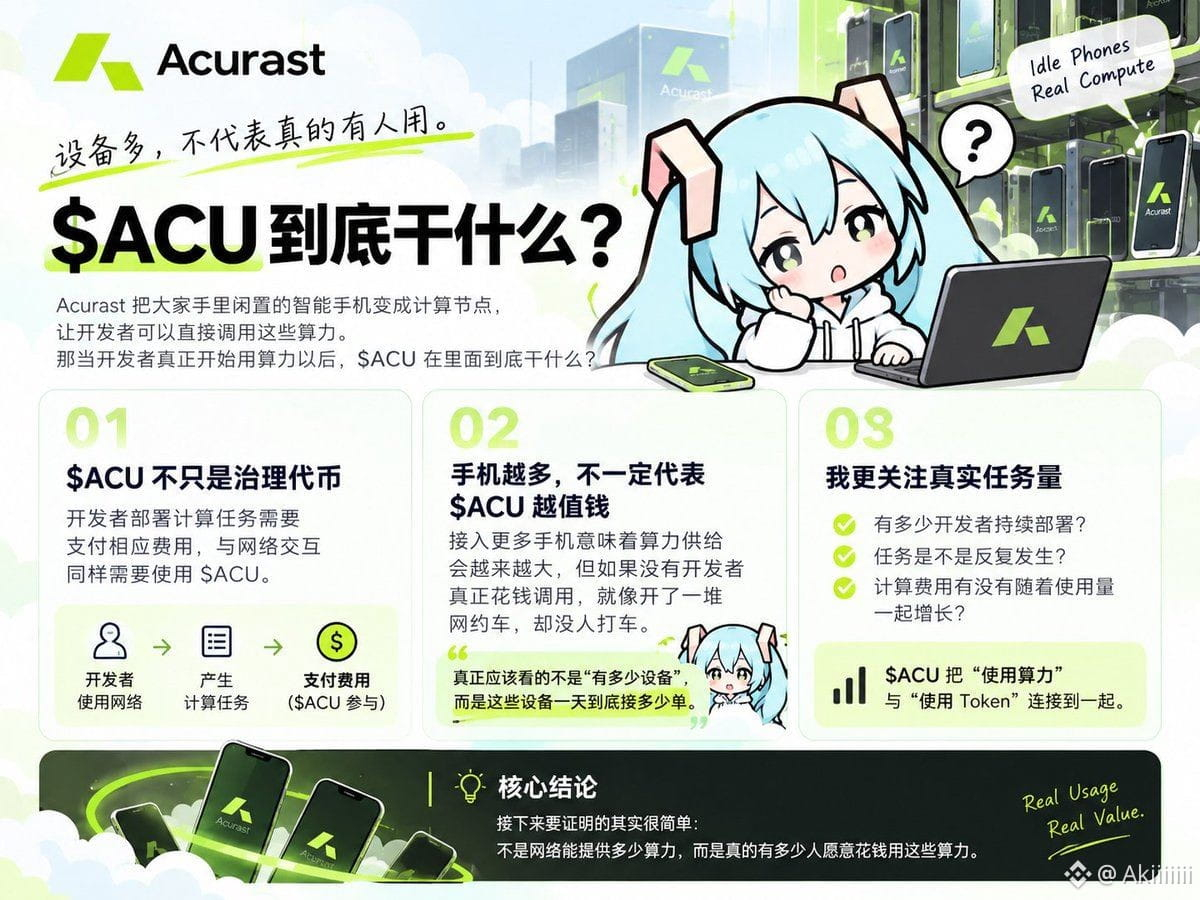

After recently looking into decentralized computing power projects, I’m starting to feel that data can be very easy to mislead:
More devices doesn’t necessarily mean there are really people using them.
Acurast’s approach is quite unique—it turns people’s idle smartphones into computing nodes, allowing developers to directly tap into this computing power.
But what I’m more concerned about is another question:
Once developers truly start using computing power, what exactly are they doing with it inside?
Let’s break it down simply ⬇️
1/ acu isn’t just about governance tokens
In its design, when developers deploy computation tasks, they need to pay the corresponding fees, and interacting with the network also requires using .
In simple terms:
developers use the network → generate computation tasks → pay fees → participate in it.
So there’s inherently a relationship between it and how much the network is used.
2/ More phones doesn’t necessarily mean it’s worth more
I think this part is key.
Acurast can onboard more and more phones, so the computing power supply does increase.
3/ Next, I’m more focused on real task volume
How many developers keep deploying?
Do tasks keep happening repeatedly?
Do computation fees grow along with usage?
These metrics may be more worth looking at than just the number of nodes.
What’s interesting is that it links “using computing power” with “using tokens.”
Next, what needs to be proven is actually quite straightforward:
It’s not about how much computing power the network can provide—it’s about how many people are genuinely willing to pay to use this computing power.
More devices doesn’t necessarily mean there are really people using them.
Acurast’s approach is quite unique—it turns people’s idle smartphones into computing nodes, allowing developers to directly tap into this computing power.
But what I’m more concerned about is another question:
Once developers truly start using computing power, what exactly are they doing with it inside?
Let’s break it down simply ⬇️
1/ acu isn’t just about governance tokens
In its design, when developers deploy computation tasks, they need to pay the corresponding fees, and interacting with the network also requires using .
In simple terms:
developers use the network → generate computation tasks → pay fees → participate in it.
So there’s inherently a relationship between it and how much the network is used.
2/ More phones doesn’t necessarily mean it’s worth more
I think this part is key.
Acurast can onboard more and more phones, so the computing power supply does increase.
3/ Next, I’m more focused on real task volume
How many developers keep deploying?
Do tasks keep happening repeatedly?
Do computation fees grow along with usage?
These metrics may be more worth looking at than just the number of nodes.
What’s interesting is that it links “using computing power” with “using tokens.”
Next, what needs to be proven is actually quite straightforward:
It’s not about how much computing power the network can provide—it’s about how many people are genuinely willing to pay to use this computing power.