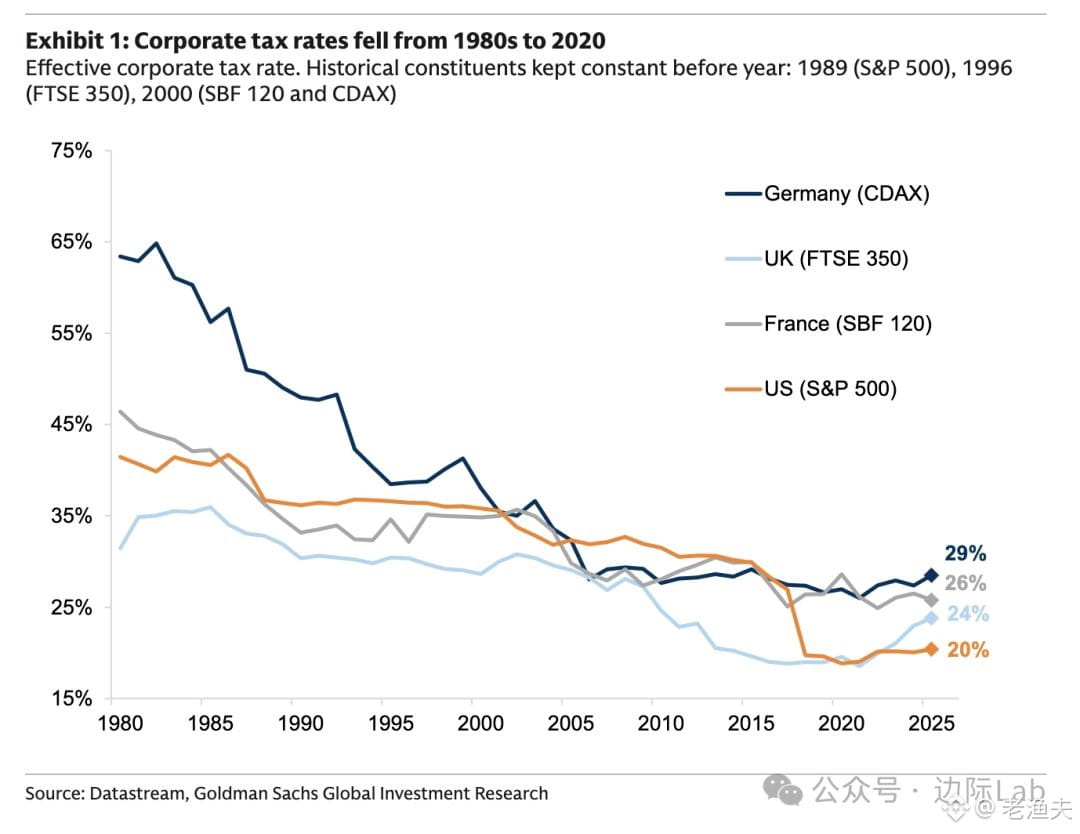
Since the 1980s, corporate tax rates in advanced economies have been on a steady downward slide. The effective tax rate on S&P 500 component stocks in the United States fell from roughly 40% to 20% in 2020, and Germany, the UK, and France have seen similar patterns.
This round of tax cuts began in the Reagan and Thatcher eras, as supply-side reforms were introduced alongside deregulation and privatization. At the time, they did help drive economic recovery.
But looking back now, the multi-decade cycle of tax cuts has likely reached its end. Governments across the world face mounting fiscal pressure, infrastructure is aging, and welfare spending is expanding rapidly. Relying on further tax cuts to stimulate growth is no longer realistic. Over the next decade, tax rates will most likely move upward—whether corporate taxes, capital gains taxes, or taxes on the wealthy.
The cycle turns back again; the policy pendulum always swings to return. The past forty years were an era of tax cuts and deregulation. The next era may well be one of higher taxes and renewed regulation. Capital allocation logic will need to adjust accordingly as well.
This round of tax cuts began in the Reagan and Thatcher eras, as supply-side reforms were introduced alongside deregulation and privatization. At the time, they did help drive economic recovery.
But looking back now, the multi-decade cycle of tax cuts has likely reached its end. Governments across the world face mounting fiscal pressure, infrastructure is aging, and welfare spending is expanding rapidly. Relying on further tax cuts to stimulate growth is no longer realistic. Over the next decade, tax rates will most likely move upward—whether corporate taxes, capital gains taxes, or taxes on the wealthy.
The cycle turns back again; the policy pendulum always swings to return. The past forty years were an era of tax cuts and deregulation. The next era may well be one of higher taxes and renewed regulation. Capital allocation logic will need to adjust accordingly as well.