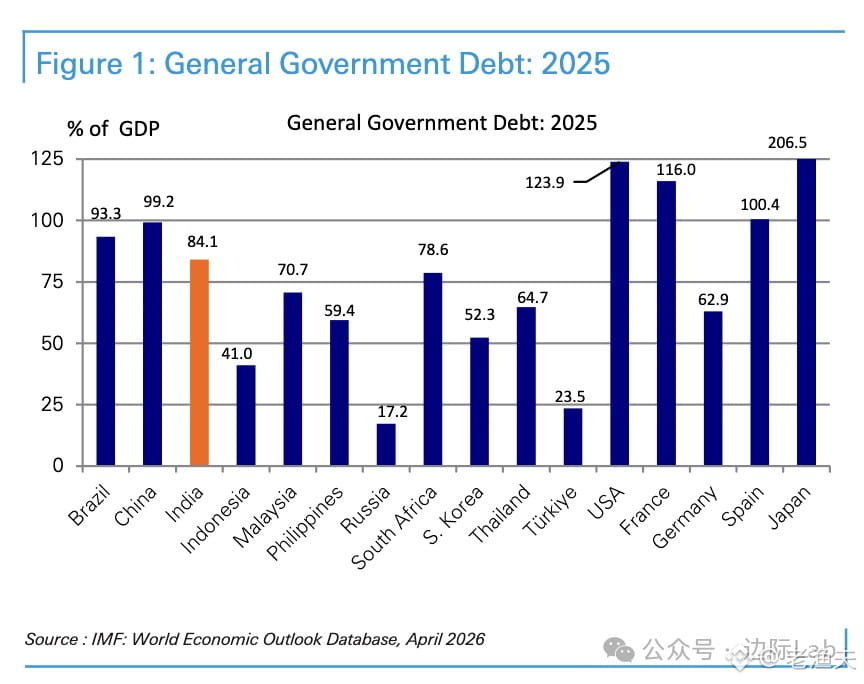
India’s debt structure is actually quite interesting. IMF data shows that in 2025, India’s government debt as a share of GDP was 84.1%—much lower than in Japan (206.5%), the United States (123.9%), France (116.0%), and the UK (100.4%), all of which are AAA/AA-rated countries. Yet India’s credit rating isn’t that high.
The key point is that more than 95% of India’s debt is denominated in the local currency—the Indian rupee—while foreign-currency exposure is less than 5% of GDP. This means that even if the rupee depreciates, it won’t trigger a debt crisis the way it often does in emerging markets—there is no significant currency-mismatch risk.
Think back to the lessons of the 1990s Asian financial crisis: Thailand, South Korea, and Indonesia all had large amounts of U.S. dollar debt. When their local currencies collapsed, the debt burden effectively doubled overnight. India learned from that and has largely stuck to funding through its own currency.
Deutsche Bank projects that by 2031, the debt ratio could fall to 77.7%, assuming fiscal discipline holds and economic growth stays in the 6–7% range. This path is credible—unlike Europe and the U.S., India does not face the same pressure from population aging, and the labor-force dividend is still being realized.
That said, the rating agencies’ logic is also understandable: they focus on institutional quality, the rule of law, and policy transparency—not just debt numbers. India still has some gaps on these “soft” indicators.
From a trading perspective, India’s government bond yields are around 7%. With rupee-denominated debt dominant and inflation in the 4–5% range, real interest rates look fairly reasonable. But foreign investors allocating to Indian bonds need to consider rupee volatility—while it’s unlikely to blow up, the currency risk in carry trades cannot be ignored.
The key point is that more than 95% of India’s debt is denominated in the local currency—the Indian rupee—while foreign-currency exposure is less than 5% of GDP. This means that even if the rupee depreciates, it won’t trigger a debt crisis the way it often does in emerging markets—there is no significant currency-mismatch risk.
Think back to the lessons of the 1990s Asian financial crisis: Thailand, South Korea, and Indonesia all had large amounts of U.S. dollar debt. When their local currencies collapsed, the debt burden effectively doubled overnight. India learned from that and has largely stuck to funding through its own currency.
Deutsche Bank projects that by 2031, the debt ratio could fall to 77.7%, assuming fiscal discipline holds and economic growth stays in the 6–7% range. This path is credible—unlike Europe and the U.S., India does not face the same pressure from population aging, and the labor-force dividend is still being realized.
That said, the rating agencies’ logic is also understandable: they focus on institutional quality, the rule of law, and policy transparency—not just debt numbers. India still has some gaps on these “soft” indicators.
From a trading perspective, India’s government bond yields are around 7%. With rupee-denominated debt dominant and inflation in the 4–5% range, real interest rates look fairly reasonable. But foreign investors allocating to Indian bonds need to consider rupee volatility—while it’s unlikely to blow up, the currency risk in carry trades cannot be ignored.