Today I saw some data, and suddenly I felt that the story of $UNI has gotten a bit more interesting.
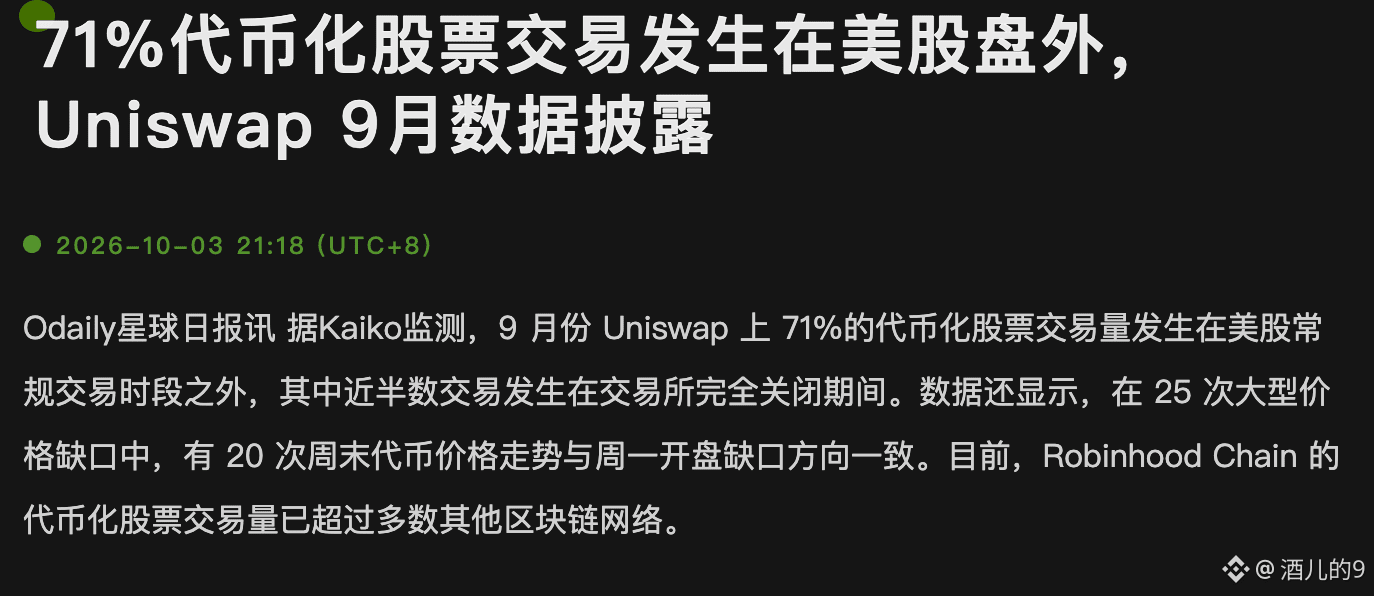
According to Kaiko, in September, 71% of the tokenized stock trading volume on Uniswap happened outside normal U.S. stock market trading hours.
Even more extreme: nearly half of the trades occurred when the U.S. exchanges were completely closed.
Think about what this implies.
In the past, once the U.S. market closed, things like NVDA and Apple basically had to wait until the next day.
Now that they’ve moved onto the chain, the market doesn’t care what time you “close” anymore.
You can trade at night; you can trade on weekends. When traditional markets are off, people on-chain are still buying and selling.
Kaiko also found that among 25 relatively large price gaps, 20 had weekend token price movements that matched the gap direction after the U.S. market opened on Monday.
This suggests something quite interesting:
On-chain might not just be following the traditional market—it’s gradually turning into a 24-hour price discovery venue outside of traditional market hours.
And right now, Uniswap happens to be one of the core players in the on-chain stock trading infrastructure.
So when you look at $UNI now, it’s not only about whether there’s activity on the DEX.
What you should be paying attention to is this: as more and more traditional assets move on-chain in the future, who will be responsible for providing liquidity for these assets?
If that answer becomes clearer over time, UNI’s upside potential will be more than just today’s price.
Many people still think tokenized stocks are simply moving stocks onto the blockchain.
But I actually feel that the real thing worth FOMO on might be the sentence that comes next:
When global assets start getting used to 24-hour trading, what will the trading entry point become?
$UNI , promising prospects ahead!
#UNI #Uniswap #RWA #DeFi #链上股票
According to Kaiko, in September, 71% of the tokenized stock trading volume on Uniswap happened outside normal U.S. stock market trading hours.
Even more extreme: nearly half of the trades occurred when the U.S. exchanges were completely closed.
Think about what this implies.
In the past, once the U.S. market closed, things like NVDA and Apple basically had to wait until the next day.
Now that they’ve moved onto the chain, the market doesn’t care what time you “close” anymore.
You can trade at night; you can trade on weekends. When traditional markets are off, people on-chain are still buying and selling.
Kaiko also found that among 25 relatively large price gaps, 20 had weekend token price movements that matched the gap direction after the U.S. market opened on Monday.
This suggests something quite interesting:
On-chain might not just be following the traditional market—it’s gradually turning into a 24-hour price discovery venue outside of traditional market hours.
And right now, Uniswap happens to be one of the core players in the on-chain stock trading infrastructure.
So when you look at $UNI now, it’s not only about whether there’s activity on the DEX.
What you should be paying attention to is this: as more and more traditional assets move on-chain in the future, who will be responsible for providing liquidity for these assets?
If that answer becomes clearer over time, UNI’s upside potential will be more than just today’s price.
Many people still think tokenized stocks are simply moving stocks onto the blockchain.
But I actually feel that the real thing worth FOMO on might be the sentence that comes next:
When global assets start getting used to 24-hour trading, what will the trading entry point become?
$UNI , promising prospects ahead!
#UNI #Uniswap #RWA #DeFi #链上股票