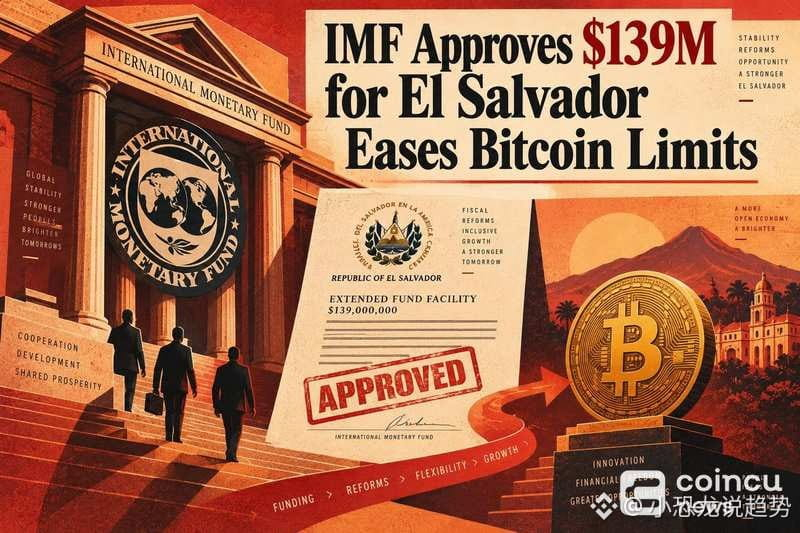
A country violated Bitcoin rules, and the IMF didn’t penalize it—it even approved a $139 million package for it 💰
🔎 进群看完整分析
On October 1, the International Monetary Fund (IMF) approved a $139 million disbursement to El Salvador, while waiving this country’s default on the “Bitcoin hoarding limits.” Reuters has confirmed this news. El Salvador is the small Central American country that, in 2021, wrote Bitcoin into its legal tender.
Let’s get the facts straight. This money belongs to the second and third combined review rounds under El Salvador’s “Extended Fund Facility” (EFF) arrangement. Under the IMF’s original lending conditions, El Salvador was barred from continuing to accumulate Bitcoin; this time, the fund chose to “waive” the violation rather than— as is customary—simply hold back the disbursement 🚨
The key difference here: a waiver doesn’t mean a policy shift. This is a one-time procedural concession for that prior violation—it does not mean the IMF endorses Bitcoin, and it certainly doesn’t mean El Salvador can freely buy Bitcoin again. The terms themselves haven’t changed; it’s just that the past is overlooked so the disbursement can continue ⚖️
Why is this worth noting? Three reasons.
First, the precedent effect. The IMF has always been tough on the idea of “sovereign states using national reserves to trade Bitcoin.” This time it turned a blind eye—meaning it has set an example for every other emerging-market sovereign that wants to touch digital assets: as long as they stay within the framework, a technical violation once may not be fatal 🦖
Second, El Salvador’s calculations. Staying in the IMF program means it can still get funding at a lower cost than in the sovereign bond market. For small countries with tight public finances, cheap money is more tangible than “going hard on the Bitcoin narrative”—and that’s also why it both accepted the restrictions and tested the waters at the edge.
Third, compare it with the other track: at the same time, U.S. spot Bitcoin ETFs saw net inflows of about $103 million in a single day, while Bitcoin traded in a range around $86,000 to $87,000. Sovereign buying, institutional ETF flows, and retail leverage—three streams of capital are pulling in the same timeline 📊
My take: this looks more like a “procedural clearance” rather than an “IMF embrace of Bitcoin.” The real signal to watch is whether, in the next review, this Bitcoin restriction clause will be written even tighter—or loosened. Which way the terms move matters more than the $139 million itself.
Who do you think will be next to treat Bitcoin as a national reserve? Let’s discuss in the comments.
Click the avatar to watch the livestream
Every day, I’ll keep you on top of crypto highlights—not just what’s happening in the news, but also the logic and opportunities behind it 👀🚀
🔎 进群看完整分析
On October 1, the International Monetary Fund (IMF) approved a $139 million disbursement to El Salvador, while waiving this country’s default on the “Bitcoin hoarding limits.” Reuters has confirmed this news. El Salvador is the small Central American country that, in 2021, wrote Bitcoin into its legal tender.
Let’s get the facts straight. This money belongs to the second and third combined review rounds under El Salvador’s “Extended Fund Facility” (EFF) arrangement. Under the IMF’s original lending conditions, El Salvador was barred from continuing to accumulate Bitcoin; this time, the fund chose to “waive” the violation rather than— as is customary—simply hold back the disbursement 🚨
The key difference here: a waiver doesn’t mean a policy shift. This is a one-time procedural concession for that prior violation—it does not mean the IMF endorses Bitcoin, and it certainly doesn’t mean El Salvador can freely buy Bitcoin again. The terms themselves haven’t changed; it’s just that the past is overlooked so the disbursement can continue ⚖️
Why is this worth noting? Three reasons.
First, the precedent effect. The IMF has always been tough on the idea of “sovereign states using national reserves to trade Bitcoin.” This time it turned a blind eye—meaning it has set an example for every other emerging-market sovereign that wants to touch digital assets: as long as they stay within the framework, a technical violation once may not be fatal 🦖
Second, El Salvador’s calculations. Staying in the IMF program means it can still get funding at a lower cost than in the sovereign bond market. For small countries with tight public finances, cheap money is more tangible than “going hard on the Bitcoin narrative”—and that’s also why it both accepted the restrictions and tested the waters at the edge.
Third, compare it with the other track: at the same time, U.S. spot Bitcoin ETFs saw net inflows of about $103 million in a single day, while Bitcoin traded in a range around $86,000 to $87,000. Sovereign buying, institutional ETF flows, and retail leverage—three streams of capital are pulling in the same timeline 📊
My take: this looks more like a “procedural clearance” rather than an “IMF embrace of Bitcoin.” The real signal to watch is whether, in the next review, this Bitcoin restriction clause will be written even tighter—or loosened. Which way the terms move matters more than the $139 million itself.
Who do you think will be next to treat Bitcoin as a national reserve? Let’s discuss in the comments.
Click the avatar to watch the livestream
Every day, I’ll keep you on top of crypto highlights—not just what’s happening in the news, but also the logic and opportunities behind it 👀🚀