


Ray Dalio’s “economic machine,” explained in 42 minutes, is now sending a harsh screech through the crypto market in October 2026. Bitcoin is hovering around $83,000, down 34% from the record high of $126,000 on October 12, 2025, yet it has still surged 44% within 90 days. This isn’t just simple price movement; it’s the inevitable result of the triple overlap of the short-term debt cycle (the Fed hiking rates to 3.75%–4%), the long-term debt cycle (the global debt-to-GDP ratio approaching historical extremes), and the productivity revolution (AI and tokenization). When the Fed faces a 64% probability of a rate decision on October 27–28, when Brent crude breaks above $100, and when daily inflows into Bitcoin ETFs plunge from $1 billion to $134 million—then we’re standing right at the critical point of what Dalio calls the “policy leverage failure.” This article will use the underlying logic of the economic machine to break down the crypto market’s true position right now, and provide actionable asset allocation principles.
First, the current coordinates of the economic machine: the dangerous intersection of three cycles
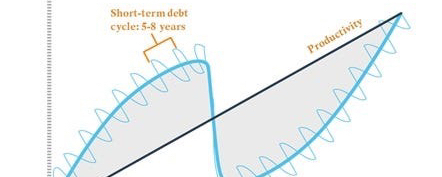
Dalio compares the economy to a perpetual-motion machine, driven together by productivity growth, the short-term debt cycle (5–8 years), and the long-term debt cycle (50–75 years). In October 2026, these three forces are forming a rare hedging configuration.
Short-term cycle: monetary policy turns tighter. On September 16, 2026, the Federal Reserve raised the benchmark rate to 3.75%–4%, the first rate hike since 2023. CME FedWatch shows that the probability of another 25-basis-point hike at the October 27–28 FOMC meeting is as high as 64%. The 10-year Treasury yield has risen to 5.17%, meaning the risk-free rate is repricing all risk assets. According to Dalio’s framework, this is the typical second half of the short-term cycle: "economic overheating → central bank tightening → liquidity contraction."
Long-term cycle: the debt burden is approaching its limit. A sudden widening of the U.S. federal budget deficit has led markets to start expecting a "money-printing restart." In (debt crises), Dalio repeatedly emphasizes that when debt growth keeps outpacing income growth, and interest rates have fallen near zero but still can’t stimulate the economy, central banks face the dilemma of "printing money or default." Today, the debt-to-GDP ratios of major global economies are already near their post–World War II historical peaks. And the decision in December 2025 by the FOMC to cancel the SRP (standing repo facility) daily $500 billion limit effectively opened a back door to "unlimited liquidity."
Productivity: a mutation in AI and financial infrastructure. Unlike the 1930s Great Depression, the current cycle comes with real progress at the productivity level. Visa data shows that about 17% of stablecoin transactions are used for business payments and cross-border settlements. CME announced it will launch Bitcoin Cash and Uniswap futures on October 19. On October 1, the SEC proposed new rules for crypto asset custody. These are not speculative bubbles, but paradigm shifts in financial infrastructure.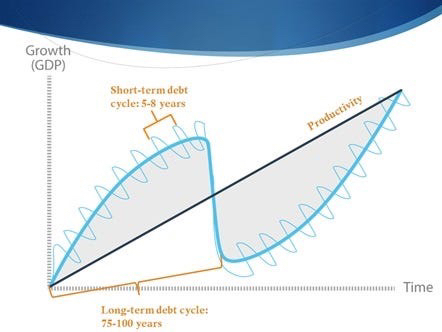
Second, Bitcoin’s pricing logic: from "digital gold" to "a liquidity barometer"
The first investment principle of Ray Dalio is: theoretical value equals the present value of future cash flows. Bitcoin has no cash flows; its core pricing logic lies in the "alternative currency premium"—the value of hedging against the erosion of fiat currency purchasing power.
Market data for 2026 perfectly validates this logic:
The liquidity premium phase (October 2025–December): Bitcoin hit its all-time high of $126,080, corresponding to the liquidity deluge toward the end of the Federal Reserve’s rate-cut cycle. Spot Bitcoin ETFs saw $6.63 billion in net inflows over five weeks, and BlackRock’s crypto investment portfolio size surged from $54.77 billion to $102.09 billion.
The liquidity contraction phase (January–August 2026): Bitcoin’s low fell to $57,800, a drop of more than 50%. SEC filings show that in Q2 2026, U.S. spot Bitcoin ETFs experienced the largest quarterly net outflows since they were launched in January 2024. This is the typical process of "discount rate rising → risk premium compressing → asset price repricing."
The current stalemate phase (October 2026): Bitcoin is fluctuating narrowly in the $83,000–$84,000 range. On one hand, international oil prices broke above $100 (Brent) on October 1, pushing up the probability of rate hikes via higher inflation expectations. On the other hand, the Fed canceled the SRP limits, and the fiscal deficit is expanding—signaling that the long-term liquidity gate has not been closed.
How would Dalio view this contradiction? The answer lies in the second item of the "Three Equilibriums": the utilization rate of economic productive capacity can’t be too high or too low. The current U.S. economy is on the edge of "stagflation"—oil prices are pushing inflation higher (overheating), but consumer and employment data are weak (cooling). In this environment, Bitcoin can’t enjoy a liquidity feast from rate cuts, nor can it simply benefit from safe-haven demand like gold, so it falls into a range-bound consolidation.
Third, key signals: the Fed meeting on October 28 and ETF fund flows
Dalio emphasizes that **price is determined by total spending divided by quantity**. In the crypto market, "total spending" is institutional money flows in the real sense.
Two current micro indicators are worth paying close attention to:
ETF fund flows are slowing down. U.S. spot Bitcoin ETFs currently manage $108.4 billion in assets, but daily inflows have dropped sharply from nearly $1.0 billion on September 21 to $134 million on September 25. This is not a bearish signal; it’s a warning of "marginal buyer exhaustion." Dalio repeatedly emphasized in his speeches: "Tell me how liquidity will change, and I’ll tell you how asset prices will move." When ETF inflows slow while the Fed hikes rates, Bitcoin’s upside momentum will inevitably be constrained.
The term structure suggests caution. The CME futures curve shows a mild contango (forward premium) between the October 2026 contract ($83,970) and the December 2027 contract ($89,330), but the March 2027 contract ($85,790) shows a slight pullback. This "strong near, weak far" structure reflects institutional concerns about the liquidity environment in 2027—they worry that the current high-interest-rate environment will last longer.
Fourth, practical allocation principles: look for asymmetric opportunities inside the debt machine
Based on Dalio’s framework, current crypto asset allocation should follow three principles:
First, distinguish between "productive assets" and "assets in the debt cycle." Dalio calls gold a "non-debt currency" because it doesn’t rely on anyone’s repayment promises. In the late stage of the current long-term debt cycle, it’s advisable to maintain a 30%–40% allocation to gold as a risk-control anchor. This portion of assets is decoupled from fiat credit, and can hedge the risk of a failed "successful deleveraging." Bitcoin currently still shows correlation above 0.7 with the Nasdaq 100 index; it hasn’t fully achieved the safe-haven function of "digital gold" yet. Therefore, it should not replace gold, but instead be treated as a high-beta allocation among risk assets.
Second, set triggers using an "if-then" logic. Don’t predict—prepare. If the Fed pauses rate hikes on October 28 (probability 36%), and Bitcoin breaks above $87,397 (the September 21 high), then you can confirm a short-term liquidity turning point and increase exposure to a 60% position size. If the Fed raises rates as expected and Brent crude stabilizes above $100, then you should cut exposure to below 30%—because a 5.17% risk-free yield will keep pulling speculative capital out of crypto markets.
Third, focus on "asymmetry." The skew (skewness) in the current Bitcoin options market shows that put option premiums have risen to the highest level since 2023. This means the market is paying too high a price for downside protection. According to Dalio’s risk premium principle, when the risk premium is priced at extreme levels, a reversal is often near. For long-term investors, at the current price level (down 34% from the historical high), the risk-reward ratio is better than it was when Bitcoin was at $126,000 in October 2025.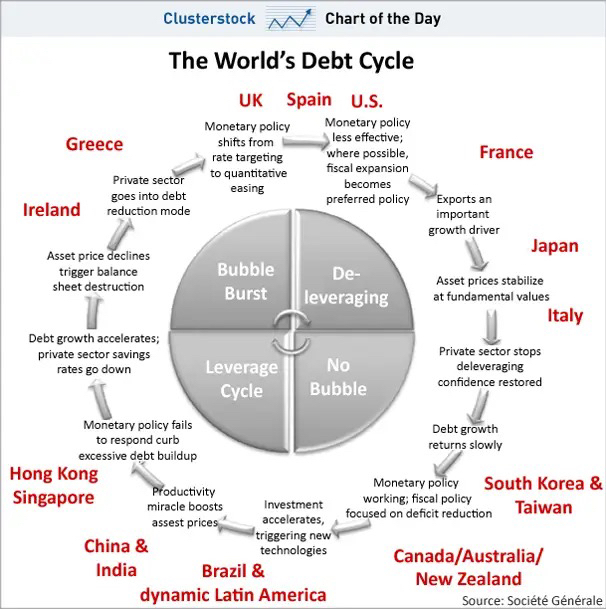
Fifth, conclusion: principles matter more than predictions
At the end of his speech, Dalio says: "Know the principles—like learning to fish, not just getting a fish."
The crypto market in October 2026 is the best laboratory to test these principles. The short-term debt cycle tells you to respect the Federal Reserve’s power over interest rates; the long-term debt cycle reminds you not to be overly confident in fiat purchasing power; and the productivity revolution tells you that the adoption curve of blockchain infrastructure is still in its early stage.
Bitcoin’s next major up-leg won’t come from retail FOMO; it will come from the success of "successful deleveraging"—that is, central banks maintaining nominal GDP growth by controlling inflation while supporting it through fiscal expansion and debt restructuring. This requires policymakers to use both monetary and fiscal levers with precision, which is highly challenging. But if it succeeds, risk assets will enter a longer bull market than 2020–2021, because then the starting point was a zero-rate environment, while now the starting point is a real rate of 5%—the "gravity" of asset pricing has changed.
During the restart of the debt machine, keeping liquidity, keeping principles, and keeping patience matter more than any price prediction.
Risk disclaimer: This article does not constitute investment advice. Crypto assets are highly volatile—please make prudent decisions based on your own risk tolerance.#以太坊三季度涨70.9% #美财政部允许各州提前提交稳定币认证 #美国10年期美债收益率逼近5.3% #美元指数创2025年5月来新高 #美国初请失业金人数降至19.7万 $BTC


