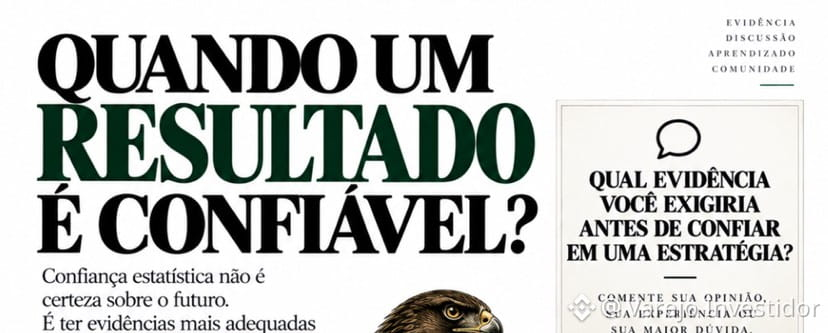

A strategy can show positive results and still not provide sufficient evidence to support a conclusion.
The first point is sample size. A few operations can produce a favorable sequence simply through random variation. As the number of observations increases, it becomes more possible to assess whether the observed behavior is consistent.
But quantity doesn’t solve everything. The quality of the data also matters. It’s necessary to check the analyzed period, costs, execution rules, different market conditions, and possible distortions in the test.
Another precaution is to separate the performance used to build the hypothesis from the performance used to verify that it continues to work. Repeatedly testing a strategy until you find a positive configuration can produce results that look strong, but have little ability to generalize.
Statistical confidence does not mean predicting the future. It means reducing uncertainty with better evidence.
For the investor, the question stops being only “did it make a profit?” and becomes: how many observations support that result, how the data were obtained, and whether the behavior remains when conditions change?
DATA → TEST → SAMPLE → VALIDATION → CONFIDENCE
Explore the related assets below and track how these assets evolve in the market.
#Trading #GestaoDeRisco #AnaliseQuantitativa #Cripto #Investimentos