Hey, my friend. I’ll show you how I think before I press the buy button, using what I see on the screen today.
First, the tide. I look at the long-term average, over 200 days. At $BTC , the price is US$ 84,849.87 and the average is US$ 71,359.87—almost 19% above it. That means an uptrend. Buying against the long-term average is like rowing against the current.
Next, the RSI, which measures how stretched the move is. Today, $BTC is at 76.9 and $ETH is at 76.7. This doesn’t mean it’s going to fall, and I don’t know what comes next. It just means that anyone entering now is entering expensively. What I do at this moment: I wait for a pullback to the average, or I enter with less.
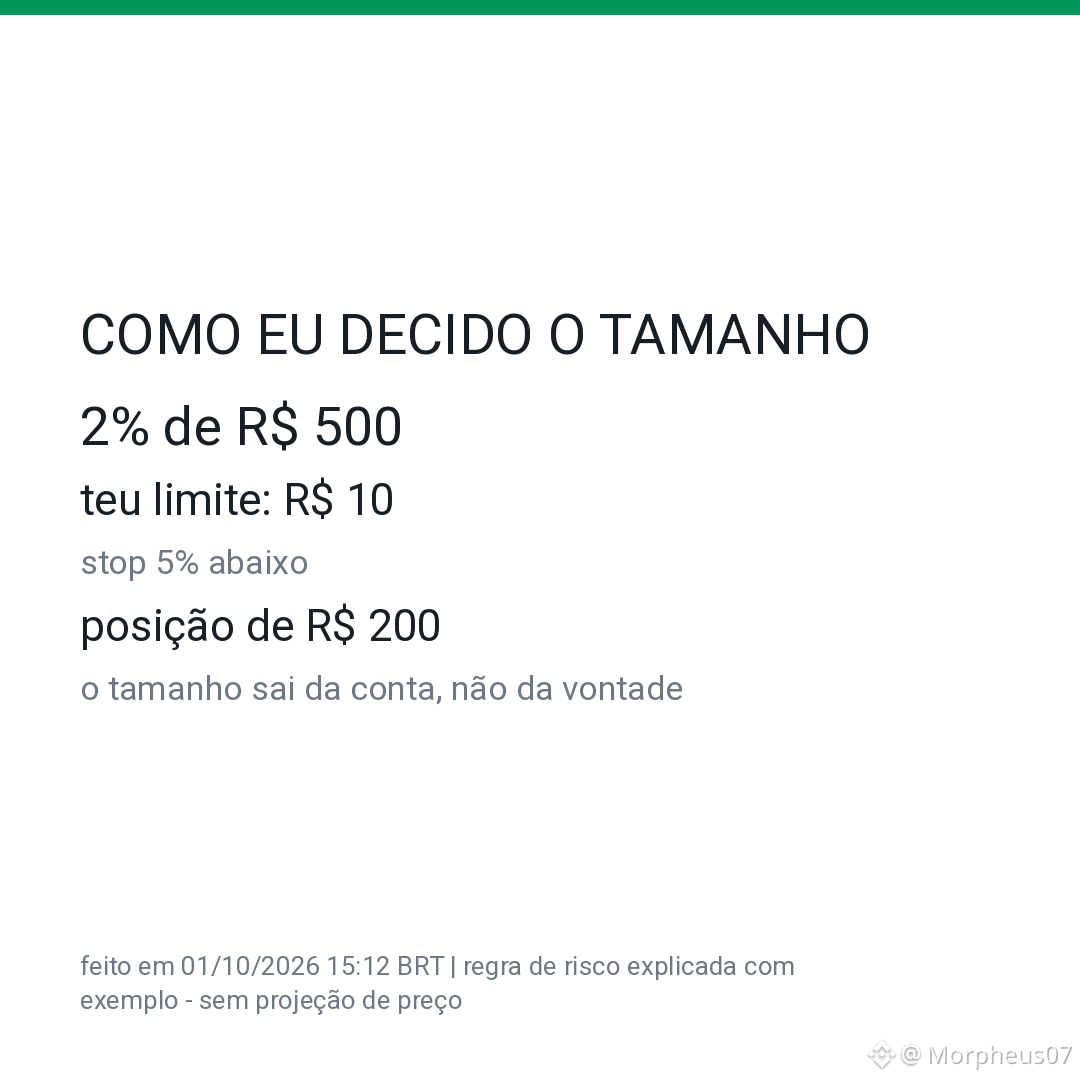
Now the math that almost everyone skips: position sizing. Suppose you set aside R$ 500 and you’re willing to lose at most 2% of it. Your limit is R$ 10 in this trade. If your stop-loss is 5% below the entry price, the position can’t exceed R$ 200, because 5% of R$ 200 is exactly your R$ 10. The sizing comes from this calculation, not from the desire to be right.
And the exit is defined before you enter. Write down on paper where you sell if it drops and where you sell if it rises. After it’s open, the brain lies.
There’s a number almost nobody looks at: funding. In BTC it’s at +9.2% per year, which shows the leveraged crowd paying a high price to stay long. When this gets too hot, the one who ends up paying the bill is whoever is currently long.
Tap on $BTC here in the text and look at the chart—it’s the same number I look at before deciding.
Which of these four parts do you still not do: the average, the RSI, the position sizing, or the exit?
First, the tide. I look at the long-term average, over 200 days. At $BTC , the price is US$ 84,849.87 and the average is US$ 71,359.87—almost 19% above it. That means an uptrend. Buying against the long-term average is like rowing against the current.
Next, the RSI, which measures how stretched the move is. Today, $BTC is at 76.9 and $ETH is at 76.7. This doesn’t mean it’s going to fall, and I don’t know what comes next. It just means that anyone entering now is entering expensively. What I do at this moment: I wait for a pullback to the average, or I enter with less.
Now the math that almost everyone skips: position sizing. Suppose you set aside R$ 500 and you’re willing to lose at most 2% of it. Your limit is R$ 10 in this trade. If your stop-loss is 5% below the entry price, the position can’t exceed R$ 200, because 5% of R$ 200 is exactly your R$ 10. The sizing comes from this calculation, not from the desire to be right.
And the exit is defined before you enter. Write down on paper where you sell if it drops and where you sell if it rises. After it’s open, the brain lies.
There’s a number almost nobody looks at: funding. In BTC it’s at +9.2% per year, which shows the leveraged crowd paying a high price to stay long. When this gets too hot, the one who ends up paying the bill is whoever is currently long.
Tap on $BTC here in the text and look at the chart—it’s the same number I look at before deciding.
Which of these four parts do you still not do: the average, the RSI, the position sizing, or the exit?