$QNT 6 surges nearly 6 times in 6 days: 25 major US banks are building an "on-chain UnionPay," and this task has been given to this coin.
QNT was at $65 on September 21st, and surged to a high of $373 on September 27th, a nearly 6-fold increase in 6 days. It's now back around $270.
QNT reached a high of $427 in 2021, then fell for over four years, reaching a low of $54 this year. Its cooperation with central banks and major banks has been ongoing, yet the price remained stagnant. Why is this time different?
Let's understand the background: Last year, the US stablecoin bill passed, and banks feared their deposits would be withdrawn: The CEO of Bank of America warned that if stablecoins could pay interest, up to $6 trillion in deposits could flow out.
The banks' countermeasure was to go on-chain themselves: turning deposits into "tokenized deposits," with instant 24-hour transfers, keeping the money in the bank.
JPMorgan Chase issues its own token, and Citibank issues its own, but they can't transfer funds between each other, just like every bank has a payment app, but no UnionPay exists.
Quant acts as the middle layer of this "UnionPay": enabling reconciliation and settlement between systems of different banks and different blockchains. QNT is its token; using its software requires a licensing fee, which is ultimately converted into locked QNT.
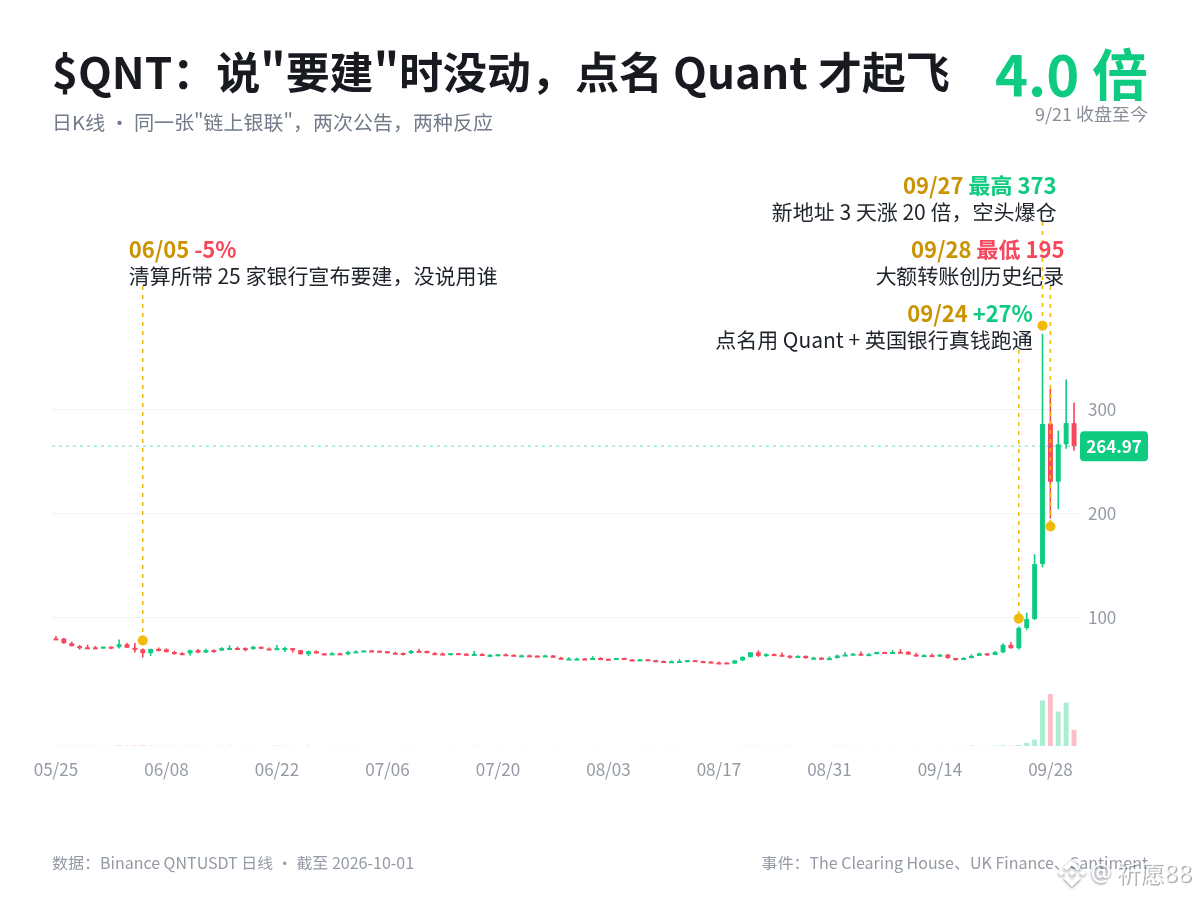
1️⃣ September 24: The US's "on-chain UnionPay" chooses Quant. The Clearing House is jointly owned by major US banks, and its network clears over $2 trillion daily. On June 5, it announced with 25 major banks that it would build this network. On September 24, it announced that the core interoperability layer would be handed over to Quant, with an opening date in the first half of 2027.
See the chart: On June 5, only "to build" was mentioned, without specifying who would use it, and QNT dropped 5% that day; on September 24, the announcement of "using Quant" caused it to soar. The market wasn't buying the "banks on-chain" story; it was buying Quant securing the contract. 2️⃣ In the same week: UK banks successfully implemented a tokenized pound sterling platform.
Last September, six major UK banks selected Quant to build a "tokenized pound" platform. QNT only rose for one day, then plummeted from 100 to 54 within a year. This time, seven banks, including Barclays and HSBC, completed their first batch of real customer transactions (mortgage refinancing, online shopping).
US selection + UK successful implementation with real money – for the first time, the market believed: this wasn't just a PowerPoint presentation.
3️⃣ Small market capitalization, retail investors and short sellers pushed it up together.
Before the surge, Binance QNT's daily spot trading volume was only a few hundred thousand to a little over a million US dollars; on September 27th, it exceeded 200 million. The number of new on-chain addresses increased from 351 to 7516 in three days, with retail investors flooding in.Short sellers were liquidated and forced to buy back (approximately $17 million in short selling in one day), adding fuel to the fire.
📅 What to watch next
• Large investors are active: A record-breaking large transfer occurred on September 28th, with the price dropping to a low of 195 that day; a wallet associated with the founder, inactive for 7 years, transferred out 26,000 coins on September 30th. Watch whether these coins flow into exchanges.
• After the new address falls, can the price hold?
My opinion: This is the strongest positive factor for $QNT in four years; major banks are indeed using it. However, banks using Quant's software doesn't equate to buying QNT: the licensing fee is calculated in fiat currency, and whether the converted QNT is from the market or Quant's own inventory is unclear. In short, buying your software doesn't mean buying your company's stock. The network won't launch until next year; a 6-fold increase in 6 days is essentially pushing forward what will happen a year later.
Do you think the "UnionPay on the blockchain" story is worth 6x? Let's discuss in the comments section 👇
#QNTThe above content is for informational purposes only and does not constitute investment advice.
QNT was at $65 on September 21st, and surged to a high of $373 on September 27th, a nearly 6-fold increase in 6 days. It's now back around $270.
QNT reached a high of $427 in 2021, then fell for over four years, reaching a low of $54 this year. Its cooperation with central banks and major banks has been ongoing, yet the price remained stagnant. Why is this time different?
Let's understand the background: Last year, the US stablecoin bill passed, and banks feared their deposits would be withdrawn: The CEO of Bank of America warned that if stablecoins could pay interest, up to $6 trillion in deposits could flow out.
The banks' countermeasure was to go on-chain themselves: turning deposits into "tokenized deposits," with instant 24-hour transfers, keeping the money in the bank.
JPMorgan Chase issues its own token, and Citibank issues its own, but they can't transfer funds between each other, just like every bank has a payment app, but no UnionPay exists.
Quant acts as the middle layer of this "UnionPay": enabling reconciliation and settlement between systems of different banks and different blockchains. QNT is its token; using its software requires a licensing fee, which is ultimately converted into locked QNT.
1️⃣ September 24: The US's "on-chain UnionPay" chooses Quant. The Clearing House is jointly owned by major US banks, and its network clears over $2 trillion daily. On June 5, it announced with 25 major banks that it would build this network. On September 24, it announced that the core interoperability layer would be handed over to Quant, with an opening date in the first half of 2027.
See the chart: On June 5, only "to build" was mentioned, without specifying who would use it, and QNT dropped 5% that day; on September 24, the announcement of "using Quant" caused it to soar. The market wasn't buying the "banks on-chain" story; it was buying Quant securing the contract. 2️⃣ In the same week: UK banks successfully implemented a tokenized pound sterling platform.
Last September, six major UK banks selected Quant to build a "tokenized pound" platform. QNT only rose for one day, then plummeted from 100 to 54 within a year. This time, seven banks, including Barclays and HSBC, completed their first batch of real customer transactions (mortgage refinancing, online shopping).
US selection + UK successful implementation with real money – for the first time, the market believed: this wasn't just a PowerPoint presentation.
3️⃣ Small market capitalization, retail investors and short sellers pushed it up together.
Before the surge, Binance QNT's daily spot trading volume was only a few hundred thousand to a little over a million US dollars; on September 27th, it exceeded 200 million. The number of new on-chain addresses increased from 351 to 7516 in three days, with retail investors flooding in.Short sellers were liquidated and forced to buy back (approximately $17 million in short selling in one day), adding fuel to the fire.
📅 What to watch next
• Large investors are active: A record-breaking large transfer occurred on September 28th, with the price dropping to a low of 195 that day; a wallet associated with the founder, inactive for 7 years, transferred out 26,000 coins on September 30th. Watch whether these coins flow into exchanges.
• After the new address falls, can the price hold?
My opinion: This is the strongest positive factor for $QNT in four years; major banks are indeed using it. However, banks using Quant's software doesn't equate to buying QNT: the licensing fee is calculated in fiat currency, and whether the converted QNT is from the market or Quant's own inventory is unclear. In short, buying your software doesn't mean buying your company's stock. The network won't launch until next year; a 6-fold increase in 6 days is essentially pushing forward what will happen a year later.
Do you think the "UnionPay on the blockchain" story is worth 6x? Let's discuss in the comments section 👇
#QNTThe above content is for informational purposes only and does not constitute investment advice.