


On the morning of October 1, MetaMask Staking (formerly Consensys Staking) announced that some of its core infrastructure had suffered a security incident. As a precautionary measure, its Ethereum validators operating on Lido have begun主动退出 (voluntarily exiting) . The incident briefly drew market attention, but as of the time of writing, the ETH price has only fluctuated slightly, suggesting that the market’s “immunity” to such security events has been significantly strengthened. This article offers an in-depth analysis of the full picture of the incident, lays out a timeline of responses from various parties, assesses the actual impact on the Ethereum ecosystem, and discusses the long-term lessons this event holds for the security of decentralized staking infrastructure.
One, the full picture of the incident: the “golden three hours” from discovery to response
In the early morning of October 1 (Beijing time), a security incident involving Ethereum staking infrastructure drew attention within the crypto community. The core of the incident was MetaMask Staking—an in-staking service provider formerly known as Consensys Staking—which discovered a security vulnerability in its infrastructure and immediately initiated its contingency plan.
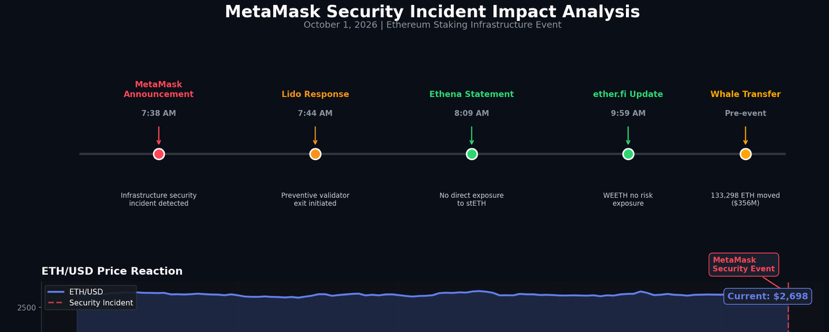
At 7:38 AM, MetaMask’s official announcement became the starting point of the whole incident. The wording was cautious but the information was clear: some infrastructure had been affected by a security incident. The company was coordinating with customers, partners, and security advisors, and proactively exiting the affected validators from non-custodial staking. The key takeaway was the emphasis on the “non-custodial” attribute—MetaMask clearly stated that it does not manage customers’ withdrawal keys, meaning the security of users’ assets is fundamentally protected.
Just 6 minutes later, at 7:44 AM, Lido responded quickly. As the staking protocol hosting the affected validators, Lido’s reply is a model for crisis communications. It describes the incident background as preventive measures following an “infrastructure intrusion investigation,” clearly stating that the scope is only the validators operated by MetaMask Staking within Lido—reassuring stETH holders that they need to take no action. It also provides a clear time expectation: ETH will gradually return with the exit, withdrawal, and re-entry cycle, with a maximum of about 45 days.
At 8:09 AM, Ethena founder Guy Young posted that USDe’s backing assets do not include any direct exposure to stETH or any other liquid staking tokens, and it is not expected to be affected. **At 9:59 AM, ether.fi confirmed** that WEETH has no risk exposure and that all funds are safe.
This series of responses demonstrates a mature ecosystem’s crisis-management capability: from incident disclosure to clarification from all parties, the entire process was completed within three hours, with relatively high information transparency, effectively curbing the spread of panic.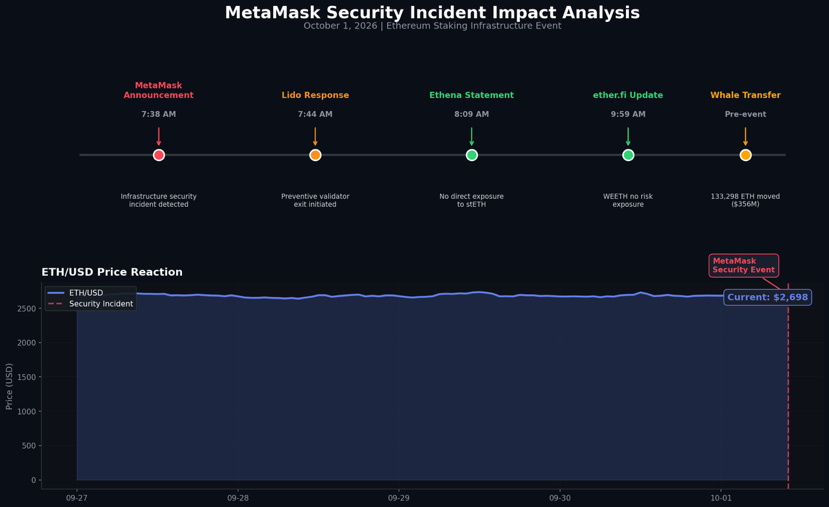
Second, technical analysis: how a non-custodial architecture becomes a “security cushion”
In this incident, the technical architecture choice of “non-custodial” became the key to protecting users’ assets. To understand this, we need to revisit the basic principles of Ethereum staking.
In Ethereum’s PoS mechanism, validator operation involves two types of keys: a signing key (used to participate in consensus) and a withdrawal key (used to extract staked assets). MetaMask Staking, as a node operator, holds the signing key, while the withdrawal key is always kept by the customer. This means that even if the infrastructure is completely compromised, the attacker cannot directly transfer users’ staked ETH. At most, they can make the validators go offline, causing a loss of staking rewards—but they cannot touch the principal.
In its response, Lido specifically emphasized this point: “This is non-custodial staking; MetaMask does not hold customers’ withdrawal keys.” In the current context, this design demonstrates its forward-looking value. According to Lido’s official disclosure, the relevant validators have started the exit process, and it is expected that the last batch of validators will complete exits by October 7 (though they have not fully withdrawn yet). A full exit–withdrawal–re-entry cycle may take about 45 days, because the current Ethereum staking entry queue is still long.
Notably, Lido also mentioned that its “ad hoc reserve fund” (over 6,750 stETH) can be used to mitigate the impact of such disruptions on the protocol’s normal operations. This multi-layered protection—non-custodial architecture, protocol reserves, and a diversified set of node operators—together forms a security buffer for the Ethereum staking ecosystem.
Third, market reaction: why didn’t panic spread?
Unlike the market panic caused by the 2022 LUNA collapse or the FTX blowup, this incident has had a negligible impact on the crypto market. As of the time of writing, BTC is at $83,942, down slightly 0.41% over 24 hours; ETH is at $2,698, actually up slightly 0.20%. The RSI indicators show BTC at 56.2 and ETH at 58.0, with no signs of being oversold or panic-driven selling.
Behind this “calmness,” there are several key factors:
First, the nature of the incident is clearly defined as “infrastructure security,” not an “operational protocol vulnerability.” The attack surface is concentrated at the operations layer of MetaMask Staking, rather than any flaw in the Ethereum protocol itself or in Lido smart contracts. This is fundamentally different from market concerns about staking derivatives after The Merge in 2022.
Second, the non-custodial model eliminates the “rug pull” risk. Historically, panic in crypto markets has often been caused by custodians misappropriating assets (e.g., FTX) or stablecoins losing their peg (e.g., UST). In this incident, control of users’ assets was never compromised, fundamentally eliminating the possibility of asset loss.
Third, the ecosystem’s rapid response builds confidence. Key participants such as Lido, Aave, Ethena, and ether.fi all spoke out within two hours after the incident, with consistent messaging: no direct exposure, and operations are functioning normally. This kind of coordinated response efficiency is unimaginable in the early days of crypto markets.
However, one intriguing detail is that on-chain data analyst @ai_9684xtpa monitored a large transfer of ETH before the incident announcement. An ancient whale that bought 560,000 ETH at ICO prices (about $0.31 per ETH) in 2015 transferred 133,298 ETH (worth roughly $356 million) to a new address. Lookonchain, the data analysis account, said the wallet appears to be associated with Joseph Lubin, Ethereum co-founder, Consensys founder, and CEO. This is the address’s first single transfer of over a hundred million dollars’ worth of ETH again after four years.
As for whether this transfer is related to the MetaMask security incident, there is currently no conclusion. But the timing coincidence—occurring before the announcement—may be enough to spark speculation in the market. One possibility is that insiders learned about the risk in advance and isolated the assets; another possibility is ordinary asset reorganization. No matter what the truth is, this detail reminds us that in a crypto market with information asymmetry, on-chain data monitoring has become an important tool for insight into risk.
Fourth, long-term takeaways for the staking ecosystem
In the short term, the impact of this incident is limited. But from a long-term perspective, it highlights several key issues in Ethereum staking infrastructure:
A re-evaluation of the risk of validator centralization. As one of Lido’s node operators, MetaMask Staking’s infrastructure security incident did not cause asset losses, but it exposed the network impact of a failure by a single node operator. Lido currently has more than 30 node operators, and this diversified design is intended to spread such risks. However, with growing institutional staking demand, the market share of leading node operators may become even more concentrated. How to strike a balance between efficiency and decentralization will be an ongoing challenge for protocols like Lido.
The paradigm value of non-custodial staking. This incident may become a live “advertisement” for the non-custodial staking model. Against a backdrop of regulators paying increasing attention to custodial providers’ compliance, “not holding customers’ private keys” is not only a technical choice, but also an important method to isolate legal risks. In June 2024, the SEC brought similar accusations against Consensys (dismissed in 2025), involving issues around MetaMask Staking as an unregistered broker. The non-custodial architecture, to a certain extent, alleviates such regulatory pressure.
A sign of maturity in the incident disclosure mechanism. From MetaMask’s proactive disclosure to Lido’s detailed explanation, and then to rapid clarifications from related parties, the flow of information during the entire incident has been relatively smooth. This stands in stark contrast to the “hiding and avoiding” handling style of early crypto projects, showing progress across the industry in crisis management.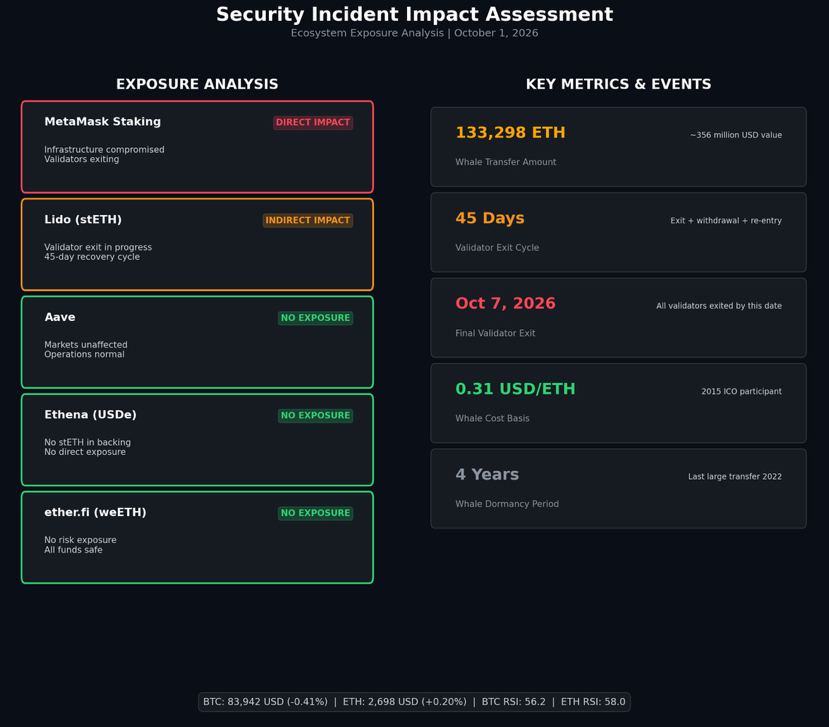
Fifth, strategies for investors to respond
For ordinary investors, this incident offers a few practical lessons:
Users holding stETH need not panic. Lido has made it clear that ETH will return gradually as validators exit, with the process taking up to 45 days. During this period, stETH liquidity may be slightly affected, but the principal is safe. If you urgently need liquidity, you can swap stETH for ETH via DEXs such as Curve, but be mindful of slippage.
Pay attention to the degree of diversification among validator operators. When choosing a staking service, you should prioritize protocols that distribute node operators and have reserve mechanisms. Lido’s reserve design and multi-operator model demonstrated its value in this incident.
Beware of market noise from “related incidents.” Large transfers from Joseph Lubin’s associated wallet may attract attention, but a single transfer by itself does not constitute a bearish signal. Asset reorganization by ancient whales is not uncommon during bull-market cycles, and investors should avoid over-interpreting it.
Looking long term, the resilience of Ethereum staking looks promising. This incident is essentially a “stress test” for the Ethereum staking ecosystem—the outcome shows that even if a leading node operator suffers a security incident, the entire system can still operate in an orderly manner, and users’ assets are protected. This resilience is one of Ethereum’s core competitive advantages as an institutional-grade infrastructure.
MetaMask Staking’s security incident ended in a “close call” scenario. It both validates the effectiveness of the non-custodial staking architecture and tests the Ethereum ecosystem’s crisis-response capability. In today’s crypto market, which is becoming increasingly institutionalized, such incidents no longer trigger panic-driven selloffs; instead, they have become a footnote to the industry’s maturity.
For investors, the most important takeaway may be this: in the world of DeFi, code is law, and architecture is security. Choosing projects that truly return control of users’ assets to users, while also having robust risk-mitigation mechanisms, is the smart move for surviving market cycles.
Disclaimer: This article is for market analysis reference only and does not constitute investment advice. The crypto market is highly volatile—please make prudent decisions based on your own risk tolerance.


