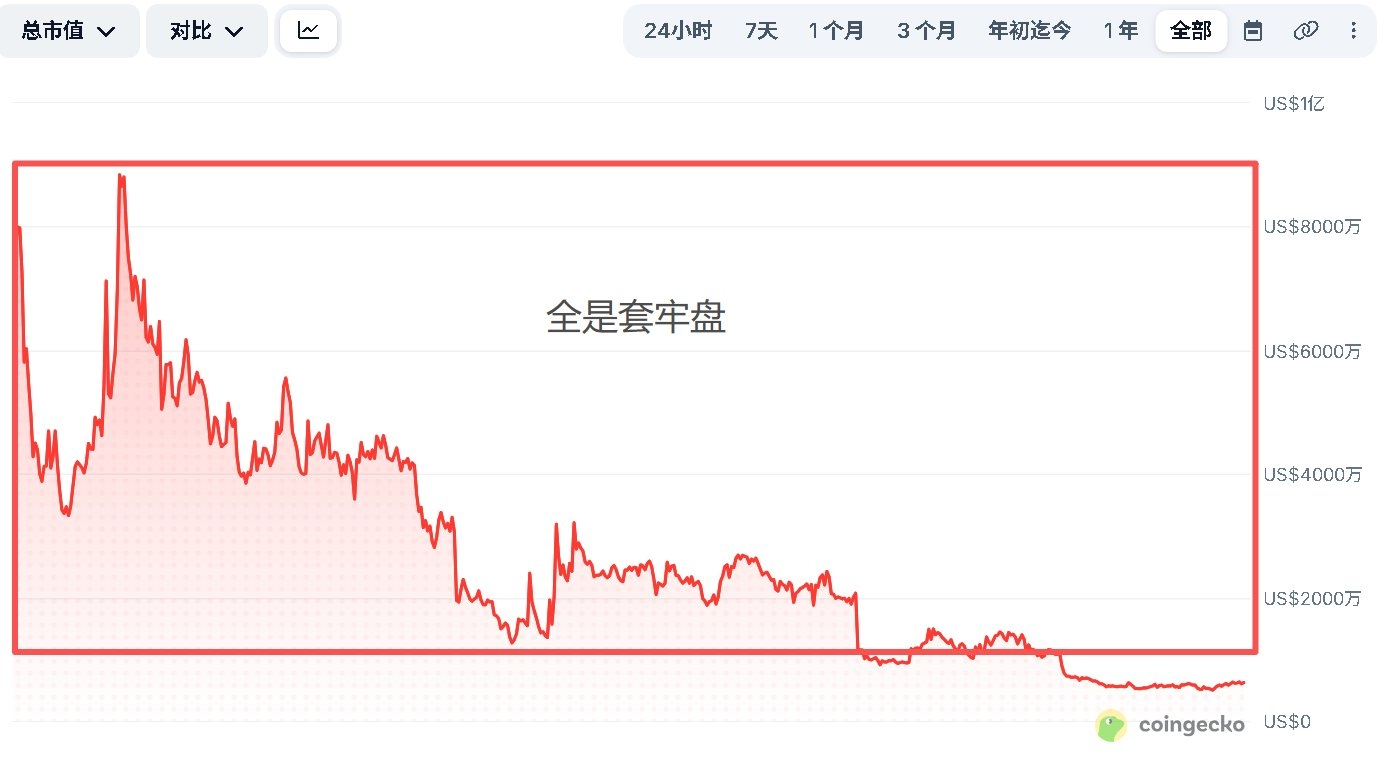
There’s a difference between on-chain and the secondary market: for the same order of magnitude—millions to ten-millions-level assets—
For Robinhood Chain, you basically can’t see what people call so-called support and resistance levels.
A 20M position can return to 5M in thirty minutes, and a 2M asset can also be ramped to 10M within thirty minutes.
But for assets in the millions to tens-of-millions range, on-chain is much, much better than the secondary market.
Because the latter most likely has a large trapped-fund supply—coming down from hundreds of millions to over a billion.
So on-chain vs the secondary market for selecting assets—the answer is very clear to me.
At the level of ten-million and below, the on-chain risk-reward is a bit higher.
But if it’s a market cap in the hundreds of millions, the secondary market is more稳妥.
What size of capital should go into what kind of pool to “fish”?
For Robinhood Chain, you basically can’t see what people call so-called support and resistance levels.
A 20M position can return to 5M in thirty minutes, and a 2M asset can also be ramped to 10M within thirty minutes.
But for assets in the millions to tens-of-millions range, on-chain is much, much better than the secondary market.
Because the latter most likely has a large trapped-fund supply—coming down from hundreds of millions to over a billion.
So on-chain vs the secondary market for selecting assets—the answer is very clear to me.
At the level of ten-million and below, the on-chain risk-reward is a bit higher.
But if it’s a market cap in the hundreds of millions, the secondary market is more稳妥.
What size of capital should go into what kind of pool to “fish”?