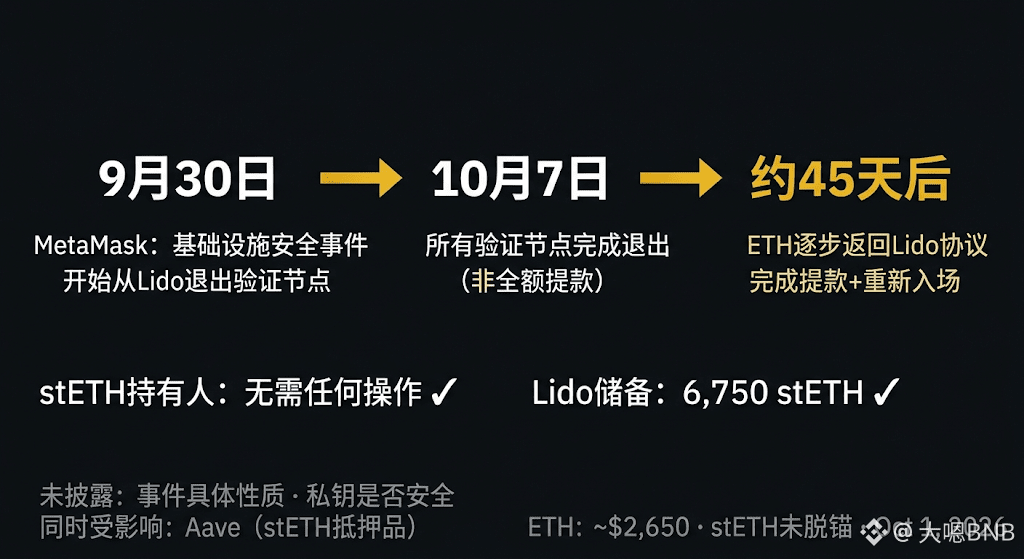

On September 30, MetaMask announced that it is handling an infrastructure security incident, and it has also begun withdrawing all of its Ethereum validator nodes from the Lido protocol.
The exit is expected to be completed by October 7, but full withdrawals will take another ~45 days—because the Ethereum validator entry queue is currently quite long.
MetaMask didn’t clarify what happened.
The official statement only said "it is investigating the infrastructure being compromised" and "no immediate threat to MetaMask wallets has been identified"—a typical early-stage security incident update: confirming something is going on, but withholding details.
Several knock-on effects are worth noting:
This incident also affects Aave—because stETH is used as collateral on Aave, and MetaMask’s exit from Lido validator nodes will impact related positions on Aave.
Lido has a temporary reserve of 6,750 stETH, specifically intended to handle this kind of node-exit situation, so it won’t directly affect ordinary stETH holders. stETH holders don’t need to take any action.
MetaMask isn’t the first to do this— in September 2025, the node operator Kiln also carried out the same kind of preventative exit after the infrastructure was compromised. This is Lido’s standard emergency procedure.
But one thing remains unanswered: how exactly was MetaMask’s infrastructure compromised, and is there any risk to the private keys. Until that becomes clear, the actual severity of the situation is still uncertain.
ETH is trading today around $2,650, and the stETH price has basically not depegged—the market is currently pricing in that this is manageable.
If later disclosures show there’s no private-key risk, then this is basically a close call; if not—then it’s another story.
Do you have a staking position in Lido?
$ETH
#metamask安全事件后撤出lido验证节点
The exit is expected to be completed by October 7, but full withdrawals will take another ~45 days—because the Ethereum validator entry queue is currently quite long.
MetaMask didn’t clarify what happened.
The official statement only said "it is investigating the infrastructure being compromised" and "no immediate threat to MetaMask wallets has been identified"—a typical early-stage security incident update: confirming something is going on, but withholding details.
Several knock-on effects are worth noting:
This incident also affects Aave—because stETH is used as collateral on Aave, and MetaMask’s exit from Lido validator nodes will impact related positions on Aave.
Lido has a temporary reserve of 6,750 stETH, specifically intended to handle this kind of node-exit situation, so it won’t directly affect ordinary stETH holders. stETH holders don’t need to take any action.
MetaMask isn’t the first to do this— in September 2025, the node operator Kiln also carried out the same kind of preventative exit after the infrastructure was compromised. This is Lido’s standard emergency procedure.
But one thing remains unanswered: how exactly was MetaMask’s infrastructure compromised, and is there any risk to the private keys. Until that becomes clear, the actual severity of the situation is still uncertain.
ETH is trading today around $2,650, and the stETH price has basically not depegged—the market is currently pricing in that this is manageable.
If later disclosures show there’s no private-key risk, then this is basically a close call; if not—then it’s another story.
Do you have a staking position in Lido?
$ETH
#metamask安全事件后撤出lido验证节点